


PTEN deletion enhances survival, neurite outgrowth and function of dopamine neuron grafts to MitoPark mice
- PMID: 22961549
- PMCID: PMC3437026
- DOI: 10.1093/brain/aws196
PTEN deletion enhances survival, neurite outgrowth and function of dopamine neuron grafts to MitoPark mice
Abstract
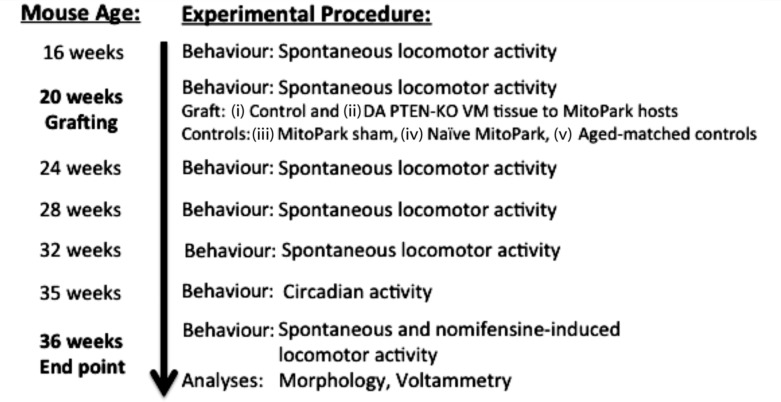
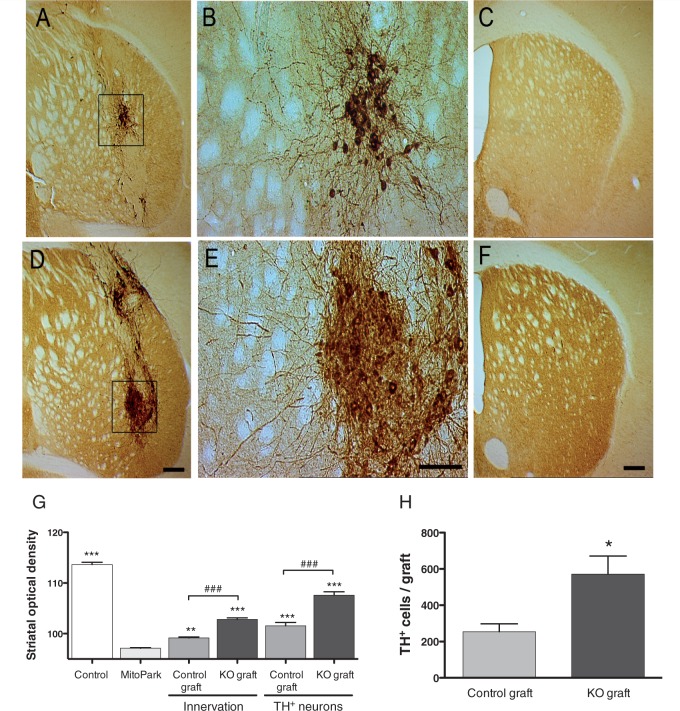
Clinical trials in Parkinson's disease have shown that transplants of embryonic mesencephalic dopamine neurons form new functional connections within the host striatum, but the therapeutic benefits have been highly variable. One obstacle has been poor survival and integration of grafted dopamine neurons. Activation of Akt, a serine/threonine kinase that promotes cell survival and growth, increases the ability of neurons to survive after injury and to regenerate lost neuronal connections. Because the lipid phosphatase, phosphatase and tensin homolog (PTEN) inhibits Akt, we generated a mouse with conditional knock-out of PTEN in dopamine neurons, leading to constitutive expression of Akt in these neurons. Ventral mesencephalic tissue from dopamine phosphatase and tensin homologue knock-out or control animals was then transplanted bilaterally into the dopamine depleted striata of MitoPark mice that express a parkinsonian phenotype because of severe respiratory chain dysfunction in dopamine neurons. After transplantation into MitoPark mice, PTEN-deficient dopamine neurons were less susceptible to cell death, and exhibited a more extensive pattern of fibre outgrowth compared to control grafts. Voltammetric measurements demonstrated that dopamine release and reuptake were significantly increased in the striata of animals receiving dopamine PTEN knock-out transplants. These animals also displayed enhanced spontaneous and drug-induced locomotor activity, relative to control transplanted MitoPark mice. Our results suggest that disinhibition of the Akt-signalling pathway may provide a valuable strategy to enhance survival, function and integration of grafted dopamine neurons within the host striatum and, more generally, to improve survival and integration of different forms of neural grafts.
Figures


References
-
- Ahn YH, Bensadoun JC, Aebischer P, Zurn AD, Seiger A, Bjorklund A, et al. Increased fiber outgrowth from xeno-transplanted human embryonic dopaminergic neurons with co-implants of polymer-encapsulated genetically modified cells releasing glial cell line-derived neurotrophic factor. Brain Res Bull. 2005;66:135–42. - PubMed
-
- Andereggen L, Meyer M, Guzman R, Ducray AD, Widmer HR. Effects of GDNF pretreatment on function and survival of transplanted fetal ventral mesencephalic cells in the 6-OHDA rat model of Parkinson's disease. Brain Res. 2009;1276:39–49. - PubMed
-
- Antonini A, Schwarz J, Oertel WH, Pogarell O, Leenders KL. Long-term changes of striatal dopamine D2 receptors in patients with Parkinson's disease: a study with positron emission tomography and [11C]raclopride. Mov Disord. 1997;12:33–8. - PubMed
-
- Backman CM, Malik N, Zhang Y, Shan L, Grinberg A, Hoffer BJ, et al. Characterization of a mouse strain expressing Cre recombinase from the 3' untranslated region of the dopamine transporter locus. Genesis. 2006;44:383–90. - PubMed
Publication types
MeSH terms
Substances
Grants and funding
LinkOut - more resources
Full Text Sources
Molecular Biology Databases
Research Materials
