. 2012 Oct 26;287(44):37434-46.
doi: 10.1074/jbc.M112.406090. Epub 2012 Sep 7.

The design and characterization of receptor-selective APRIL variants

Affiliations

The design and characterization of receptor-selective APRIL variants

Fiona C Kimberley et al. J Biol Chem. .

Abstract

A proliferation-inducing ligand (APRIL), a member of the TNF ligand superfamily with an important role in humoral immunity, is also implicated in several cancers as a prosurvival factor. APRIL binds two different TNF receptors, B cell maturation antigen (BCMA) and transmembrane activator and cylclophilin ligand interactor (TACI), and also interacts independently with heparan sulfate proteoglycans. Because APRIL shares binding of the TNF receptors with B cell activation factor, separating the precise signaling pathways activated by either ligand in a given context has proven quite difficult. In this study, we have used the protein design algorithm FoldX to successfully generate a BCMA-specific variant of APRIL, APRIL-R206E, and two TACI-selective variants, D132F and D132Y. These APRIL variants show selective activity toward their receptors in several in vitro assays. Moreover, we have used these ligands to show that BCMA and TACI have a distinct role in APRIL-induced B cell stimulation. We conclude that these ligands are useful tools for studying APRIL biology in the context of individual receptor activation.


Figures
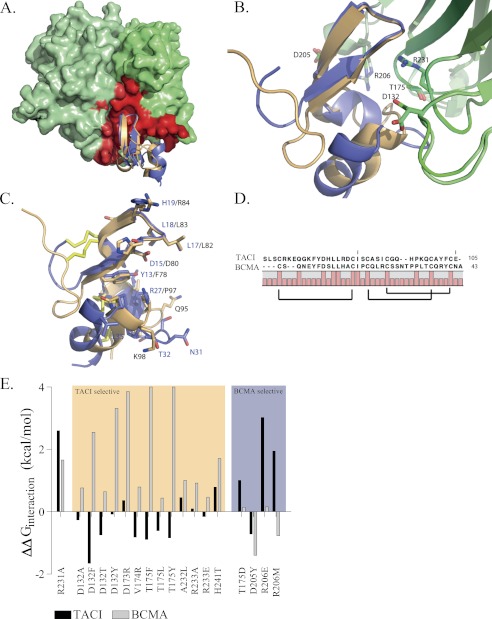
FIGURE 1.
FIGURE 1.
Crystal Structures of APRIL in complex with BCMA and TACI and prediction of the APRIL-selective mutants. A, front view of APRIL (light and dark green) in complex with TACI (orange) or BCMA (blue). The APRIL-TACI and APRIL-BCMA complexes are superimposed. APRIL monomers are depicted using a molecular surface representation, and main chain coordinates of the receptors are depicted schematically. For clarity, only a single receptor unit is depicted, and two ligand monomers are shown. The TACI and BCMA receptor-binding interface of APRIL is mapped in red on the APRIL surface. In contrast to most other TNF family ligands, the receptor-binding interface resides only for a small part in the cleft between two adjacent ligand monomers because most of the receptors interactions are located on the central surface of a single APRIL monomer. B, detailed view of TACI and BCMA in complex with APRIL. Selected APRIL residues involved in an interaction with the receptors are depicted (APRIL structure in complex with BCMA and TACI is depicted in light green or dark green, respectively). C, detailed view of TACI (orange) and BCMA (blue) residues involved in APRIL binding. TACI and BCMA show a root mean square deviation of 1.45 Å upon superposition (calculated over 95 main chain atoms); the main chain coordinates show a larger displacement C-terminally of the β-sheet. The interacting residues of BCMA or TACI are relatively non-conserved. Labels of BCMA residues are colored blue, TACI is shown in black, and cysteine bridges are colored yellow. D, structure-based alignment of the ECD ligand-binding domain of human BCMA and human TACI. Brackets indicate cysteine bridge connectivity. Full bars, conserved residues. E, FoldX interaction energy. Interaction free energy between APRIL variants and BCMA or TACI is calculated as the difference with the interaction energy of wild type APRIL and expressed as ΔΔG in kcal/mol. The FoldX interaction energy is corrected for unfavorable intrachain Van der Waals clashes upon mutation (see “Experimental Procedures”). Variants are grouped as TACI-specific or BCMA-specific. R231A, a previously constructed APRIL variant unable to bind both receptors, was used as control. Structure images were generated using PyMOL (available on the World Wide Web) and based on Protein Data Bank entries 1xu1 and 1xu2 (21).
FIGURE 2.
FIGURE 2.
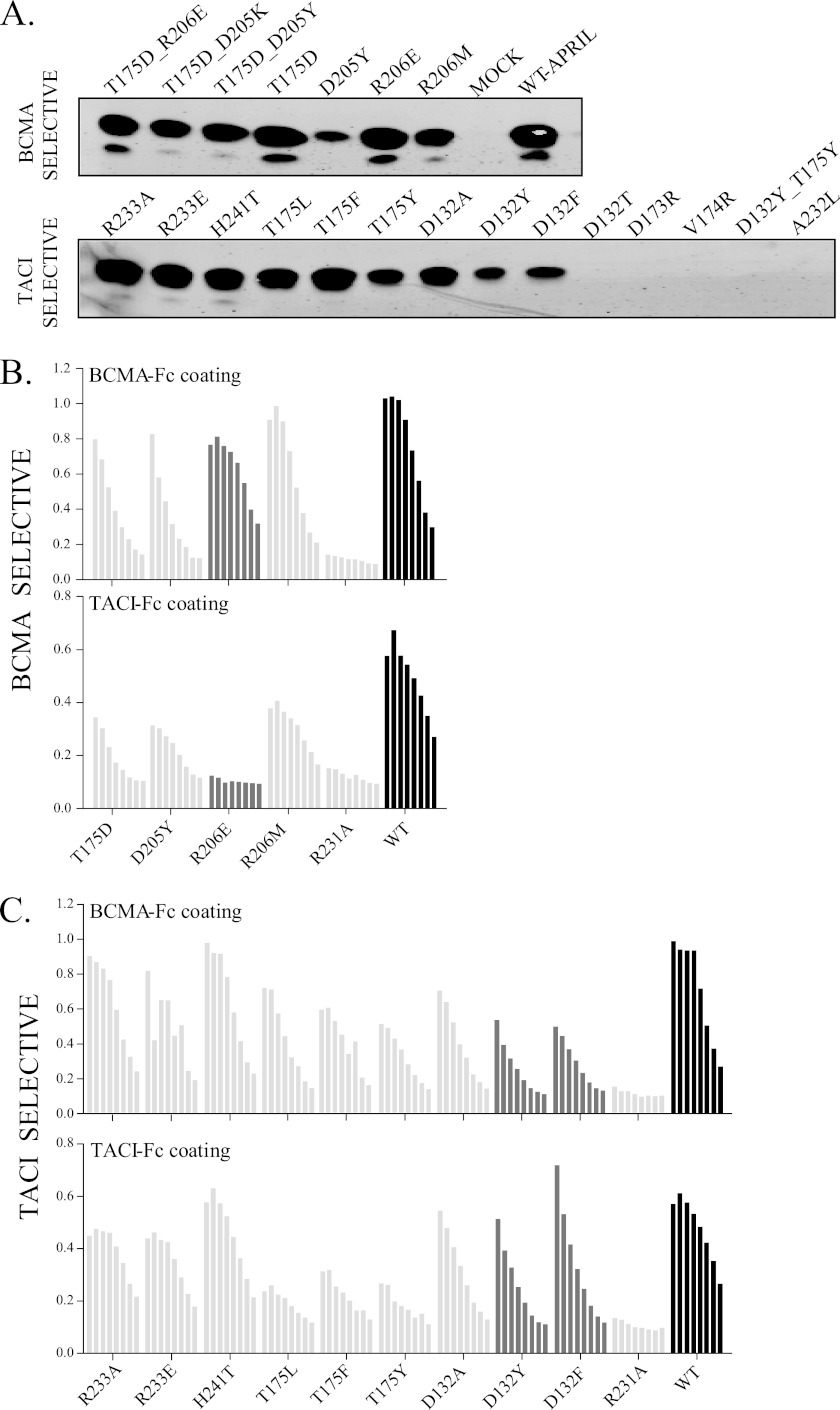
Production and receptor binding properties of the APRIL mutants. A, protein expression of APRIL variants in conditioned medium by transient transfection of 293T cells. Supernatants (10 μl of each) were analyzed by anti-FLAG immunoblotting. Top, mutants predicted to be selective for BCMA. Bottom, mutants predicted to be selective for TACI. All mutants were checked more than three times following independent rounds of transfection to assess their expression. B and C, receptor-binding ELISA to compare binding of the predicted BCMA- and TACI-specific APRIL variants to human BCMA-Fc and TACI-Fc. Bars (from left to right), doubling dilutions of the conditioned media starting from undiluted media. Relevant APRIL variants are shown with dark gray bars, WT APRIL with black bars, and other variants with light gray bars. This is representative of three separate experiments performed with independent APRIL-containing cell conditioned media. R231A APRIL variant does not bind any of the APRIL receptors (negative binding control).
FIGURE 3.
FIGURE 3.
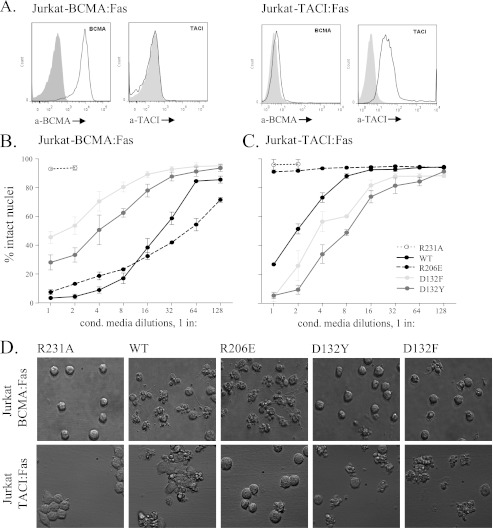
R206E shows specificity for BCMA, whereas D132Y and D132F show selectivity for TACI. Binding activity of the ligands was tested on TACI:Fas- and BCMA:Fas-expressing reporter cells. The ligand binding is directly associated with induced cell death. A, staining for human BCMA and TACI on Jurkat BCMA:Fas (left) and Jurkat JOM2 TACI:Fas cells (right). B and C, measurement of cell death produced after a 16-h treatment with doubling dilutions of the APRIL variants on BCMA:Fas (B) and TACI:Fas (C) reporter cells. D, microscopic pictures (×40) of Jurkat-BCMA-Fas (top) and Jurkat-TACI-Fas (bottom) cells after a 1-h stimulation with the indicated APRIL variants. Conditioned media were matched for APRIL amounts before incubation.
FIGURE 4.
FIGURE 4.
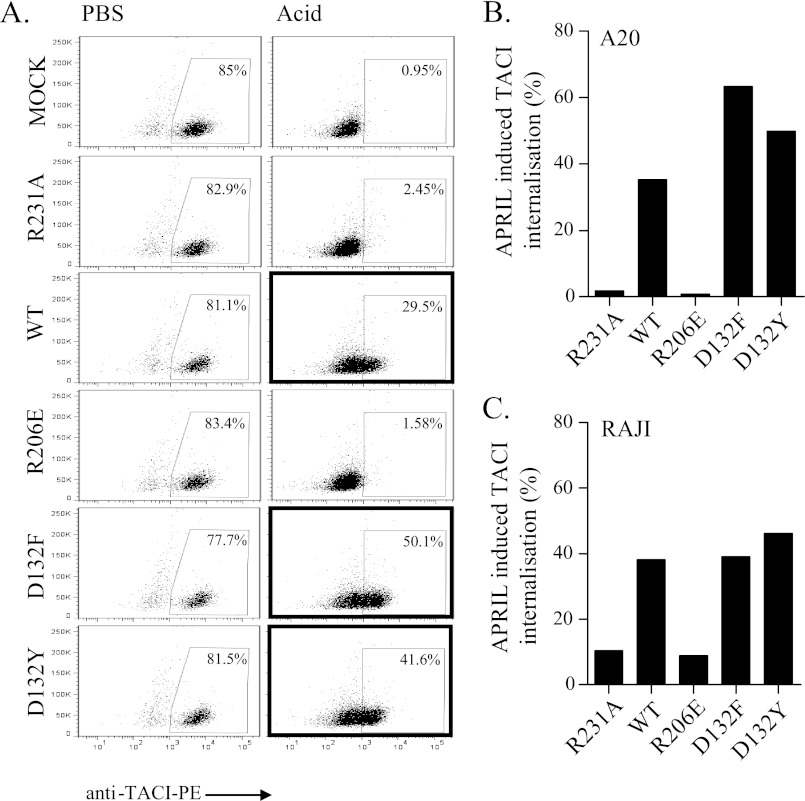
D132F and D132Y, but not R206E, triggered TACI internalization on endogenously expressed receptors. Cells were stained with a PE-coupled anti-TACI antibody and incubated with the indicated ligands for 1 h at 37 °C to allow receptor internalization. Subsequently, cells were placed on ice to halt membrane movements and then treated with either PBS (control) or acid solution (pH 2) to strip off labeled receptors that were not internalized. A, example of FACS profile of the TACI internalization for A20 cells. The high PE signal that remained after acid treatment (marked boxes) reflects TACI being internalized and protected inside cells. B, quantification of A expressed as percentage of APRIL-induced TACI internalization. C, quantification of TACI internalization for human Raji cells.
FIGURE 5.
FIGURE 5.
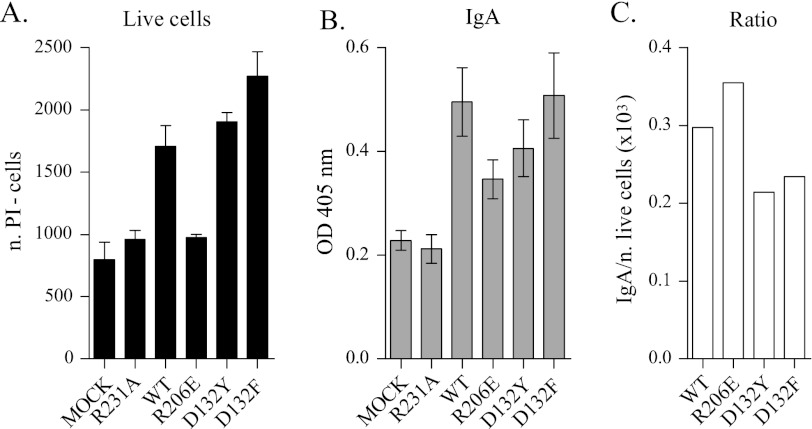
Differential effects of APRIL variants on B splenocytes survival and IgA production. Primary mouse splenocytes were positively selected for B220 and stimulated for 6 days with the indicated ligands in conditioned medium diluted 1:1 in normal medium. After 6 days, propidium iodide-negative cells (live cells) were counted (A), and supernatants were screened for soluble IgA levels (B). C, graphs representing the ratio between IgA and number of live B cells stimulated. Due to the different concentrations of ligands produced in conditioned medium, the concentrations of all of the variants were adjusted to that of the lowest expresser, D132F. Error bars, S.E. among triplicates.
FIGURE 6.
FIGURE 6.
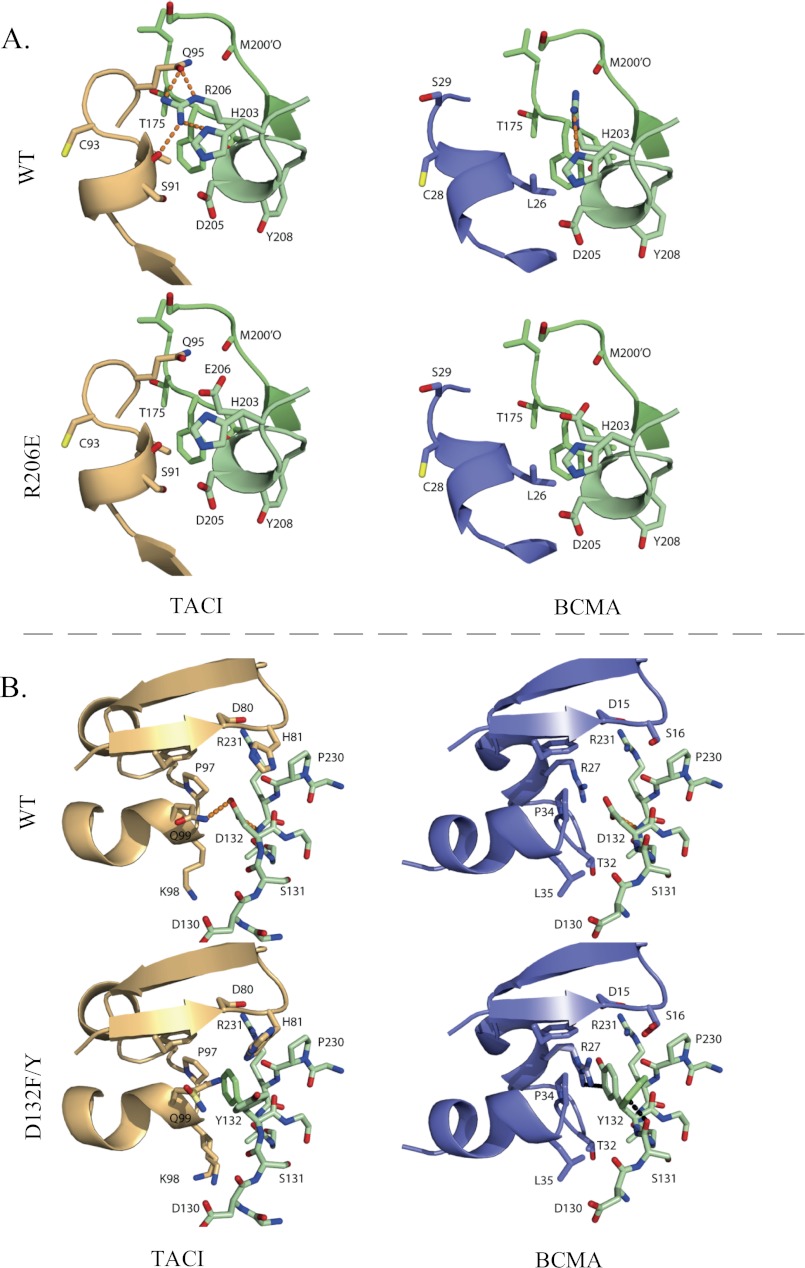
A, structural consequences of the R206E substitution. In the WT APRIL-TACI crystal structure, Arg-206 makes hydrogen bonds with TACI, whereas in the WT APRIL-BCMA crystal structure, Arg-206 is not involved in the interaction with BCMA. The Glu-206 substitution in TACI and BCMA is not involved in hydrogen bond interactions. B, structural consequences of the D132F and D132Y substitution. In the WT APRIL-BCMA structure, Asp-132 (D132) is involved in a favorable electrostatic interaction with Arg-27, whereas in the WT APRIL-TACI complex, Asp-132 accepts a (weak) hydrogen bond from Gln-99 (Q99) of TACI. The loss of this hydrogen bond due to the Phe-132 and Tyr-132 substitution is compensated in TACI by favorable Van der Waals interactions, whereas in BCMA, the Phe or Tyr either clashes with Arg-27 (R27) or with the main chain oxygen of Ser-131 (S131) of APRIL. TACI is depicted in orange, BCMA in blue, and APRIL in green. The D132F and D132Y structures are superimposed; residues that differ are indicated in lighter shades of blue, green, and orange. Hydrogen bonds are shown as an orange dotted line, and Van der Waals clashes are shown as a black dotted line.

References

    1. Hahne M., Kataoka T., Schröter M., Hofmann K., Irmler M., Bodmer J. L., Schneider P., Bornand T., Holler N., French L. E., Sordat B., Rimoldi D., Tschopp J. (1998) APRIL, a new ligand of the tumor necrosis factor family, stimulates tumor cell growth. J. Exp. Med. 188, 1185–1190 - PMC - PubMed
    1. Castigli E., Wilson S. A., Scott S., Dedeoglu F., Xu S., Lam K. P., Bram R. J., Jabara H., Geha R. S. (2005) TACI and BAFF-R mediate isotype switching in B cells. J. Exp. Med. 201, 35–39 - PMC - PubMed
    1. Castigli E., Scott S., Dedeoglu F., Bryce P., Jabara H., Bhan A. K., Mizoguchi E., Geha R. S. (2004) Impaired IgA class switching in APRIL-deficient mice. Proc. Natl. Acad. Sci. U.S.A. 101, 3903–3908 - PMC - PubMed
    1. O'Connor B. P., Raman V. S., Erickson L. D., Cook W. J., Weaver L. K., Ahonen C., Lin L. L., Mantchev G. T., Bram R. J., Noelle R. J. (2004) BCMA is essential for the survival of long lived bone marrow plasma cells. J. Exp. Med. 199, 91–98 - PMC - PubMed
    1. Kimberley F. C., Medema J. P., Hahne M. (2009) APRIL in B-cell malignancies and autoimmunity. Results Probl. Cell Differ. 49, 161–182 - PubMed

Publication types

MeSH terms

Substances