. 2012 Sep 15;28(18):i451-i457.
doi: 10.1093/bioinformatics/bts389.

EnrichNet: network-based gene set enrichment analysis

Affiliations

EnrichNet: network-based gene set enrichment analysis

Enrico Glaab et al. Bioinformatics. .

Abstract

Motivation: Assessing functional associations between an experimentally derived gene or protein set of interest and a database of known gene/protein sets is a common task in the analysis of large-scale functional genomics data. For this purpose, a frequently used approach is to apply an over-representation-based enrichment analysis. However, this approach has four drawbacks: (i) it can only score functional associations of overlapping gene/proteins sets; (ii) it disregards genes with missing annotations; (iii) it does not take into account the network structure of physical interactions between the gene/protein sets of interest and (iv) tissue-specific gene/protein set associations cannot be recognized.

Results: To address these limitations, we introduce an integrative analysis approach and web-application called EnrichNet. It combines a novel graph-based statistic with an interactive sub-network visualization to accomplish two complementary goals: improving the prioritization of putative functional gene/protein set associations by exploiting information from molecular interaction networks and tissue-specific gene expression data and enabling a direct biological interpretation of the results. By using the approach to analyse sets of genes with known involvement in human diseases, new pathway associations are identified, reflecting a dense sub-network of interactions between their corresponding proteins.

Availability: EnrichNet is freely available at http://www.enrichnet.org.

Contact: Natalio.Krasnogor@nottingham.ac.uk, reinhard.schneider@uni.lu or avalencia@cnio.es

Supplementary information: Supplementary data are available at Bioinformatics Online.


Figures
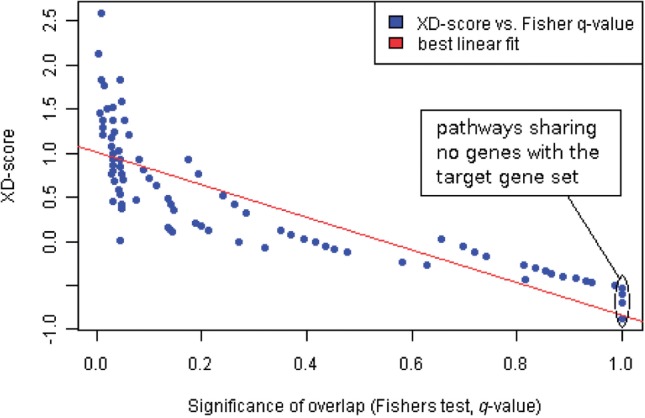
Fig. 1.
Fig. 1.
Regression plot: Xd-scores versus significance-of-overlap scores (Fisher's test, q-values), computed for the comparison of gastric cancer mutated genes against gene sets from the BioCarta database (absolute Pearson correlation: 0.93). Non-overlapping dataset pairs, for which a meaningful scoring is only possible with the XD-distance, are highlighted on the right. See also Table 1 for a list of the 20 top-ranked pathways in this plot
Fig. 2.
Fig. 2.
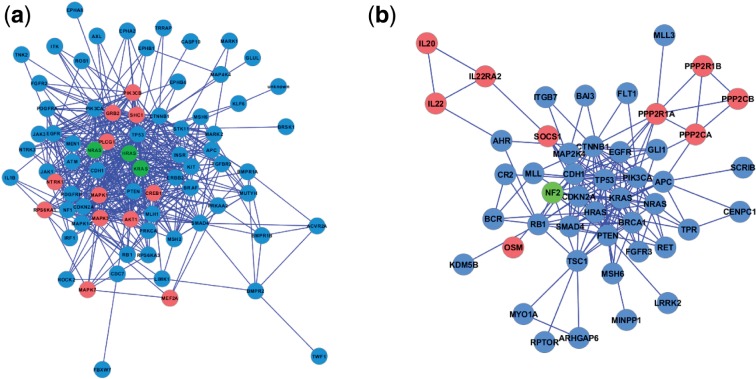
Protein–protein interaction sub-networks (largest connected components) for target and reference set pairs with small overlap, predicted to be functionally associated by EnrichNet: (a) gastric cancer mutated genes (blue) and genes/proteins from the BioCarta pathway ‘Role of Erk5 in Neuronal Survival’ (magenta, the shared genes are shown in green); (b) bladder cancer mutated genes (blue) and genes/proteins from Gene Ontology term ‘Tyrosine phosphorylation of Stat3’ (GO:0042503, magenta; the only shared gene NF2 is shown in green). An over-representation analysis approach would have missed these associations, since only few of the cancer mutated genes are members of the corresponding processes
Fig. 3.
Fig. 3.
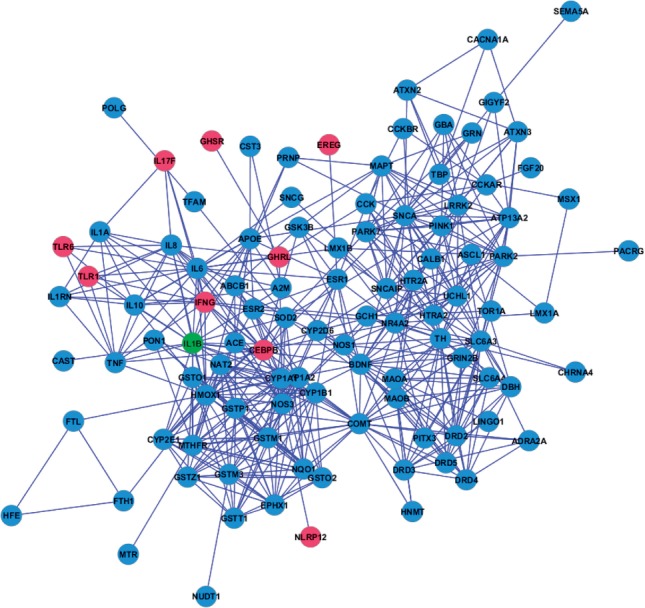
Protein–protein interaction sub-network (largest connected component) for the PD gene set (blue) and genes/proteins from GO term ‘Regulation of interleukin-6 biosynthetic process’ (magenta, GO:0045408; the only shared gene IL1B is shown in green)

References

    1. Al-Shahrour, et al. From genes to functional classes in the study of biological systems. BMC Bioinformatics. 2007;8:114. - PMC - PubMed
    1. Alon U., et al. Broad patterns of gene expression revealed by clustering analysis of tumor and normal colon tissues probed by oligonucleotide arrays. Proc. Natl. Acad. Sci. USA. 1999;96:6745. - PMC - PubMed
    1. Apweiler R., et al. The InterPro database, an integrated documentation resource for protein families, domains and functional sites. Nucleic Acids Res. 2001;29:37. - PMC - PubMed
    1. Ashburner M., et al. Gene Ontology: tool for the unification of biology. Nat. Genet. 2000;25:25–29. - PMC - PubMed
    1. Backes C., et al. GeneTrail—advanced gene set enrichment analysis. Nucleic Acids Res. 2007;35(Suppl. 2):W186. - PMC - PubMed

Publication types