


Rising diabetes prevalence among urban-dwelling black South Africans
- PMID: 22962583
- PMCID: PMC3433459
- DOI: 10.1371/journal.pone.0043336
Rising diabetes prevalence among urban-dwelling black South Africans
Abstract
Objective: To examine the prevalence of and the association of psychosocial risk factors with diabetes in 25-74-year-old black Africans in Cape Town in 2008/09 and to compare the prevalence with a 1990 study.
Research design and methods: A randomly selected cross-sectional sample had oral glucose tolerance tests. The prevalence of diabetes (1998 WHO criteria), other cardiovascular risk factors and psychosocial measures, including sense of coherence (SOC), locus of control and adverse life events, were determined. The comparison of diabetes prevalence between this and a 1990 study used the 1985 WHO diabetes criteria.
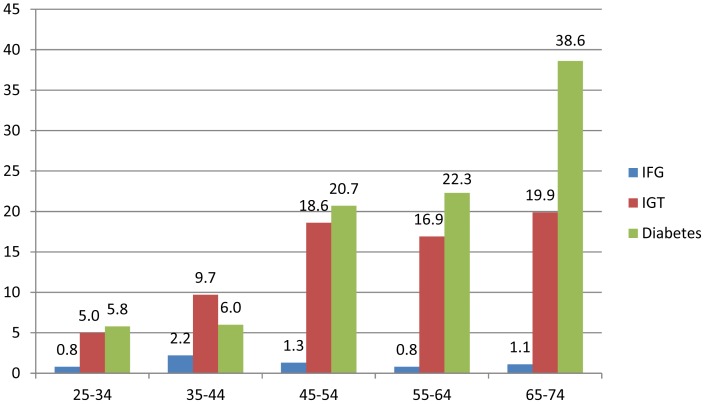
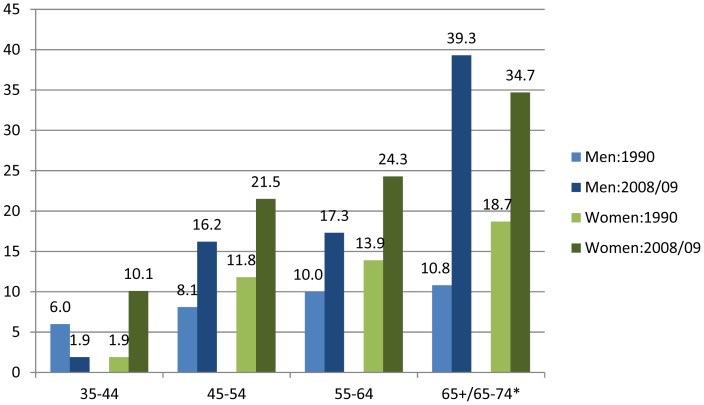
Results: There were 1099 participants, 392 men and 707 women (response rate 86%). The age-standardised (SEGI) prevalence of diabetes was 13.1% (95% confidence interval (CI) 11.0-15.1), impaired glucose tolerance (IGT) 11.2% (9.2-13.1) and impaired fasting glycaemia 1.2% (0.6-1.9). Diabetes prevalence peaked in 65-74-year-olds (38.6%). Among diabetic participants, 57.9% were known and 38.6% treated. Using 1985 WHO criteria, age-standardised diabetes prevalence was higher by 53% in 2008/09 (12.2% (10.2-14.2)) compared to 1990 (8.0% (5.8-10.3)) and IGT by 67% (2008/09: 11.7% (9.8-13.7); 1990: 7.0% (4.9-9.1)). In women, older age (OR: 1.05, 95%CI: 1.03-1.08, p<0.001), diabetes family history (OR: 3.13, 95%CI: 1.92-5.12, p<0.001), higher BMI (OR: 1.44, 95%CI: 1.20-1.82, p = 0.001), better quality housing (OR: 2.08, 95%CI: 1.01-3.04, p = 0.047) and a lower SOC score (≤ 40) was positively associated with diabetes (OR: 2.57, 95%CI: 1.37-4.80, p = 0.003). Diabetes was not associated with the other psychosocial measures in women or with any psychosocial measure in men. Only older age (OR: 1.05, 95%CI: 1.02-1.08, p = 0.002) and higher BMI (OR: 1.10, 95%CI: 1.04-1.18, p = 0.003) were significantly associated with diabetes in men.
Conclusions: The current high prevalence of diabetes in urban-dwelling South Africans, and the likelihood of further rises given the high rates of IGT and obesity, is concerning. Multi-facetted diabetes prevention strategies are essential to address this burden.
Conflict of interest statement
Figures
References
-
- Mbanya JC, Motala AA, Sobngwi E, Assah FK, Enoru ST (2010) Diabetes in sub-Saharan Africa. Lancet 375: 2254–2266. - PubMed
-
- Levitt NS (2008) Diabetes in Africa: epidemiology, management and healthcare challenges. Heart 94: 1376–1382. - PubMed
-
- Bradshaw D, Norman R, Pieterse D, Levitt NS (2007) Estimating the burden of disease attributable to diabetes in South Africa in 2000. S Afr Med J 97: 700–706. - PubMed
-
- Levitt NS, Katzenellenbogen JM, Bradshaw D, Hoffman MN, Bonnici F (1993) The prevalence and identification of risk factors for NIDDM in urban Africans in Cape Town, South Africa. Diabetes Care 16: 601–607. - PubMed
-
- Mensah GA, Mokdad AH, Ford E, Narayan KM, Giles WH, et al. (2004) Obesity, metabolic syndrome, and type 2 diabetes: emerging epidemics and their cardiovascular implications. Cardiol Clin 22: 485–504. - PubMed
Publication types
MeSH terms
Substances
LinkOut - more resources
Full Text Sources
Medical
