


Hepatitis C virus prevalence in The Netherlands: migrants account for most infections
- PMID: 22963908
- PMCID: PMC9151883
- DOI: 10.1017/S0950268812001884
Hepatitis C virus prevalence in The Netherlands: migrants account for most infections
Abstract
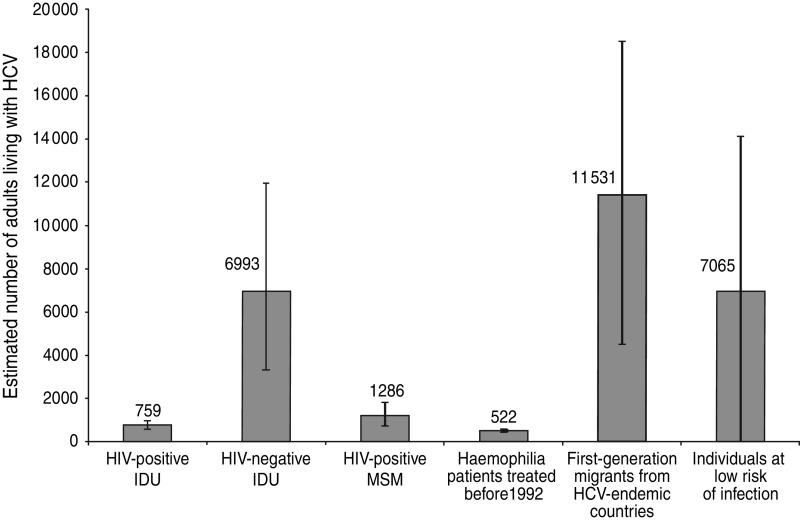
A population-based anti-hepatitis C virus (HCV) prevalence is important for surveillance purposes and it provides insight into the burden of disease. The outcomes of recent studies in the general Dutch population as well as recent HCV data from specific risk groups including migrants, men who have sex with men (MSM) and injecting drug users (IDUs), were implemented in a modified version of the Workbook Method (a spreadsheet originally designed for HIV estimations), to estimate Dutch HCV seroprevalence. The estimated national seroprevalence of HCV was 0·22% (min 0·07%, max 0·37%), corresponding to 28 100 (min n = 9600, max n = 48 000) HCV-infected individuals in The Netherlands. Of these, first-generation migrants from HCV-endemic countries (HCV prevalence ≥2%) accounted for the largest HCV-infected group, followed by IDUs and HIV-positive MSM.
Figures
References
-
- World Health Organization. Hepatitis C: Factsheet no. 164, 2011. (http://www.who.int/mediacentre/factsheets/fs164/en/). Accessed 22 February 2012.
-
- Rantala M, van de Laar MJ. Surveillance and epidemiology of hepatitis B and C in Europe – a review. Eurosurveillance 2008; 13. - PubMed
-
- Veldhuijzen IK, Conyn-van Spaendonck MAE, Dorigo-Zetsma JW. Seroprevalence of hepatitis B and C in the Dutch population [in Dutch]. Infectieziekten Bulletin 1999; 10: 182–184.
MeSH terms
LinkOut - more resources
Full Text Sources
Medical
