Crumbs limits oxidase-dependent signaling to maintain epithelial integrity and prevent photoreceptor cell death
- PMID: 22965909
- PMCID: PMC3444775
- DOI: 10.1083/jcb.201203083
Crumbs limits oxidase-dependent signaling to maintain epithelial integrity and prevent photoreceptor cell death
Abstract
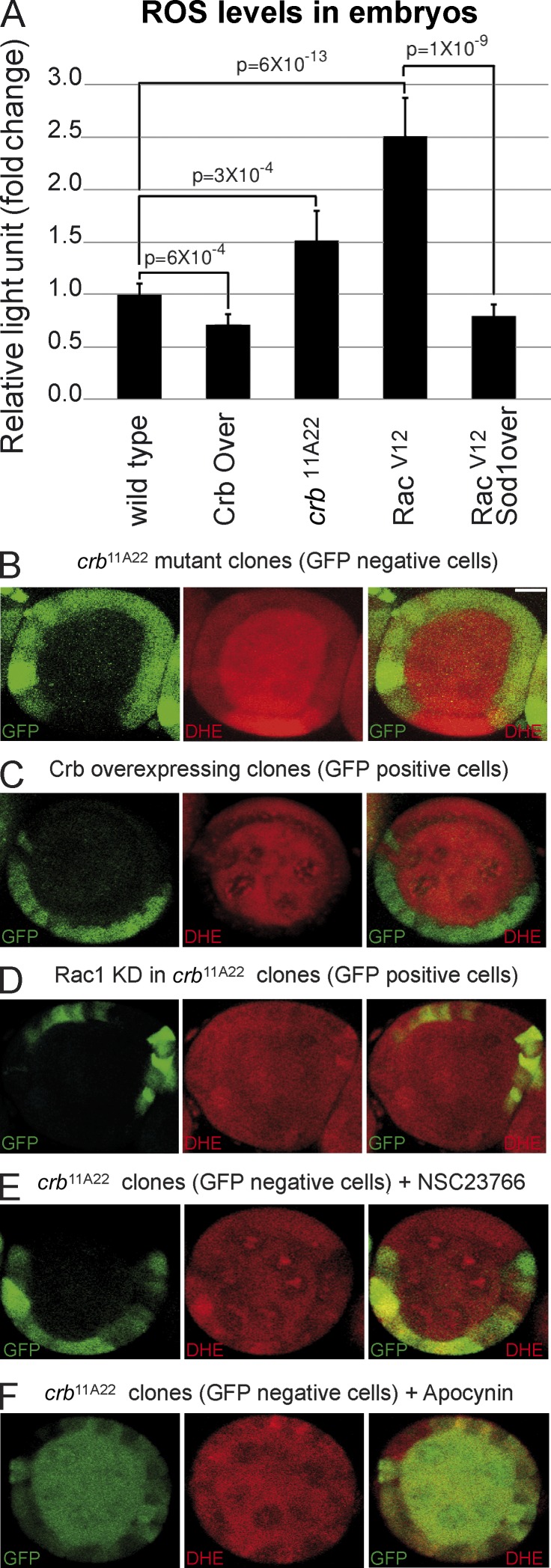
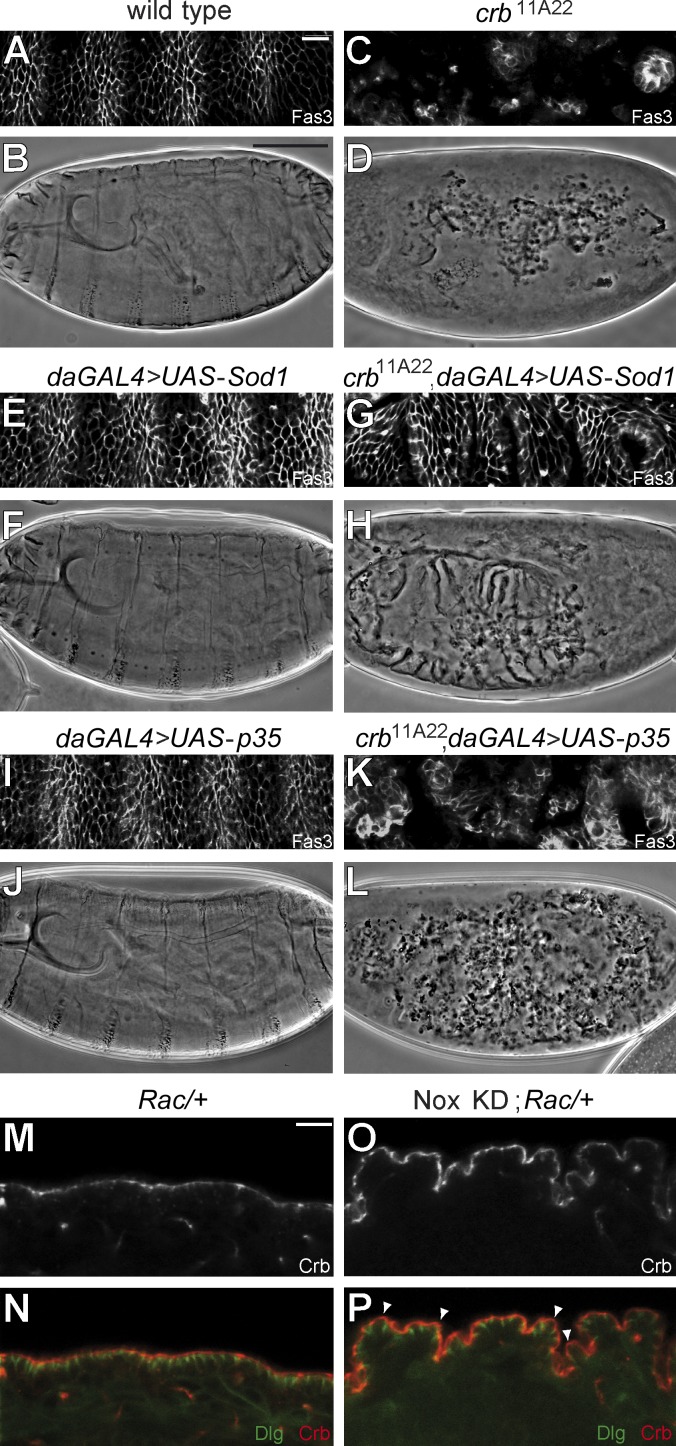
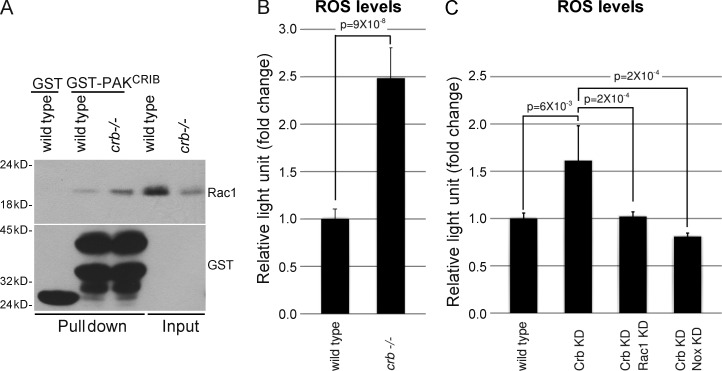
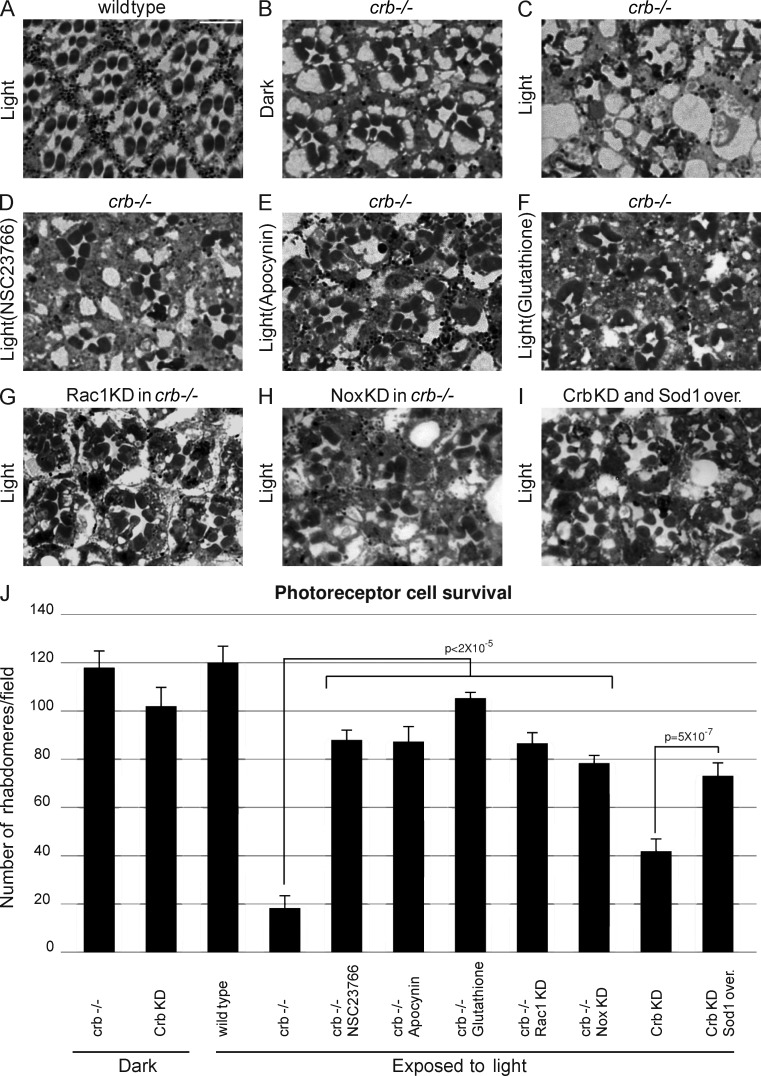
Drosophila melanogaster Crumbs (Crb) and its mammalian orthologues (CRB1-3) share evolutionarily conserved but poorly defined roles in regulating epithelial polarity and, in photoreceptor cells, morphogenesis and stability. Elucidating the molecular mechanisms of Crb function is vital, as mutations in the human CRB1 gene cause retinal dystrophies. Here, we report that Crb restricts Rac1-NADPH oxidase-dependent superoxide production in epithelia and photoreceptor cells. Reduction of superoxide levels rescued epithelial defects in crb mutant embryos, demonstrating that limitation of superoxide production is a crucial function of Crb and that NADPH oxidase and superoxide contribute to the molecular network regulating epithelial tissue organization. We further show that reduction of Rac1 or NADPH oxidase activity or quenching of reactive oxygen species prevented degeneration of Crb-deficient retinas. Thus, Crb fulfills a protective role during light exposure by limiting oxidative damage resulting from Rac1-NADPH oxidase complex activity. Collectively, our results elucidate an important mechanism by which Crb functions in epithelial organization and the prevention of retinal degeneration.
Figures
Similar articles
-
Crumbs controls epithelial integrity by inhibiting Rac1 and PI3K.J Cell Sci. 2011 Oct 15;124(Pt 20):3393-8. doi: 10.1242/jcs.092601. Epub 2011 Oct 7. J Cell Sci. 2011. PMID: 21984807
-
Unique cell biological profiles of retinal disease-causing missense mutations in the polarity protein Crumbs.J Cell Sci. 2017 Jul 1;130(13):2147-2158. doi: 10.1242/jcs.197178. Epub 2017 May 17. J Cell Sci. 2017. PMID: 28515229
-
Drosophila Crumbs is a positional cue in photoreceptor adherens junctions and rhabdomeres.Nature. 2002 Mar 14;416(6877):178-83. doi: 10.1038/nature720. Epub 2002 Feb 17. Nature. 2002. PMID: 11850624
-
Towards understanding CRUMBS function in retinal dystrophies.Hum Mol Genet. 2006 Oct 15;15 Spec No 2:R235-43. doi: 10.1093/hmg/ddl195. Hum Mol Genet. 2006. PMID: 16987889 Review.
-
[Role of Crumbs proteins in the control of epithelial cell and photoreceptor morphogenesis].Med Sci (Paris). 2004 Jun-Jul;20(6-7):663-7. doi: 10.1051/medsci/2004206-7663. Med Sci (Paris). 2004. PMID: 15329816 Review. French.
Cited by
-
Zebrafish Crb1, Localizing Uniquely to the Cell Membranes around Cone Photoreceptor Axonemes, Alleviates Light Damage to Photoreceptors and Modulates Cones' Light Responsiveness.J Neurosci. 2020 Sep 9;40(37):7065-7079. doi: 10.1523/JNEUROSCI.0497-20.2020. Epub 2020 Aug 14. J Neurosci. 2020. PMID: 32817065 Free PMC article.
-
NADPH Oxidase Contributes to Photoreceptor Degeneration in Constitutively Active RAC1 Mice.Invest Ophthalmol Vis Sci. 2016 May 1;57(6):2864-75. doi: 10.1167/iovs.15-18974. Invest Ophthalmol Vis Sci. 2016. PMID: 27233035 Free PMC article.
-
Crumbs organizes the transport machinery by regulating apical levels of PI(4,5)P2 in Drosophila.Elife. 2019 Nov 7;8:e50900. doi: 10.7554/eLife.50900. Elife. 2019. PMID: 31697234 Free PMC article.
-
Transcriptomic responses in the nervous system and correlated behavioural changes of a cephalopod exposed to ocean acidification.BMC Genomics. 2024 Jun 25;25(1):635. doi: 10.1186/s12864-024-10542-5. BMC Genomics. 2024. PMID: 38918719 Free PMC article.
-
Apico-basal polarity complex and cancer.J Biosci. 2014 Mar;39(1):145-55. doi: 10.1007/s12038-013-9410-z. J Biosci. 2014. PMID: 24499799 Review.
References
-
- Afanasev I. 2009. Detection of superoxide in cells, tissues and whole organisms. Front Biosci (Elite Ed). 1:153–160 - PubMed
Publication types
MeSH terms
Substances
Grants and funding
LinkOut - more resources
Full Text Sources
Molecular Biology Databases
Research Materials