


Molecular basis of electrophilic and oxidative defense: promises and perils of Nrf2
- PMID: 22966037
- PMCID: PMC4648289
- DOI: 10.1124/pr.110.004333
Molecular basis of electrophilic and oxidative defense: promises and perils of Nrf2
Abstract
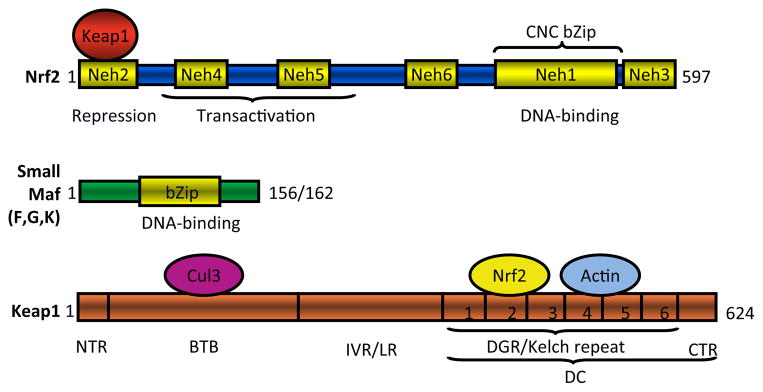
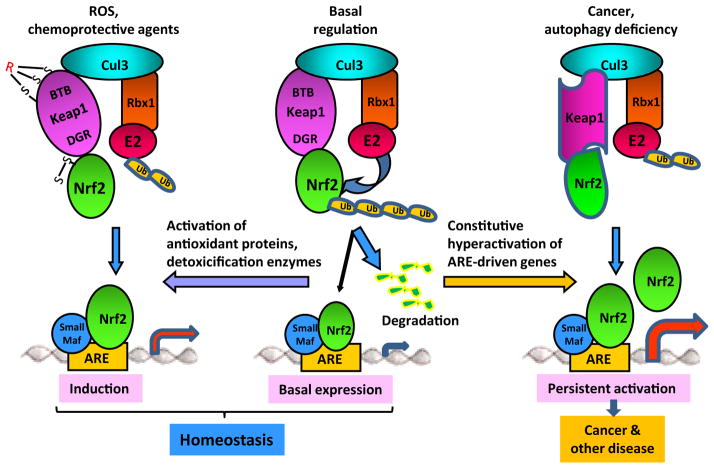
Induction of drug-metabolizing enzymes through the antioxidant response element (ARE)-dependent transcription was initially implicated in chemoprevention against cancer by antioxidants. Recent progress in understanding the biology and mechanism of induction revealed a critical role of induction in cellular defense against electrophilic and oxidative stress. Induction is mediated through a novel signaling pathway via two regulatory proteins, the nuclear factor erythroid 2-related factor 2 (Nrf2) and the Kelch-like erythroid cell-derived protein with CNC homology-associated protein 1 (Keap1). Nrf2 binds to Keap1 at a two site-binding interface and is ubiquitinated by the Keap1/cullin 3/ring box protein-1-ubiquitin ligase, resulting in a rapid turnover of Nrf2 protein. Electrophiles and oxidants modify critical cysteine thiols of Keap1 and Nrf2 to inhibit Nrf2 ubiquitination, leading to Nrf2 activation and induction. Induction increases stress resistance critical for cell survival, because knockout of Nrf2 in mice increased susceptibility to a variety of toxicity and disease processes. Collateral to diverse functions of Nrf2, genome-wide search has led to the identification of a plethora of ARE-dependent genes regulated by Nrf2 in an inducer-, tissue-, and disease-dependent manner to control drug metabolism, antioxidant defense, stress response, proteasomal degradation, and cell proliferation. The protective nature of Nrf2 could also be hijacked in a number of pathological conditions by means of somatic mutation, epigenetic alteration, and accumulation of disruptor proteins, promoting drug resistance in cancer and pathologic liver features in autophagy deficiency. The repertoire of ARE inducers has expanded enormously; the therapeutic potential of the inducers has been examined beyond cancer prevention. Developing potent and specific ARE inducers and Nrf2 inhibitors holds certain new promise for the prevention and therapy against cancer, chronic disease, and toxicity.
Figures
References
-
- Aikawa Y, Morimoto K, Yamamoto T, Chaki H, Hashiramoto A, Narita H, Hirono S, Shiozawa S. Treatment of arthritis with a selective inhibitor of c-Fos/activator protein-1. Nat Biotechnol. 2008;26:817–823. - PubMed
-
- Alam J, Camhi S, Choi AM. Identification of a second region upstream of the mouse heme oxygenase-1 gene that functions as a basal level and inducer-dependent transcription enhancer. J Biol Chem. 1995;270:11977–11984. - PubMed
-
- Alam J, Wicks C, Stewart D, Gong P, Touchard C, Otterbein S, Choi AM, Burow ME, Tou J. Mechanism of heme oxygenase-1 gene activation by cadmium in MCF-7 mammary epithelial cells. Role of p38 kinase and Nrf2 transcription factor. J Biol Chem. 2000;275:27694–27702. - PubMed
-
- Andrews NC, Erdjument-Bromage H, Davidson MB, Tempst P, Orkin SH. Erythroid transcription factor NF-E2 is a haematopoietic-specific basic-leucine zipper protein. Nature. 1993a;362:722–728. - PubMed
Publication types
MeSH terms
Substances
Grants and funding
LinkOut - more resources
Full Text Sources
Other Literature Sources
Research Materials
