. 2012 Dec;80(12):4115-22.
doi: 10.1128/IAI.00752-12. Epub 2012 Sep 10.

Escherichia coli isolates that carry vat, fyuA, chuA, and yfcV efficiently colonize the urinary tract

Affiliations

Escherichia coli isolates that carry vat, fyuA, chuA, and yfcV efficiently colonize the urinary tract

Rachel R Spurbeck et al. Infect Immun. 2012 Dec.

Abstract

Extraintestinal Escherichia coli (ExPEC), a heterogeneous group of pathogens, encompasses avian, neonatal meningitis, and uropathogenic E. coli strains. While several virulence factors are associated with ExPEC, there is no core set of virulence factors that can be used to definitively differentiate these pathotypes. Here we describe a multiplex of four virulence factor-encoding genes, yfcV, vat, fyuA, and chuA, highly associated with uropathogenic E. coli strains that can distinguish three groups of E. coli: diarrheagenic and animal-associated E. coli strains, human commensal and avian pathogenic E. coli strains, and uropathogenic and neonatal meningitis E. coli strains. Furthermore, human intestinal isolates that encode all four predictor genes express them during exponential growth in human urine and colonize the bladder in the mouse model of ascending urinary tract infection in higher numbers than human commensal strains that do not encode the four predictor genes (P = 0.02), suggesting that the presence of the predictors correlates with uropathogenic potential.


Figures
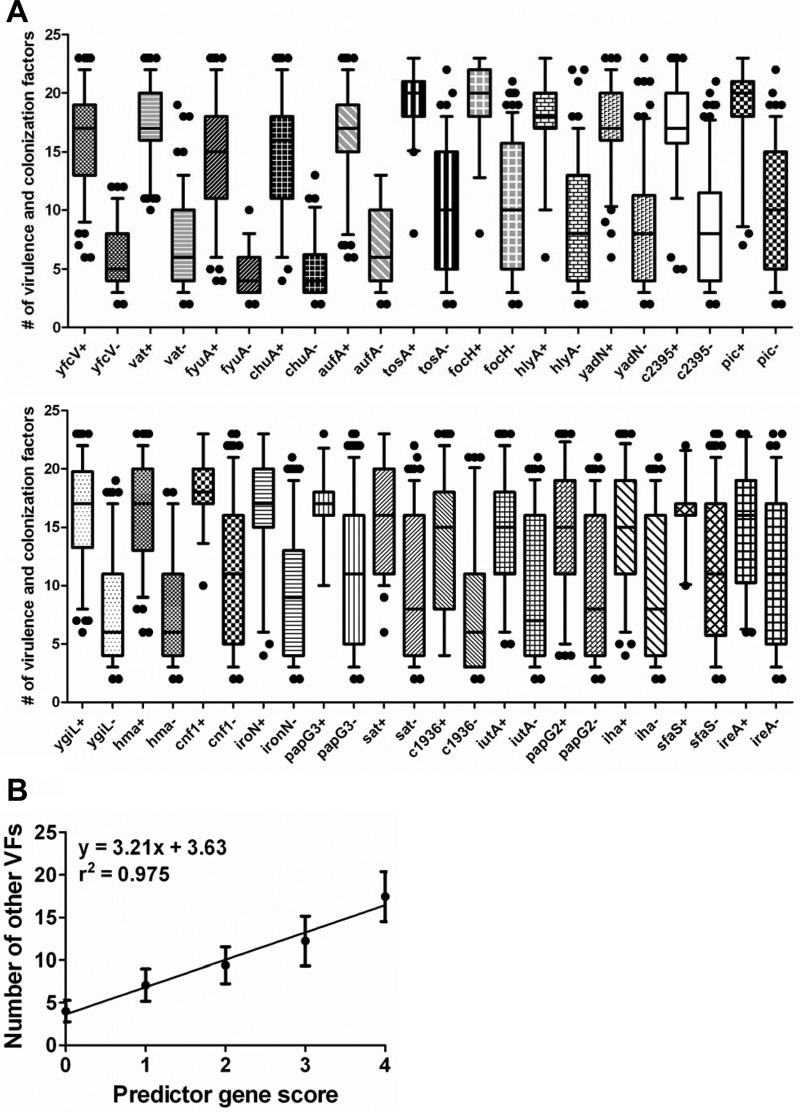
Fig 1
Fig 1
Power of each virulence gene to predict the presence of other virulence genes in E. coli isolates. (A) Box-and-whisker plot of the number of other virulence or colonization factor genes present (total screened = 29) in strains positive for each predictor gene compared to strains negative for the predictor gene. The line in each box indicates the median, whiskers indicate the 5th to 95th percentiles, and dots are outliers. +, positive for the gene; −, negative for the gene. (B) Comparison of the PG score with the number of other VF genes present in each isolate. Data points indicate the mean number of other VF genes for PG score. Error bars represent the standard deviation.
Fig 2
Fig 2
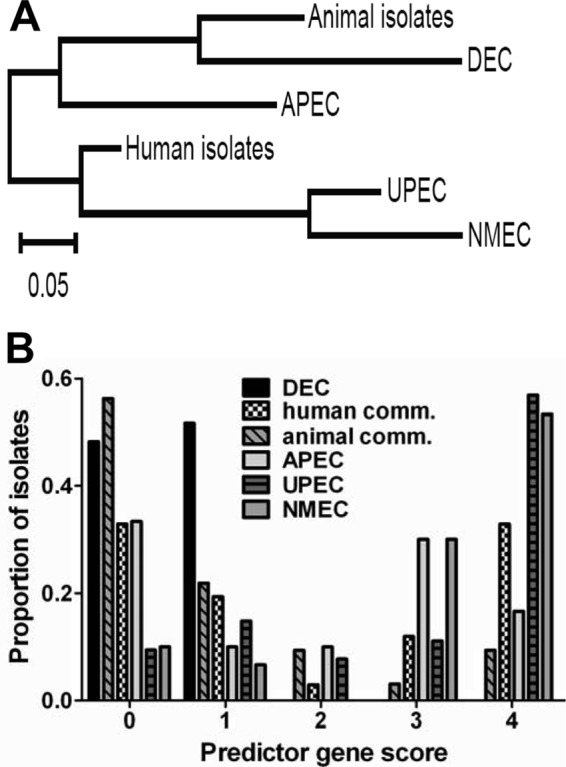
Multiplex PCR results for yfcV, vat, fyuA, and chuA separate E. coli pathotypes into three groups, (i) animal isolates and DEC, (ii) APEC and human isolates, and (iii) UPEC and NMEC isolates, with high PG scores correlating with UPEC and NMEC isolates. (A) Dendrogram depicting the distribution of the E. coli pathotypes on the basis of the Bray-Curtis similarity metric; (B) proportion of isolates with the indicated PG score for each E. coli pathotype (comm., commensal).
Fig 3
Fig 3
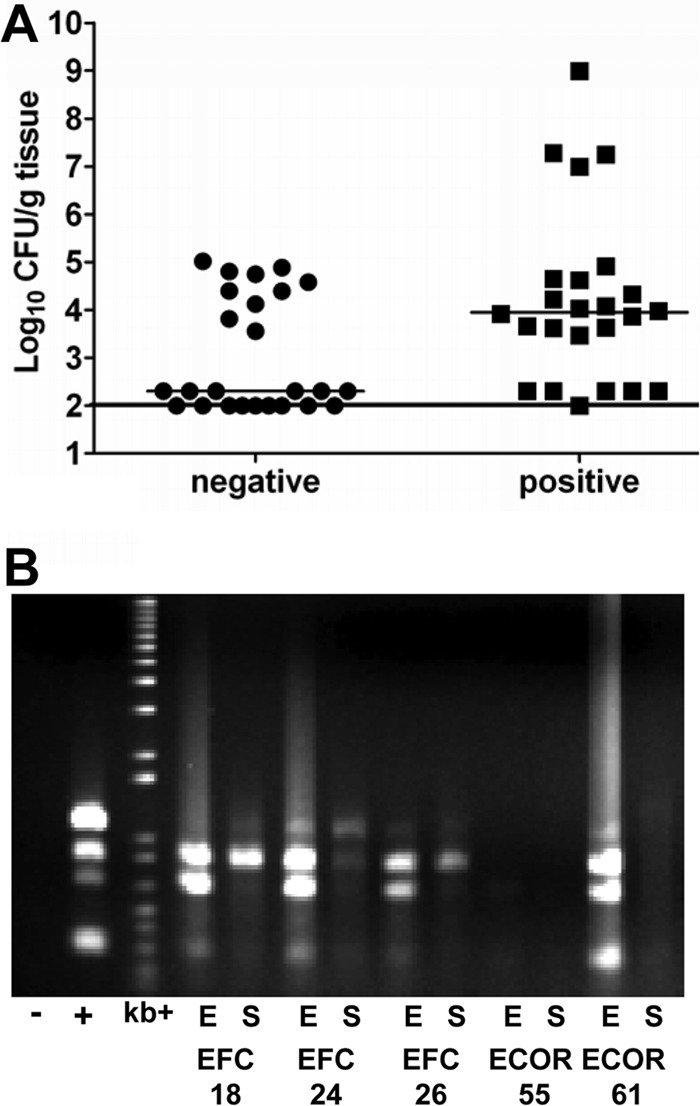
Human fecal isolates that encode and express the four predictor genes more efficiently colonize the mouse bladder in the murine model of ascending UTI than isolates that do not encode the predictor genes. (A) Individual in vivo challenge of the murine model of ascending UTI (five mice/strain) with five human fecal E. coli isolates (EFC18, EFC24, EFC26, ECOR55, and ECOR61) that encode yfcV, vat, fyuA, and chuA (positive) and five that encode none of the predictor genes (negative, EFC7, EFC9, EFC14, EFC22, and ECOR5). (B) Multiplex PCR of the predictor genes using cDNA from the human fecal E. coli isolates used in the in vivo study (EFC18, EFC24, EFC26, ECOR55, and ECOR61) cultured in human urine as the template. Lanes: −, no-template control; +, positive genomic DNA control from UTI89; kb+, 1-kb-plus ladder; E, exponential phase; S, stationary phase.

References

    1. Alteri CJ, Hagan EC, Sivick KE, Smith SN, Mobley HL. 2009. Mucosal immunization with iron receptor antigens protects against urinary tract infection. PLoS Pathog. 5:e1000586 doi: - DOI - PMC - PubMed
    1. Bokete TN, et al. 1997. Genetic and phenotypic analysis of Escherichia coli with enteropathogenic characteristics isolated from Seattle children. J. Infect. Dis. 175:1382–1389 - PubMed
    1. Caugant DA, et al. 1983. Genetic diversity and relationships among strains of Escherichia coli in the intestine and those causing urinary tract infections. Prog. Allergy 33:203–227 - PubMed
    1. Colwell RK. 2009. User's guide to EstimateS version 8.2. viceroy.eeb.uconn.edu/EstimateS/ University of Connecticut, Storrs, CT
    1. Foxman B. 2003. Epidemiology of urinary tract infections: incidence, morbidity, and economic costs. Dis. Mon. 49:53–70 - PubMed

Publication types

MeSH terms