


Linking community and disease ecology: the impact of biodiversity on pathogen transmission
- PMID: 22966136
- PMCID: PMC3427561
- DOI: 10.1098/rstb.2011.0364
Linking community and disease ecology: the impact of biodiversity on pathogen transmission
Abstract
The increasing number of zoonotic diseases spilling over from a range of wild animal species represents a particular concern for public health, especially in light of the current dramatic trend of biodiversity loss. To understand the ecology of these multi-host pathogens and their response to environmental degradation and species extinctions, it is necessary to develop a theoretical framework that takes into account realistic community assemblages. Here, we present a multi-host species epidemiological model that includes empirically determined patterns of diversity and composition derived from community ecology studies. We use this framework to study the interaction between wildlife diversity and directly transmitted pathogen dynamics. First, we demonstrate that variability in community composition does not affect significantly the intensity of pathogen transmission. We also show that the consequences of community diversity can differentially impact the prevalence of pathogens and the number of infectious individuals. Finally, we show that ecological interactions among host species have a weaker influence on pathogen circulation than inter-species transmission rates. We conclude that integration of a community perspective to study wildlife pathogens is crucial, especially in the context of understanding and predicting infectious disease emergence events.
Figures
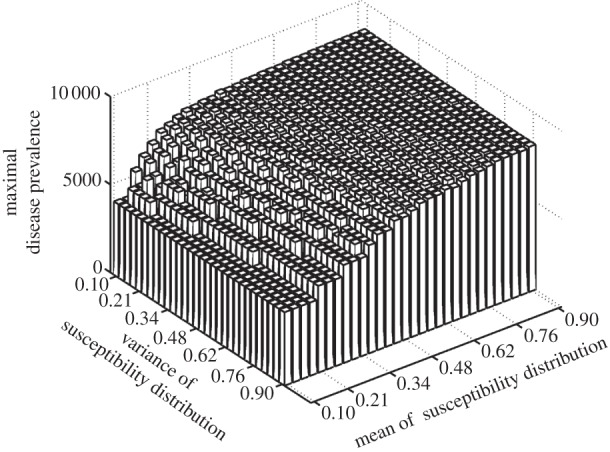
 days,
days,  ,
,  . k and ω are modified to explore different forms of susceptibilities distribution.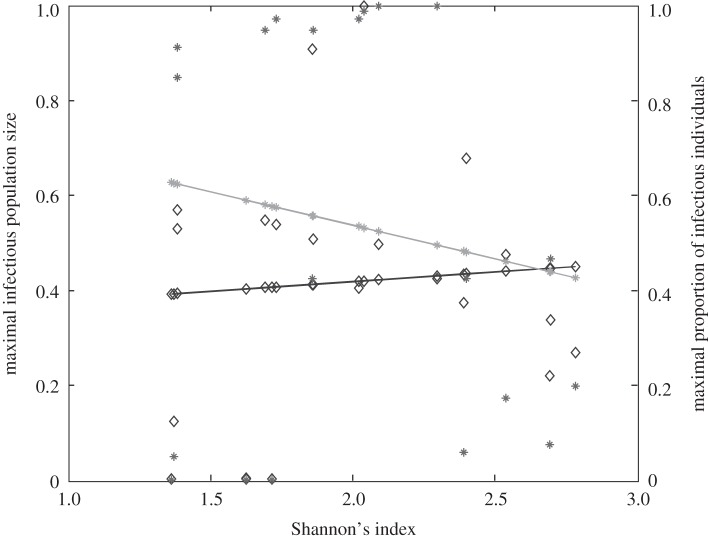
 days,
days,  ,
,  ,
,  ,
,  . z and Y0 are modified to explore different shapes of host community structures.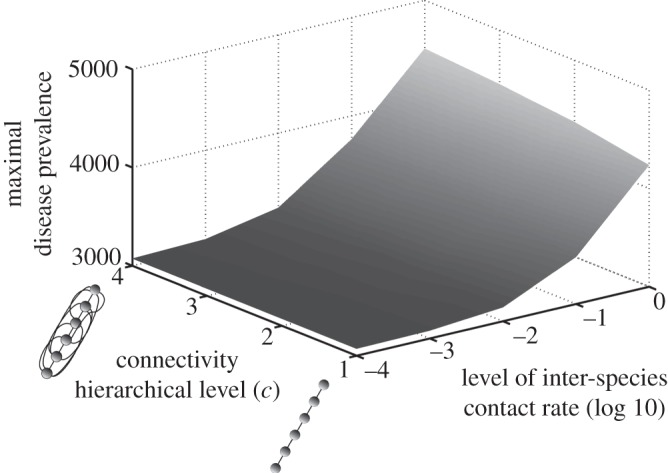
 days, k = 0.1,
  .
.References
-
- Kermak W., McKendrik A. 1927. A contribution to the mathematical theory of epidemics. Proc. R. Soc. Lond. A 115, 700–726 10.1098/rspa.1927.0118 (doi:10.1098/rspa.1927.0118) - DOI
-
- Anderson R. M., May R. M. 1991. Infectious diseases of humans: dynamics and control. Oxford, UK: Oxford Science Publications
-
- Grenfell B. T., Bjornstad O. N., Kappey J. 2001. Travelling waves and spatial hierarchies in measles epidemics. Nature 414, 716–723 10.1038/414716a (doi:10.1038/414716a) - DOI - PubMed
-
- Keeling M. J., Rohani P. 2008. Modeling infectious diseases in humans and animals. Princeton, NJ: Princeton University Press
-
- Daszak P., Cunningham A. A., Hyatt A. D. 2001. Anthropogenic environmental change and the emergence of infectious diseases in wildlife. Acta Trop. 78, 103–116 10.1016/S0001-706X(00)00179-0 (doi:10.1016/S0001-706X(00)00179-0) - DOI - PubMed
Publication types
MeSH terms
LinkOut - more resources
Full Text Sources
