


Association between indicators of disability burden and subsequent depression among older persons
- PMID: 22967459
- PMCID: PMC3605908
- DOI: 10.1093/gerona/gls179
Association between indicators of disability burden and subsequent depression among older persons
Abstract
Background: Disability is associated with depression in older persons, yet the effect of disability burden on the likelihood of being depressed is uncertain.
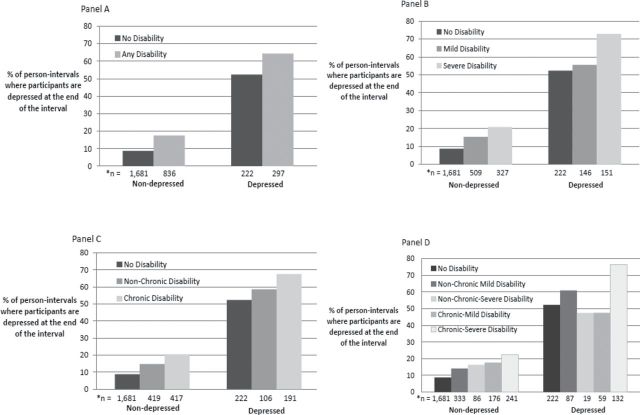
Methods: A total of 754 community-living persons, aged ≥70, underwent monthly assessments in four essential activities of daily living and assessments of depression (yes/no) every 18 months for up to 108 months. Within each 18-month person-interval, participants' disability burden was operationalized as none or any, and according to severity (none, mild, or severe) and chronicity (none, nonchronic, or chronic) given the highest level of severity or chronicity experienced during a given 18-month interval, respectively. A variable combining severity and chronicity (none, nonchronic mild, nonchronic severe, chronic-mild, or chronic-severe) was also created. Using generalized estimating equations, we evaluated the association between each indicator of disability burden and subsequent depression.
Results: Participants who had any versus no disability during the previous 18 months were 65% more likely to experience subsequent depression (OR = 1.65; 95% confidence interval [CI] 1.34, 2.02). Quantifying severity (mild disability vs. none, OR = 1.43; 95% CI: 1.15, 1.79; severe disability vs. none, OR = 2.07; 95% CI 1.56, 2.74) and chronicity (nonchronic disability vs. none, OR = 1.44; 95% CI 1.13, 1.83; chronic disability vs. none, OR = 1.96; 95% CI 1.50, 2.55) indicated increasingly stronger associations with subsequent depression, with the highest likelihood of subsequent depression (OR = 2.42; 95% CI 1.78, 3.30) observed among participants with chronic-severe disability.
Conclusions: Quantifying the magnitude of disability burden, particularly on the basis of severity and chronicity, provides additional information regarding the likelihood of experiencing subsequent depression among older persons.
Figures
References
-
- Blazer DG. Depression in late life: review and commentary. J Gerontol A Biol Sci Med Sci. 2003. 58 249–265 - PubMed
-
- Himelhoch S, Weller WE, Wu AW, Anderson GF, Cooper LA. Chronic medical illness, depression, and use of acute medical services among Medicare beneficiaries. Med Care. 2004. 42 512–521 - PubMed
-
- Fried TR, Bradley EH, Williams CS, Tinetti ME. Functional disability and health care expenditures for older persons. Arch Intern Med. 2001. 161 2602–2607 - PubMed
-
- Guralnik JM, Ferrucci L. Underestimation of disability occurrence in epidemiological studies of older people: is research on disability still alive?. J Am Geriatr Soc. 2002. 50 1599–1601 - PubMed
-
- Sun W, Schooling CM, Chan WM, Ho KS, Lam TH. The association between depressive symptoms and mortality among Chinese elderly: a Hong Kong cohort study. J Gerontol A Biol Sci Med Sci. 2011. 66 459–466 - PubMed
Publication types
MeSH terms
Grants and funding
LinkOut - more resources
Full Text Sources
Medical
