


Limited contribution of common genetic variants to risk for liver injury due to a variety of drugs
- PMID: 22968431
- PMCID: PMC3636716
- DOI: 10.1097/FPC.0b013e3283589a76
Limited contribution of common genetic variants to risk for liver injury due to a variety of drugs
Abstract
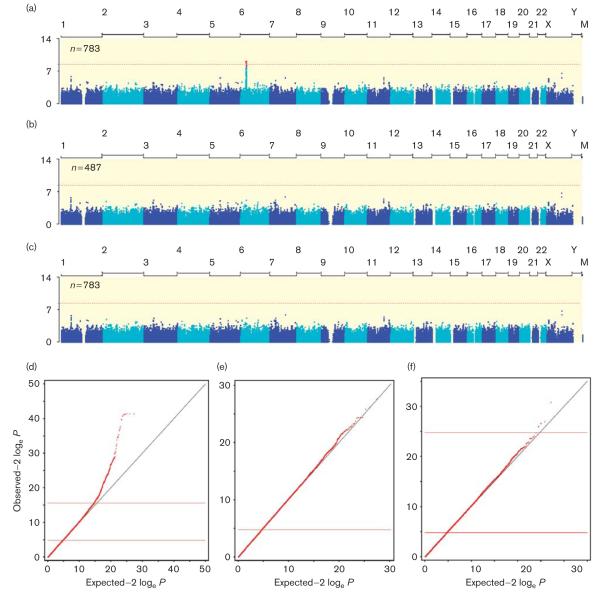
Background and aims: Drug-induced liver injury (DILI) is a serious adverse drug event that is suspected to have a heritable component. We carried out a genome-wide association study of 783 individuals of European ancestry who experienced DILI due to more than 200 implicated drugs.
Methods: DILI patients from the US-based Drug-Induced Liver Injury Network (n=401) and three international registries (n=382) were genotyped with the Illumina 1Mduo BeadChip and compared with population controls (n=3001). Potential associations were tested in 307 independent Drug-Induced Liver Injury Network cases.
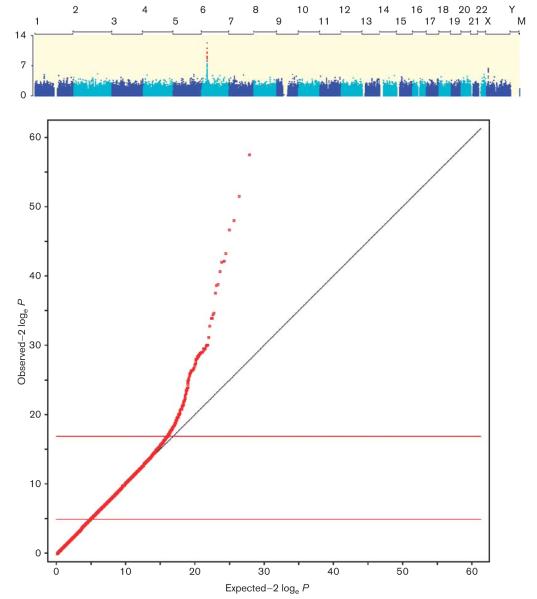
Results: After accounting for known major histocompatibility complex risk alleles for flucloxacillin-DILI and amoxicillin/clavulanate-DILI, there were no genome-wide significant associations, including in the major histocompatibility complex region. Stratification of DILI cases according to clinical phenotypes (injury type, latency, age of onset) also did not show significant associations. An analysis of hepatocellular DILI (n=285) restricted to 193 single-nucleotide polymorphisms previously associated with autoimmune disease showed a trend association for rs7574865, in the vicinity of signal transducer and activator of transcription 4 (STAT4) (P=4.5×10(-4)). This association was replicated in an independent cohort of 168 hepatocellular DILI cases (P=0.011 and 1.5×10(-5) for combined cohorts). No significant associations were found with stratification by other clinical or demographic variables.
Conclusion: Although not significant at the genome-wide level, the association between hepatocellular DILI and STAT4 is consistent with the emerging role of the immune system in DILI. However, the lack of genome-wide association study findings supports the idea that strong genetic determinants of DILI may be largely drug-specific or may reflect rare genetic variations, which were not assessed in our study.
Figures
References
-
- Ostapowicz G, Fontana RJ, Schiodt FV, Larson A, Davern TJ, Han SH, et al. Results of a prospective study of acute liver failure at 17 tertiary care centers in the United States. Ann Intern Med. 2002;137:947–954. - PubMed
-
- Watkins PB, Seligman PJ, Pears JS, Avigan MI, Senior JR. Using controlled clinical trials to learn more about acute drug-induced liver injury. Hepatology. 2008;48:1680–1689. - PubMed
-
- Andrade RJ, Robles M, Ulzurrun E, Lucena MI. Drug-induced liver injury: insights from genetic studies. Pharmacogenomics. 2009;10:1467–1487. - PubMed
-
- Daly AK. Drug-induced liver injury: past, present and future. Pharmacogenomics. 2010;11:607–611. - PubMed
-
- Lucena MI, Kaplowitz N, Hallal H, Castiella A, Garcia-Bengoechea M, Otazua P, et al. Recurrent drug-induced liver injury (DILI) with different drugs in the Spanish Registry. The dilemma of the relationship to autoimmune hepatitis. J Hepatol. 2011 - PubMed
Publication types
MeSH terms
Grants and funding
- U01 DK065211/DK/NIDDK NIH HHS/United States
- 2U01-DK065176-06/DK/NIDDK NIH HHS/United States
- 2U01-DK065201-06/DK/NIDDK NIH HHS/United States
- 5U01DK065193-04/DK/NIDDK NIH HHS/United States
- U01 DK065176/DK/NIDDK NIH HHS/United States
- 2U01-DK065211-06/DK/NIDDK NIH HHS/United States
- UL1 RR025747/RR/NCRR NIH HHS/United States
- 5U01-DK065238-08/DK/NIDDK NIH HHS/United States
- UL1 RR025761/RR/NCRR NIH HHS/United States
- U01 DK065201/DK/NIDDK NIH HHS/United States
- DH_/Department of Health/United Kingdom
- U01 DK065238/DK/NIDDK NIH HHS/United States
- 076113/WT_/Wellcome Trust/United Kingdom
- G0901364/MRC_/Medical Research Council/United Kingdom
- UL1 TR001108/TR/NCATS NIH HHS/United States
- U01 DK065193/DK/NIDDK NIH HHS/United States
- 2U01-DK065184-06/DK/NIDDK NIH HHS/United States
- 085475/WT_/Wellcome Trust/United Kingdom
- WT_/Wellcome Trust/United Kingdom
- UL1 RR024986/RR/NCRR NIH HHS/United States
- U01 DK065184/DK/NIDDK NIH HHS/United States
LinkOut - more resources
Full Text Sources
Medical
Molecular Biology Databases
Miscellaneous
