


Predictors of range of motion in patients undergoing manipulation after TKA
- PMID: 22968534
- PMCID: PMC3528912
- DOI: 10.1007/s11999-012-2591-1
Predictors of range of motion in patients undergoing manipulation after TKA
Abstract
Background: Knee stiffness or limited range of motion (ROM) after total knee arthroplasty (TKA) may compromise patient function. Patients with stiffness are usually managed with manipulation under anesthesia (MUA) to improve ROM. However, the final ROM obtained is multifactorial and may depend on factors such as comorbidities, implant type, or the timing of MUA.
Questions/purposes: We asked whether diabetes mellitus, implant type, and the interval between TKA and MUA influenced post-MUA ROM.
Methods: From a group of 2462 patients with 3224 TKAs performed between 1999 and 2007 we retrospectively reviewed 96 patients with 119 TKAs (4.3%) who underwent MUA. We determined the presence of diabetes mellitus, implant type, and the interval between TKA and MUA.
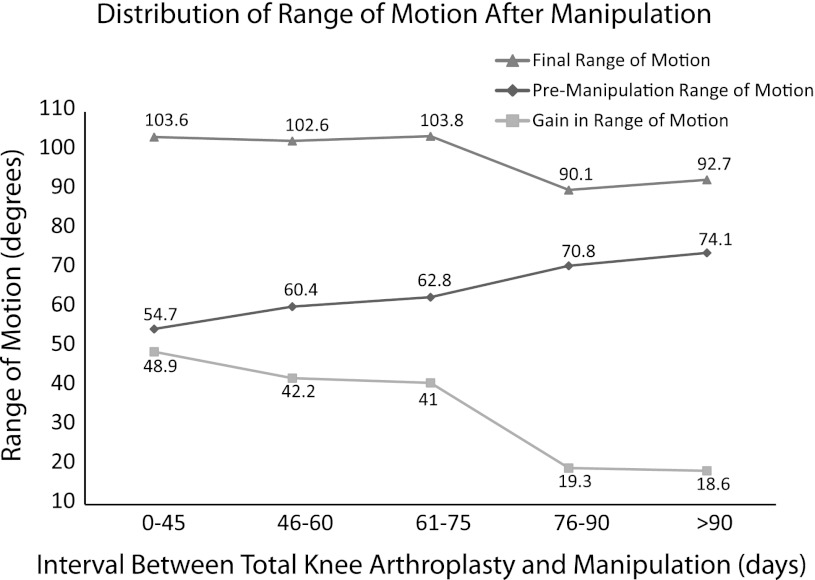
Results: The average increase in ROM after MUA was 34°. Patients with diabetes mellitus experienced lower final ROM after MUA (87.5° versus 100.3°) as did patients with cruciate-retaining (CR) prostheses versus posterior-stabilized (92.3° versus 101.6°). The interval between TKA and MUA inversely correlated with final ROM with a decrease after 75 days.
Conclusions: Most patients experience improvements in ROM after MUA. Patients with diabetes mellitus or CR prostheses are at risk for lower final ROM after MUA. Manipulation within 75 days of TKA is associated with better ROM.
Figures
References
-
- Babis GC, Trousdale RT, Pagnano MW, Morrey BF. Poor outcomes of isolated tibial insert exchange and arthrolysis for the management of stiffness following total knee arthroplasty. J Bone Joint Surg Am. 2001;83:1534–1536. - PubMed
-
- Bong MR, Di Cesare PE. Stiffness after total knee arthroplasty. J Am Acad Orthop Surg. 2004;12:164–171. - PubMed
-
- Brosseau L, Balmer S, Tousignant M, O’Sullivan JP, Goudreault C, Goudreault M, Gringras S. Intra- and intertester reliability and criterion validity of the parallelogram and universal goniometers for measuring maximum active knee flexion and extension of patients with knee restrictions. Arch Phys Med Rehabil. 2001;82:396–402. doi: 10.1053/apmr.2001.19250. - DOI - PubMed
MeSH terms
LinkOut - more resources
Full Text Sources
Other Literature Sources
Medical
