. 2013 Feb;225(3):719-31.
doi: 10.1007/s00213-012-2857-z. Epub 2012 Sep 12.

Simultaneous blockade of dopamine and noradrenaline reuptake promotes disadvantageous decision making in a rat gambling task

Affiliations

Simultaneous blockade of dopamine and noradrenaline reuptake promotes disadvantageous decision making in a rat gambling task

Petra J J Baarendse et al. Psychopharmacology (Berl). 2013 Feb.

Abstract

Rationale: The inability to make profitable long-term decisions has been implicated in several psychiatric disorders. There is emerging evidence to support a role for dopamine (DA) in decision making, but our understanding of the role of noradrenaline (NA) and serotonin (5-HT) in decision making, and of possible interactions between the three monoamines, is limited. Moreover, impulsivity has been associated with aberrant decision making, but the underlying mechanisms are incompletely understood.

Objective: The purpose of this study is to improve our understanding of the neuropharmacological mechanisms of decision making and impulse control.

Methods: We investigated the effects of amphetamine (0.25-1.0 mg/kg) and selective reuptake inhibitors of DA (GBR12909; 2.5-10 mg/kg), NA (atomoxetine; 0.3-3.0 mg/kg), and 5-HT (citalopram; 0.3-3.0 mg/kg) in a rat gambling task (rGT). Since the rGT allows for detection of impulsive action, i.e., premature responding, we also assessed the relationship between decision making and impulsivity.

Results: In the rGT, rats developed an optimal choice strategy from the first session onwards. Elevation of endogenous DA or NA levels increased and decreased impulsivity, respectively, but did not alter decision making. However, simultaneous blockade of DA and NA disrupted decision making, reflected by a relative decrease in choice for the advantageous choice options. Increasing 5-HT neurotransmission did not affect decision making or impulsivity.

Conclusions: These data suggest important but complementary or redundant roles of DA and NA neurotransmission in decision-making processes based on reward probability and punishment. Moreover, impulse control and decision making in the rGT rely on dissociable mechanisms.


Figures
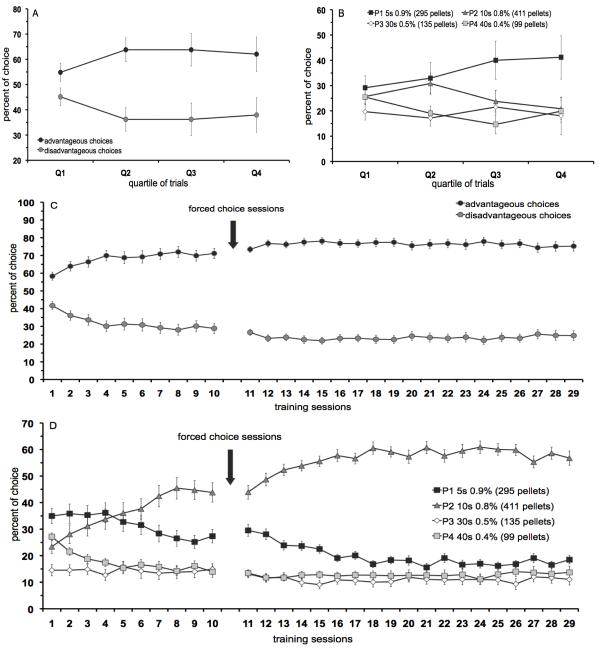
Figure 1
Figure 1
Development of choice pattern in the rGT. Advantageous versus disadvantageous options (A) and four different response options (B) during each quartile of trials within the 1st 30-min session. Advantageous versus disadvantageous options (C) and four different response options (D) over training sessions. In total, n=40 animals were included in the analysis. All data are expressed as mean±SEM. Note that not all scales of the panels are identical.
Figure 2
Figure 2
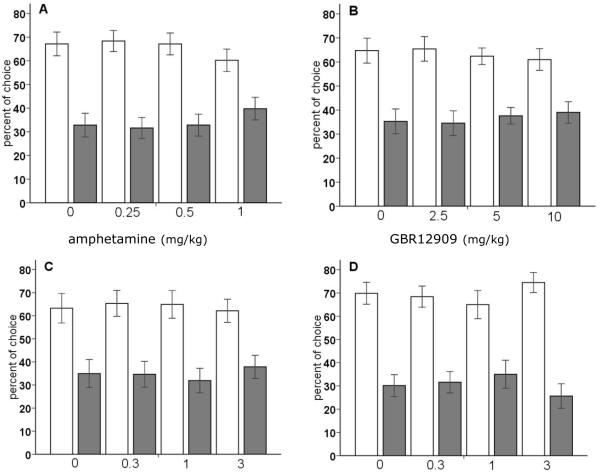
Effects of amphetamine (A), the selective DA reuptake inhibitor GBR12909 (B), the selective NA reuptake inhibitor atomoxetine (C) and the selective 5-HT reuptake inhibitor citalopram (D) on choice behavior, i.e., advantageous options versus disadvantageous options in the rGT. In total, n=20, n=20, n=14, and n=19 animals were included in the analysis, respectively. Asterisk indicates p<0.05 and two asterisks indicate p<0.01 compared to vehicle treatment (paired samples t-test). All data are expressed as mean±SEM.
Figure 3
Figure 3
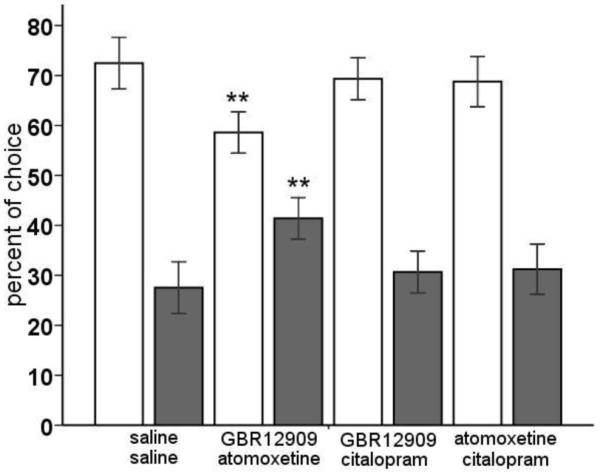
Effects of combined administration of the selective DA reuptake inhibitor GBR12909 (10 mg/kg), the selective NA reuptake inhibitor atomoxetine (3 mg/kg) and/or the selective 5-HT reuptake inhibitor citalopram (3 mg/kg) on choice behavior, i.e., advantageous options versus disadvantageous options in the rGT. In total, n=20 animals were included in the analysis. Asterisk indicates p<0.05 compared to vehicle treatment (paired samples t-test). All data are expressed as mean±SEM.
Figure 4
Figure 4
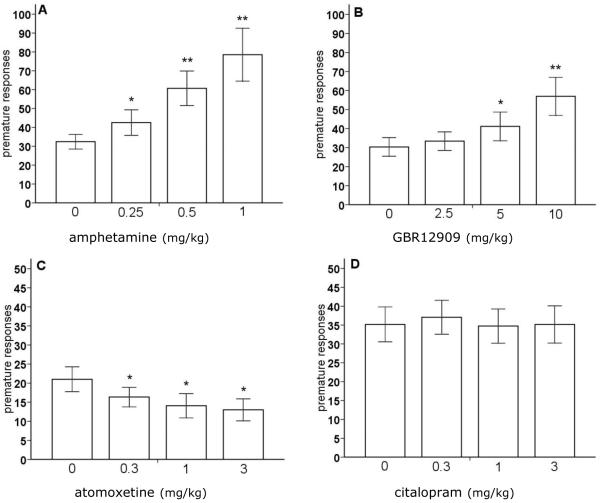
Effects of amphetamine (A), the selective DA reuptake inhibitor GBR12909 (B), the selective NA reuptake inhibitor atomoxetine (C) and the selective 5-HT reuptake inhibitor citalopram (D) on premature responding, i.e., impulsive action, in the rGT. In total, n=20, n=20, n=14, and n=19 animals were included in the analysis, respectively. Asterisk indicates p<0.05 and two asterisks indicate p<0.01 compared to vehicle treatment (paired samples t-test). All data are expressed as mean±SEM. Note that not all scales of the panels are identical.
Figure 5
Figure 5
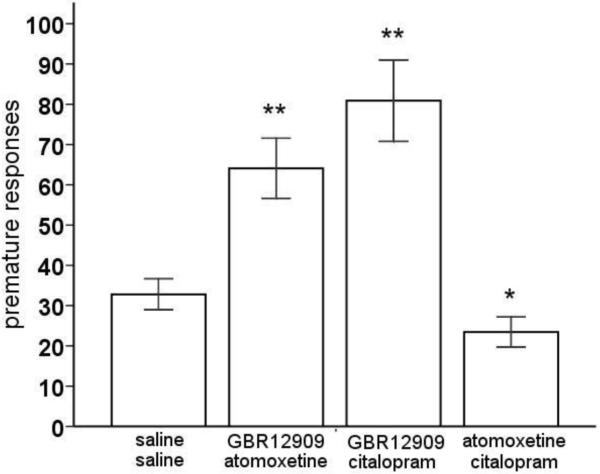
Effects of combined administration of the selective DA reuptake inhibitor GBR12909 (10 mg/kg), the selective NA reuptake inhibitor atomoxetine (3 mg/kg) and/or the selective 5-HT reuptake inhibitor citalopram (3 mg/kg) on premature responding, i.e., impulsive action, in the rGT. In total, n=20 animals were included in the analysis. Asterisk indicates p<0.05 and two asterisks indicate p<0.01 compared to vehicle treatment (paired samples t-test). All data are expressed as mean±SEM.

References

    1. Arnsten AFT. Catecholamine regulation of the prefrontal cortex. J Psychopharmacol. 1997;11:151–162. - PubMed
    1. Arnsten AFT. Through the looking glass: differential noradrenergic modulation of prefrontal cortical function. Neural Plasticity. 2000;7:133–46. - PMC - PubMed
    1. Aston-Jones G, Cohen JD. An integrative theory of locus coeruleus–norepinephrine function: adaptive gain and optimal performance. Annu Rev Neurosci. 2005;28:403–450. - PubMed
    1. Baarendse PJJ, Vanderschuren LJMJ. Dissociable effects of monoamine reuptake inhibitors on distinct forms of impulsive behavior in rats. Psychopharmacology. 2012;219:313–326. - PMC - PubMed
    1. Bark R, Dieckmann S, Bogerts B, Northoff G. Deficit in decision making in catatonic schizophrenia: an exploratory study. Psychiatry Res. 2005;134:131–141. - PubMed

Publication types

Substances