Review
. 2012 Oct 21;12(20):4006-9.
doi: 10.1039/c2lc90100e.

Exploiting mechanical biomarkers in microfluidics

Affiliations
Review

Exploiting mechanical biomarkers in microfluidics

Xiaole Mao et al. Lab Chip. .

Abstract

Cellular mechanical properties have been observed to have important implications for pathogenesis and pathophysiology. These observations have led to the recent development of a unique class of biomarkers: mechanical biomarkers. Compared with the traditional biochemical-based biomarkers (e.g., antibodies), mechanical biomarkers have many advantages such as label-free, low cost, convenient maintenance, and reduced assay time. In the past few years, there has been an increasing effort to exploit cellular mechanical biomarkers in microfluidic devices. This trend makes sense because microfluidic devices often feature structures that have characteristic lengths similar to those of cells, which renders them uniquely capable of probing and utilizing mechanical biomarkers. In this Focus article, we discuss a few examples of mechanical biomarker-based microfluidic applications. We believe that these examples are just the tip of the iceberg and that the full potential of mechanical biomarkers in microfluidic-based diagnostics and therapeutics has yet to be revealed.


Figures
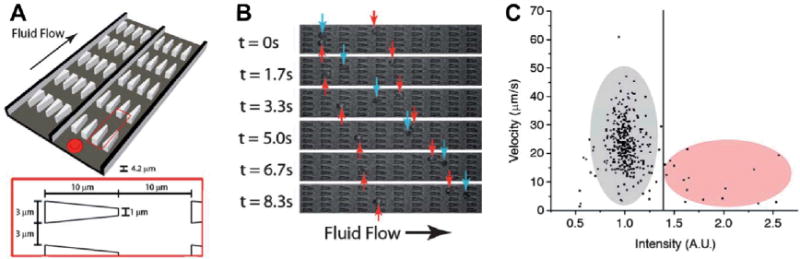
Fig. 1
Fig. 1
Principles of pillar-based deformability cytometry. (A) Schematic of the device design. The device contains an array of obstacles. Physical dimensions of the obstacles are shown in the inset. Each array contains 10 by 200 obstacles. (B) Optical images of infected RBCs (red arrows) and uninfected RBCs (blue arrows) in the device. (C) Velocity vs. intensity for RBCs (infected cells: gray; uninfected cells: red).
Fig. 2
Fig. 2
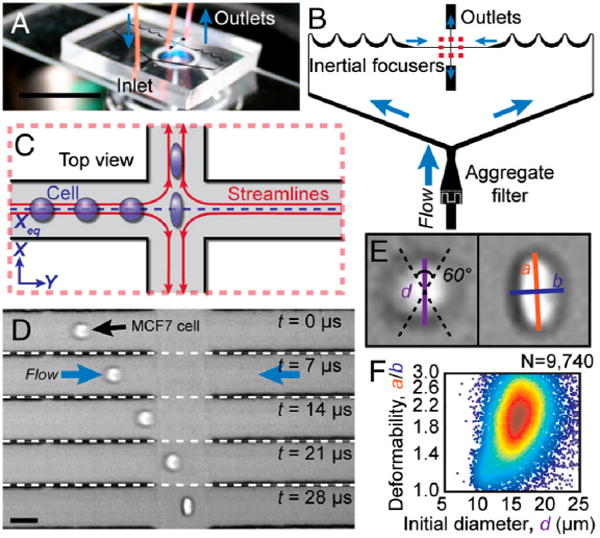
Principles of “hydrodynamic stretching” based deformability cytometry. (A) A photograph of the microfluidic deformability cytometry device. (B) A schematic of the microfluidic device including the “inertial focusing” region and the “hydrodynamic stretching” region. (C) A schematic of the deformation of a cell delivered to the center of an extensional flow via inertial focusing. (D) High-speed microscopic images showing a focused cell entering the extensional flow region. (E) Definition of the shape parameters extracted from images. (F) Density scatter plot of size and deformability measurements. Images reproduced from ref. .
Fig. 3
Fig. 3
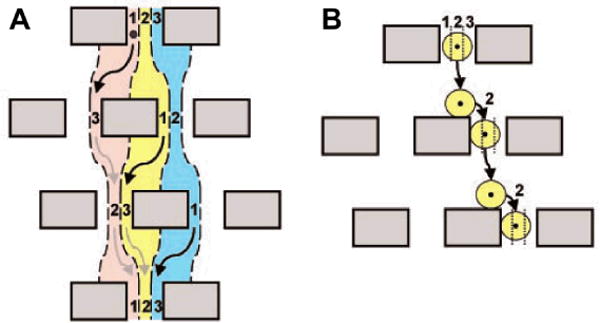
The principle of deterministic lateral displacement (DLD). (A) Three fluid streams (represented by red, yellow, and blue) enter the three lanes (represented by 1, 2, and 3, from left to right, respectively) at the first obstacle row. Small particles will follow the streamlines and fall repeatedly into the same lane. (B) Big particles travel laterally as they enter the next row of obstacles. Image reproduced with permission from ref. .
Fig. 4
Fig. 4
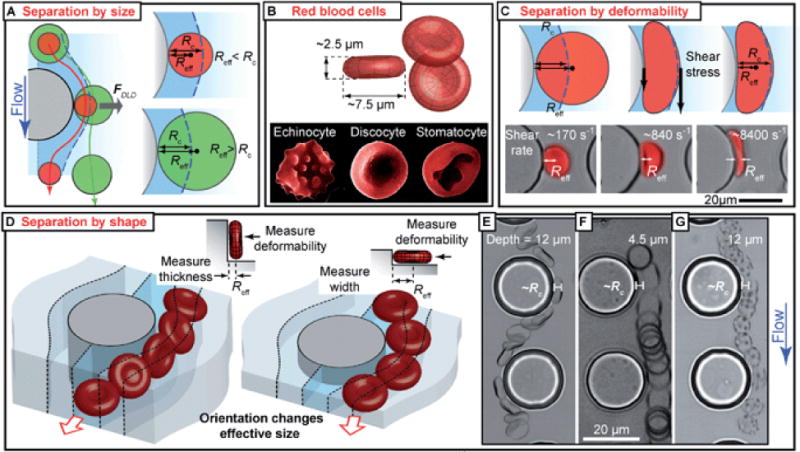
DLD-based separation by cell shape and deformability. (A) DLD separation based on effective cell diameter. (B) Different forms of RBCs in normal and abnormal states. (C) Shear-induced deformation of RBCs affects effective cell diameter. (D) Orientation affects effective cell diameter. (E, F, G) Channel depth affects RBC orientation, hence effective cell diameter and cell trajectory in a DLD device.

References

    1. Suresh S, Spatz J, Mills JP, Micoulet A, Dao M, Lim CT, Beil M, Seufferlein T. Acta Biomaterialia. 2005;1:15–30. - PubMed
    1. Mao X, Nawaz AA, Lin S-CS, Lapsley MI, Zhao Y, McCoy JP, El-Deiry WS, Huang TJ. Biomicrofluidics. 2012;6:024113. - PMC - PubMed
    1. Mills JP, Diez-Silva M, Quinn DJ, Dao M, Lang MJ, Tan KSW, Lim CT, Milon G, David PH, Mercereau-Puijalon O, Bonnefoy S, Suresh S. Proc Nat Acad Sci. 2007;104:9213–9217. - PMC - PubMed
    1. Shi J, Ahmed D, Mao X, Lin S-CS, Lawit A, Huang TJ. Lab on a Chip. 2009;9:2890–2895. - PubMed
    1. Moraes C, Sun Y, Simmons CA. Integrative Biology. 2011;3:959–971. - PubMed

Publication types