


Role of magnetic resonance imaging, cerebrospinal fluid, and electroencephalogram in diagnosis of sporadic Creutzfeldt-Jakob disease
- PMID: 22968768
- PMCID: PMC3651672
- DOI: 10.1007/s00415-012-6664-6
Role of magnetic resonance imaging, cerebrospinal fluid, and electroencephalogram in diagnosis of sporadic Creutzfeldt-Jakob disease
Abstract
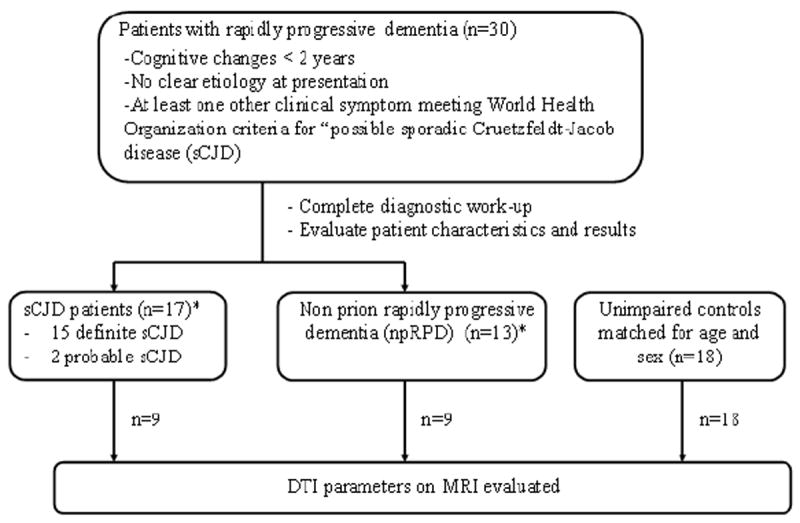
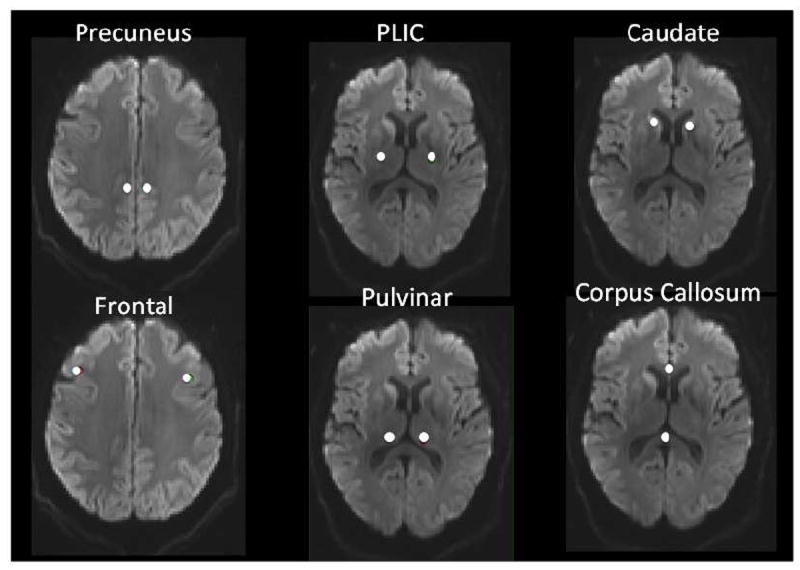
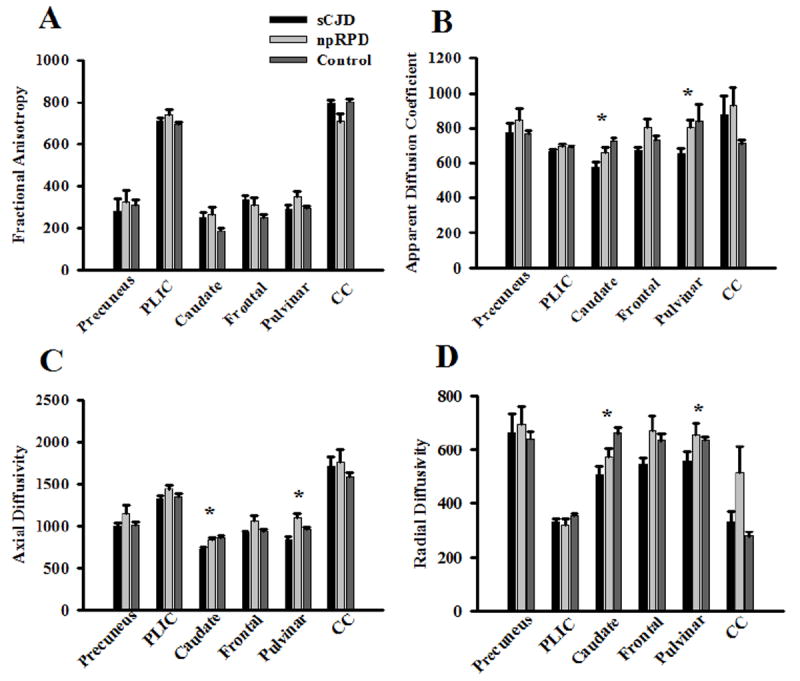
Sporadic Creutzfeldt-Jakob disease (sCJD) is a rapidly progressive dementia (RPD) that can be difficult to identify antemortem, with definitive diagnosis requiring tissue confirmation. We describe the clinical, magnetic resonance imaging (MRI), cerebrospinal fluid (CSF), and electroencephalogram (EEG) measures of a small cohort of 30 patients evaluated for RPD. Clinical and diagnostic measures were cross-sectionally obtained from 17 sCJD patients (15 definite, two probable), 13 non-prion rapidly progressive dementia patients (npRPD), and 18 unimpaired controls. In a subset of patients (nine sCJD and nine npRPD) diffusion tensor imaging (DTI) measures [fractional anisotropy (FA), mean diffusivity (MD), axial diffusivity (AD), and radial diffusivity (RD)] were also obtained for the caudate, corpus callosum, posterior limb of the internal capsule, pulvinar, precuneus, and frontal lobe. Differences among groups were assessed by an analysis of variance. Compared to npRPD individuals, sCJD patients had cerebellar dysfunction, significantly higher CSF tau, "positive" CSF 14-3-3, and hyperintensities on diffusion-weighted imaging (DWI) that met previously established imaging criteria for sCJD. EEG changes were similar for the two groups. In addition, sCJD patients had significant decreases in DTI measures (MD, AD, RD but not FA) within the caudate and pulvinar compared to either npRPD patients or unimpaired controls. Our results confirm that CSF abnormalities and MRI (especially DWI) can assist in distinguishing sCJD patients from npRPD patients. Future longitudinal studies using multiple measures (including CSF and MRI) are needed for evaluating pathological changes seen in sCJD patients.
Figures
References
-
- Parchi P, Giese A, Capellari S, Brown P, Schulz-Schaeffer W, Windl O, Zerr I, Budka H, Kopp N, Piccardo P, Poser S, Rojiani A, Streichemberger N, Julien J, Vital C, Ghetti B, Gambetti P, Kretzschmar H. Classification of sporadic Creutzfeldt-Jakob disease based on molecular and phenotypic analysis of 300 subjects. Ann Neurol. 1999;46(2):224–233. - PubMed
-
- Kovacs GG, Puopolo M, Ladogana A, Pocchiari M, Budka H, van Duijn C, Collins SJ, Boyd A, Giulivi A, Coulthart M, Delasnerie-Laupretre N, Brandel JP, Zerr I, Kretzschmar HA, de Pedro-Cuesta J, Calero-Lara M, Glatzel M, Aguzzi A, Bishop M, Knight R, Belay G, Will R, Mitrova E. Genetic prion disease: the EUROCJD experience. Human genetics. 2005;118(2):166–174. - PubMed
-
- World OH. Global surveillance, diagnosis and therapy of human transmissible spongiform encephalopathies: report of a WHO consultation. September 1, 2010 1998
-
- Collins SJ, Sanchez-Juan P, Masters CL, Klug GM, van Duijn C, Poleggi A, Pocchiari M, Almonti S, Cuadrado-Corrales N, de Pedro-Cuesta J, Budka H, Gelpi E, Glatzel M, Tolnay M, Hewer E, Zerr I, Heinemann U, Kretszchmar HA, Jansen GH, Olsen E, Mitrova E, Alperovitch A, Brandel JP, Mackenzie J, Murray K, Will RG. Determinants of diagnostic investigation sensitivities across the clinical spectrum of sporadic Creutzfeldt-Jakob disease. Brain. 2006;129(Pt 9):2278–2287. - PubMed
Publication types
MeSH terms
Grants and funding
LinkOut - more resources
Full Text Sources
Medical
Miscellaneous
