


Meeting people's needs in a fully interoperable domotic environment
- PMID: 22969322
- PMCID: PMC3435952
- DOI: 10.3390/s120606802
Meeting people's needs in a fully interoperable domotic environment
Abstract
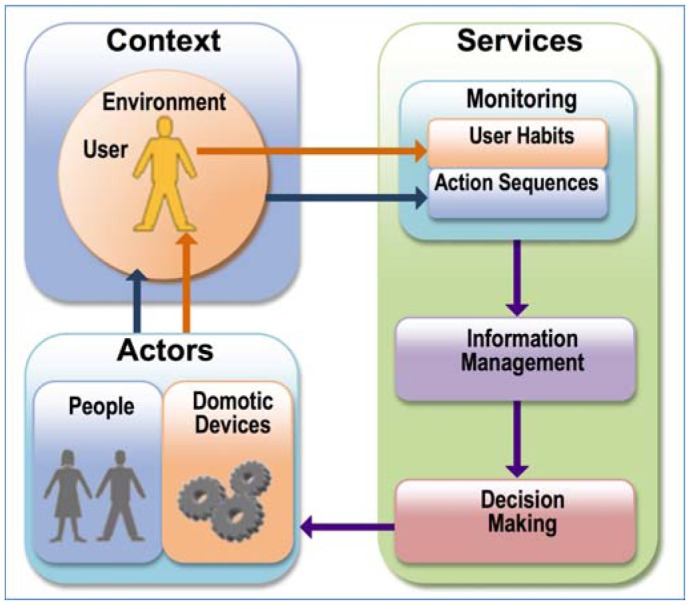
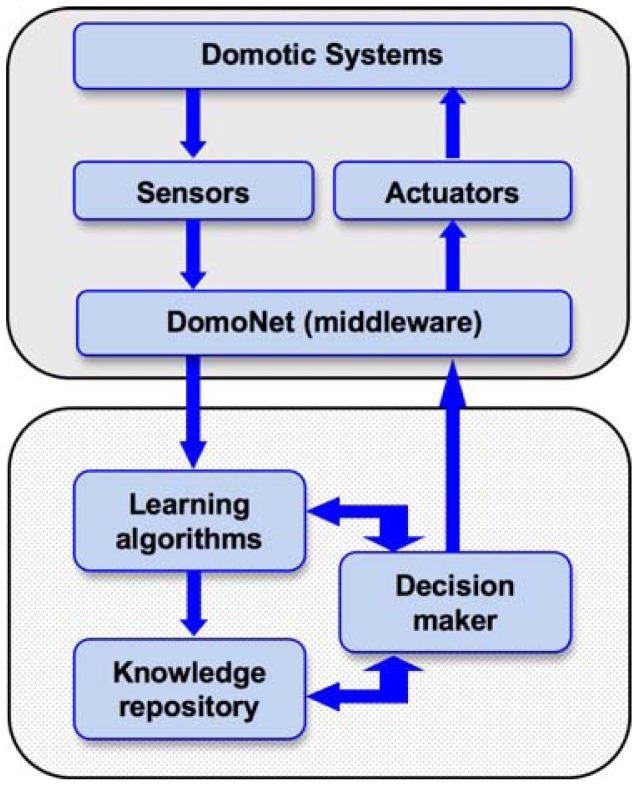
The key idea underlying many Ambient Intelligence (AmI) projects and applications is context awareness, which is based mainly on their capacity to identify users and their locations. The actual computing capacity should remain in the background, in the periphery of our awareness, and should only move to the center if and when necessary. Computing thus becomes 'invisible', as it is embedded in the environment and everyday objects. The research project described herein aims to realize an Ambient Intelligence-based environment able to improve users' quality of life by learning their habits and anticipating their needs. This environment is part of an adaptive, context-aware framework designed to make today's incompatible heterogeneous domotic systems fully interoperable, not only for connecting sensors and actuators, but for providing comprehensive connections of devices to users. The solution is a middleware architecture based on open and widely recognized standards capable of abstracting the peculiarities of underlying heterogeneous technologies and enabling them to co-exist and interwork, without however eliminating their differences. At the highest level of this infrastructure, the Ambient Intelligence framework, integrated with the domotic sensors, can enable the system to recognize any unusual or dangerous situations and anticipate health problems or special user needs in a technological living environment, such as a house or a public space.
Keywords: Ambient Intelligent; DomoNet; XML; association rules; data mining; domotics; home environment; interoperability; machine learning; web services.
Figures

References
-
- Weiser M. The computer for the twenty-first century. Sci. Am. 1991;3:94–104.
-
- José R., Rodrigues H., Otero N. Ambient intelligence: Beyond the inspiring vision. J. Univ. Comput. Sci. 2010;16:1480–1499.
-
- Isern D., Sánchez D., Moreno A. Agents applied in health care: A review. Int. J. Med. Inf. 2010;75:145–166. - PubMed
-
- Ali R., Abdel-Naby S., Mana A., Munoz A., Giorgini P. Agent Oriented AmI Engineering. Springer; Paris, France: 2008.
-
- Scholten H., van Dijk H., De Cock D., Preneel B., D'Hooge M., Kung A. Secure Service Discovery in Home Networks. Proceedings of International Conference on Consumer Electronics; Las Vegas, NV, USA. 8–12 January 2006; pp. 115–116.
MeSH terms
LinkOut - more resources
Full Text Sources
Other Literature Sources
