


Predictive significance of the proportion of ER-positive or PgR-positive tumor cells in response to neoadjuvant chemotherapy for operable HER2-negative breast cancer
- PMID: 22969846
- PMCID: PMC3438790
- DOI: 10.3892/etm.2011.359
Predictive significance of the proportion of ER-positive or PgR-positive tumor cells in response to neoadjuvant chemotherapy for operable HER2-negative breast cancer
Abstract
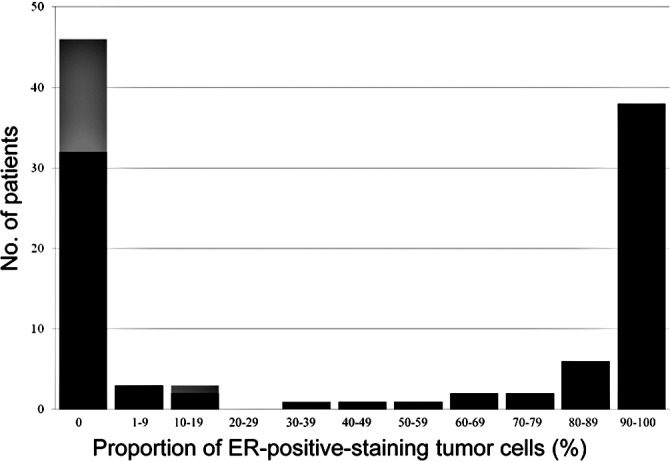
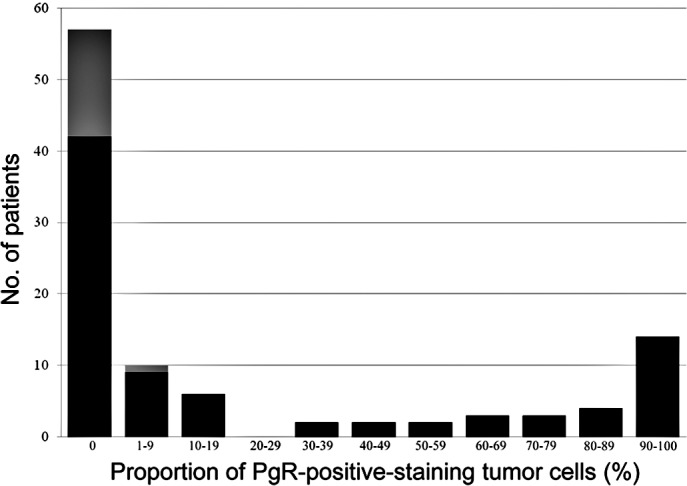
Estrogen receptor (ER) and progesterone receptor (PgR) status are predictive factors for the clinical and pathological response to neoadjuvant chemotherapy for operable breast cancer. However, it remains unclear as to how the proportion of ER-positive or PgR-positive tumor cells affects the response to neoadjuvant chemotherapy. We examined the correlation of the proportion of ER-positive or PgR-positive tumor cells with the clinical and pathological response to neoadjuvant chemotherapy for operable human epidermal growth factor receptor 2 (HER2)-negative breast cancer. From April 2002 to October 2010, 103 patients received neoadjuvant chemotherapy containing epirubicin and taxane in our clinic. A clinical response was observed in 86 (83%) patients, and a pathological complete response (pCR) was observed in 16 (16%) patients. Fourteen (30%) of 46 patients with ER-negative tumors achieved pCR and 15 (26%) of 57 patients with PgR-negative tumors achieved pCR. Patients with more than 30% ER-positive tumor cells or more than 1% PgR-positive tumor cells did not achieve pCR. No significant correlation was observed between pCR and the menopausal status, tumor size, grade and Ki-67 expression. In univariate analysis, pCR was associated with the ER status (p=0.001), PgR status (p=0.0001) and chemotherapy regimens (p=0.03). Multivariate analysis revealed that ER and PgR status were significant factors for pCR, and patients with ER-negative tumors were 18.6 times more likely to achieve pCR than those with greater than or equal to 30% ER-positive tumor cells (p=0.006; 95% confidence interval 2.3-149.9). We demonstrated a predictive significance of the proportion of ER-positive or PgR-positive tumor cells in the response to neoadjuvant chemotherapy for operable HER2-negative breast cancer. ER-negativity (<1%) was a significant predictive factor for achieving pCR in multivariate analysis. Conversely, patients with more than 30% ER-positive tumor cells or more than 1% PgR-positive tumor cells may not achieve pCR.
Figures
References
-
- Van der Hage JA, van de Velde CJ, Julien JP, Tubiana-Hulin M, Vandervelden C, Duchateau L. Preoperative chemotherapy in primary operable breast cancer: results from the European Organization for Research and Treatment of Cancer trial 10902. J Clin Oncol. 2001;19:4224–4237. - PubMed
-
- Bear HD, Anderson S, Brown A, et al. The effect on tumor response of adding sequential preoperative docetaxel to preoperative doxorubicin and cyclophosphamide: preliminary results from the National Surgical Adjuvant Breast and Bowel Project Protocol B-27. J Clin Oncol. 2003;21:4165–4174. - PubMed
-
- Fisher B, Bryant J, Wolmark N, et al. Effect of preoperative chemotherapy on the outcome of women with operable breast cancer. J Clin Oncol. 1998;16:2672–2685. - PubMed
-
- Makris A, Powles TJ, Ashley SE, et al. A reduction in the requirements for mastectomy in a randomized trial of neoadjuvant chemoendocrine therapy in primary breast cancer. Ann Oncol. 1998;9:1179–1184. - PubMed
-
- Mauriac L, MacGrogan G, Avril A, et al. Neoadjuvant chemotherapy for operable breast carcinoma larger than 3 cm: a unicentre randomized trial with a 124-month median follow-up. Institut Bergonie Bordeaux Groupe Sein (IBBGS) Ann Oncol. 1999;10:47–52. - PubMed
LinkOut - more resources
Full Text Sources
Research Materials
Miscellaneous