


T cell activation markers and African mitochondrial DNA haplogroups among non-Hispanic black participants in AIDS clinical trials group study 384
- PMID: 22970105
- PMCID: PMC3433792
- DOI: 10.1371/journal.pone.0043803
T cell activation markers and African mitochondrial DNA haplogroups among non-Hispanic black participants in AIDS clinical trials group study 384
Abstract
Introduction: Mitochondrial function influences T cell dynamics and is affected by mitochondrial DNA (mtDNA) variation. We previously reported an association between African mtDNA haplogroup L2 and less robust CD4 cell recovery on antiretroviral therapy (ART) in non-Hispanic black ACTG 384 subjects. We explored whether additional T cell parameters in this cohort differed by mtDNA haplogroup.
Methods: ACTG 384 randomized ART-naïve subjects to two different nucleoside regimens with efavirenz, nelfinavir, or both. CD4 and CD8 memory and activation markers were available at baseline and week 48 on most subjects. mtDNA sequencing was performed on whole blood DNA, and haplogroups were determined. We studied non-Hispanic black subjects with HIV RNA <400 copies/mL at week 48. Analyses included Wilcoxon ranksum test and linear regression.
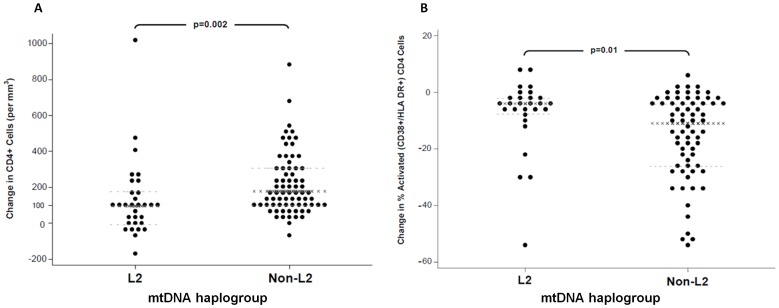
Results: Data from 104 subjects were included. Major African mtDNA haplogroups included L1 (N=25), L2 (N=31), and L3 (N=32). Baseline age, HIV RNA, and CD4 cells did not differ between L2 and non-L2 haplogroups. Compared to non-L2 haplogroups, L2 subjects had lower baseline activated CD4 cells (median 12% vs. 17%; p=0.03) and tended toward lower activated CD8 cells (41% vs. 47%; p=0.06). At 48 weeks of ART, L2 subjects had smaller decreases in activated CD4 cells (-4% vs. -11%; p=0.01), and smaller CD4 cell increases (+95 vs. +178; p=0.002). In models adjusting for baseline age, CD4 cells, HIV RNA, and naïve-to-memory CD4 cell ratio, haplogroup L2 was associated with lower baseline (p=0.04) and 48-week change in (p=0.01) activated CD4 cells.
Conclusions: Among ART-naïve non-Hispanic blacks, mtDNA haplogroup L2 was associated with baseline and 48-week change in T cell activation, and poorer CD4 cell recovery. These data suggest mtDNA variation may influence CD4 T cell dynamics by modulating T cell activation. Further study is needed to replicate these associations and identify mechanisms.
Conflict of interest statement
Figures
References
-
- Gazzola L, Tincati C, Bellistri GM, Monforte A, Marchetti G (2009) The absence of CD4+ T cell count recovery despite receipt of virologically suppressive highly active antiretroviral therapy: clinical risk, immunological gaps, and therapeutic options. Clin Infect Dis 48: 328–337. - PubMed
-
- Grabar S, Le Moing V, Goujard C, Leport C, Kazatchkine MD, et al. (2000) Clinical outcome of patients with HIV-1 infection according to immunologic and virologic response after 6 months of highly active antiretroviral therapy. Ann Intern Med 133: 401–410. - PubMed
-
- Rigato PO, Hong MA, Casseb J, Ueda M, de Castro I, et al. (2008) Better CD4+ T cell recovery in Brazilian HIV-infected individuals under HAART due to cumulative carriage of SDF-1–3′A, CCR2-V64I, CCR5-D32 and CCR5-promoter 59029A/G polymorphisms. Curr HIV Res 6: 466–473. - PubMed
Publication types
MeSH terms
Substances
Grants and funding
- T32 GM080178/GM/NIGMS NIH HHS/United States
- AI069452/AI/NIAID NIH HHS/United States
- UM1 AI069556/AI/NIAID NIH HHS/United States
- U01 AI069511/AI/NIAID NIH HHS/United States
- AI069450/AI/NIAID NIH HHS/United States
- U01 AI069477/AI/NIAID NIH HHS/United States
- U01 AI069419/AI/NIAID NIH HHS/United States
- U01 AI069502/AI/NIAID NIH HHS/United States
- U01 AI069513/AI/NIAID NIH HHS/United States
- AI69467/AI/NIAID NIH HHS/United States
- UM1 AI069423/AI/NIAID NIH HHS/United States
- AI069415/AI/NIAID NIH HHS/United States
- U01 AI069474/AI/NIAID NIH HHS/United States
- U01 AI069434/AI/NIAID NIH HHS/United States
- AI069556/AI/NIAID NIH HHS/United States
- UM1 AI069501/AI/NIAID NIH HHS/United States
- UM1 AI069472/AI/NIAID NIH HHS/United States
- U01 AI069467/AI/NIAID NIH HHS/United States
- U01 AI069423/AI/NIAID NIH HHS/United States
- UM1 AI069513/AI/NIAID NIH HHS/United States
- UL1 TR000445/TR/NCATS NIH HHS/United States
- AI069465/AI/NIAID NIH HHS/United States
- AI069419/AI/NIAID NIH HHS/United States
- AI069511/AI/NIAID NIH HHS/United States
- AI46370/AI/NIAID NIH HHS/United States
- AI077505/AI/NIAID NIH HHS/United States
- U01 AI027661/AI/NIAID NIH HHS/United States
- UM1 AI069424/AI/NIAID NIH HHS/United States
- R01 AI077505/AI/NIAID NIH HHS/United States
- U01 AI069465/AI/NIAID NIH HHS/United States
- K01 AI062435/AI/NIAID NIH HHS/United States
- UM1 AI069434/AI/NIAID NIH HHS/United States
- UM1 AI069432/AI/NIAID NIH HHS/United States
- AI069501/AI/NIAID NIH HHS/United States
- P30 AI054999/AI/NIAID NIH HHS/United States
- AI069532/AI/NIAID NIH HHS/United States
- AI069474/AI/NIAID NIH HHS/United States
- AI069434/AI/NIAID NIH HHS/United States
- UM1 AI069495/AI/NIAID NIH HHS/United States
- AI38858/AI/NIAID NIH HHS/United States
- U01 AI069484/AI/NIAID NIH HHS/United States
- UM1 AI069471/AI/NIAID NIH HHS/United States
- U01 AI069556/AI/NIAID NIH HHS/United States
- UM1 AI069428/AI/NIAID NIH HHS/United States
- AI069513/AI/NIAID NIH HHS/United States
- AI069502/AI/NIAID NIH HHS/United States
- U01 AI069532/AI/NIAID NIH HHS/United States
- AI069423/AI/NIAID NIH HHS/United States
- U01 AI069428/AI/NIAID NIH HHS/United States
- R21 NS059330/NS/NINDS NIH HHS/United States
- R21 HL087726/HL/NHLBI NIH HHS/United States
- UM1 AI069415/AI/NIAID NIH HHS/United States
- AI27661/AI/NIAID NIH HHS/United States
- UM1 AI069484/AI/NIAID NIH HHS/United States
- AI069428/AI/NIAID NIH HHS/United States
- AI34853/AI/NIAID NIH HHS/United States
- U01 AI069501/AI/NIAID NIH HHS/United States
- AI069495/AI/NIAID NIH HHS/United States
- UM1 AI069477/AI/NIAID NIH HHS/United States
- U01 AI069432/AI/NIAID NIH HHS/United States
- AI069484/AI/NIAID NIH HHS/United States
- U01 AI069450/AI/NIAID NIH HHS/United States
- AI54999/AI/NIAID NIH HHS/United States
- U01 AI038858/AI/NIAID NIH HHS/United States
- U01 AI046370/AI/NIAID NIH HHS/United States
- U01 AI068636/AI/NIAID NIH HHS/United States
- U01 AI034853/AI/NIAID NIH HHS/United States
- UM1 AI069474/AI/NIAID NIH HHS/United States
- NS059330/NS/NINDS NIH HHS/United States
- UM1 AI069452/AI/NIAID NIH HHS/United States
- AI069424/AI/NIAID NIH HHS/United States
- U01 AI069415/AI/NIAID NIH HHS/United States
- AI062435/AI/NIAID NIH HHS/United States
- HL087726/HL/NHLBI NIH HHS/United States
- U01 AI069495/AI/NIAID NIH HHS/United States
- UM1 AI069502/AI/NIAID NIH HHS/United States
- U01 AI025859/AI/NIAID NIH HHS/United States
- UM1 AI069450/AI/NIAID NIH HHS/United States
- AI34835/AI/NIAID NIH HHS/United States
- UM1 AI069532/AI/NIAID NIH HHS/United States
- U01 AI069424/AI/NIAID NIH HHS/United States
- UM1 AI069465/AI/NIAID NIH HHS/United States
- AL32782/PHS HHS/United States
- 5T32GM80178/GM/NIGMS NIH HHS/United States
- AI069472/AI/NIAID NIH HHS/United States
- UM1 AI069419/AI/NIAID NIH HHS/United States
- AI069432/AI/NIAID NIH HHS/United States
- AI25859/AI/NIAID NIH HHS/United States
- UM1 AI069511/AI/NIAID NIH HHS/United States
- U01AI068636/AI/NIAID NIH HHS/United States
- U01 AI069452/AI/NIAID NIH HHS/United States
- UM1 AI069467/AI/NIAID NIH HHS/United States
- AI38844/AI/NIAID NIH HHS/United States
- AI069477/AI/NIAID NIH HHS/United States
- AI069471/AI/NIAID NIH HHS/United States
- U01 AI069471/AI/NIAID NIH HHS/United States
- U01 AI069472/AI/NIAID NIH HHS/United States
- AI69495/AI/NIAID NIH HHS/United States
LinkOut - more resources
Full Text Sources
Research Materials
