


Oxygen and hydrogen peroxide in the early evolution of life on earth: in silico comparative analysis of biochemical pathways
- PMID: 22970865
- PMCID: PMC3440028
- DOI: 10.1089/ast.2011.0704
Oxygen and hydrogen peroxide in the early evolution of life on earth: in silico comparative analysis of biochemical pathways
Abstract
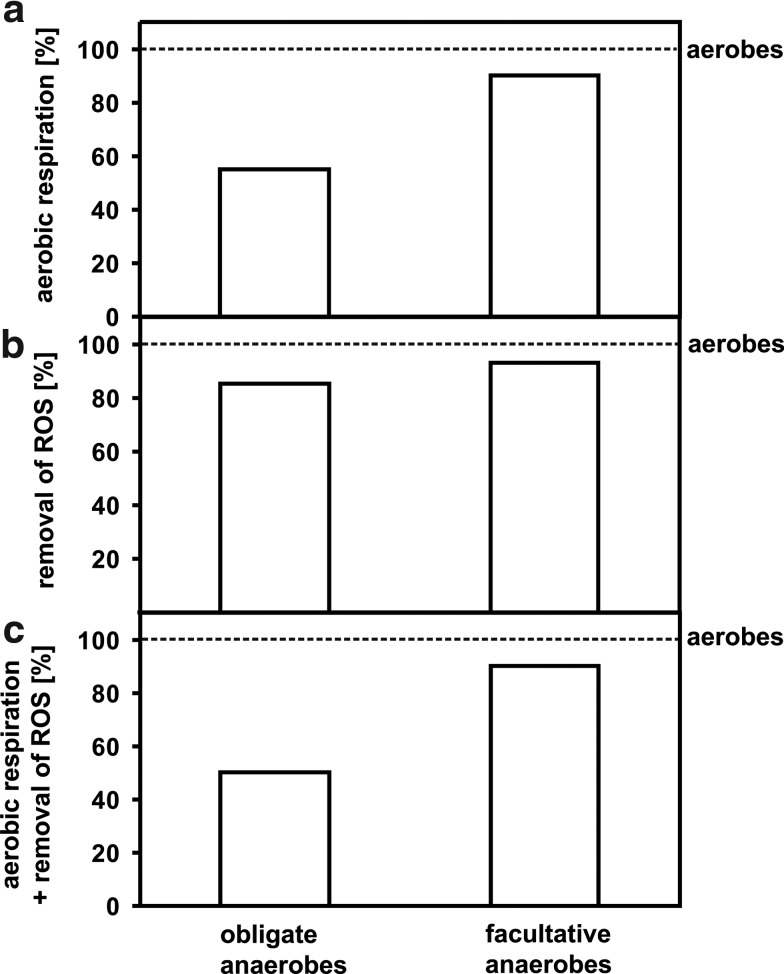
In the Universe, oxygen is the third most widespread element, while on Earth it is the most abundant one. Moreover, oxygen is a major constituent of all biopolymers fundamental to living organisms. Besides O(2), reactive oxygen species (ROS), among them hydrogen peroxide (H(2)O(2)), are also important reactants in the present aerobic metabolism. According to a widely accepted hypothesis, aerobic metabolism and many other reactions/pathways involving O(2) appeared after the evolution of oxygenic photosynthesis. In this study, the hypothesis was formulated that the Last Universal Common Ancestor (LUCA) was at least able to tolerate O(2) and detoxify ROS in a primordial environment. A comparative analysis was carried out of a number of the O(2)-and H(2)O(2)-involving metabolic reactions that occur in strict anaerobes, facultative anaerobes, and aerobes. The results indicate that the most likely LUCA possessed O(2)-and H(2)O(2)-involving pathways, mainly reactions to remove ROS, and had, at least in part, the components of aerobic respiration. Based on this, the presence of a low, but significant, quantity of H(2)O(2) and O(2) should be taken into account in theoretical models of the early Archean atmosphere and oceans and the evolution of life. It is suggested that the early metabolism involving O(2)/H(2)O(2) was a key adaptation of LUCA to already existing weakly oxic zones in Earth's primordial environment.
Figures
References
-
- Alberts B. Johnson A. Lewis J. Raff M. Roberts K. Walter P. Molecular Biology of The Cell. 4th. Garland Science, Taylor & Francis Group; New York: 2002. Energy conversion: mitochondria and chloroplasts; pp. 767–829.
-
- Balk M. Bose M. Ertem G. Rogoff D.A. Rothschild L.J. Freund F.T. Oxidation of water to hydrogen peroxide at the rock-water interface due to stress-activated electric currents in rocks. Earth Planet Sci Lett. 2009;283:87–92.
-
- Blank C.E. Phylogenomic dating—a method of constraining the age of microbial taxa that lack a conventional fossil record. Astrobiology. 2009;9:173–191. - PubMed
-
- Borda M.J. Elsetinow A.R. Schooen A.R. Strongin D.R. Pyrite-induced hydrogen peroxide formation as a driving force in the evolution of photosynthetic organisms on an early Earth. Astrobiology. 2001;1:283–288. - PubMed
-
- Brioukhanov A.L. Netrusov A.I. Catalase and superoxide dismutase: distribution, properties, and physiological role in cells of strict anaerobes. Biochemistry (Moscow) 2004;69:949–962. - PubMed
Publication types
MeSH terms
Substances
LinkOut - more resources
Full Text Sources
Molecular Biology Databases
