


Socio-economic inequalities in malnutrition among children and adolescents in Colombia: the role of individual-, household- and community-level characteristics
- PMID: 22971355
- PMCID: PMC10271289
- DOI: 10.1017/S1368980012004090
Socio-economic inequalities in malnutrition among children and adolescents in Colombia: the role of individual-, household- and community-level characteristics
Abstract
Objective: To examine socio-economic inequalities in malnutrition among Colombian children and adolescents, and to assess the contribution of individual-, household- and community-level factors to those inequalities.
Design: Cross-sectional data were used from two sources: 2005 Colombian Demographic and Health Survey and 2005 Colombian census. Malnutrition outcomes included stunting and overweight. Multilevel Poisson models were used to estimate the association between individual, household and contextual characteristics and malnutrition. Changes in prevalence ratios of the poorest quintile (v. richest) were compared to assess the contribution of different characteristics to inequalities in malnutrition.
Setting: Population-based, representative of Colombia.
Subjects: Children and adolescents <18 years of age (n 30 779) from the Colombian Demographic and Health Survey.
Results: Children and adolescents living in the poorest households were close to five times more likely to be stunted, while those from the richest households were 1.3–2.8 times more likely than their poorest counterparts to be overweight. Care practices and household characteristics, particularly mother’s education, explained over one-third of socio-economic inequalities in stunting. The proportion explained by access to services was not negligible (between 6% and 14 %). Access to sanitation was significantly associated with a lower prevalence of stunting for all age groups. Between 14% and 32% of socio-economic disparities in overweight were explained by maternal and household characteristics. Mother’s overweight was positively associated with overweight of the child.
Conclusion: Socio-economic inequalities in stunting and overweight coexist among children and adolescents in Colombia. Malnutrition inequalities are largely explained by household characteristics, suggesting the need for targeted interventions.
Figures
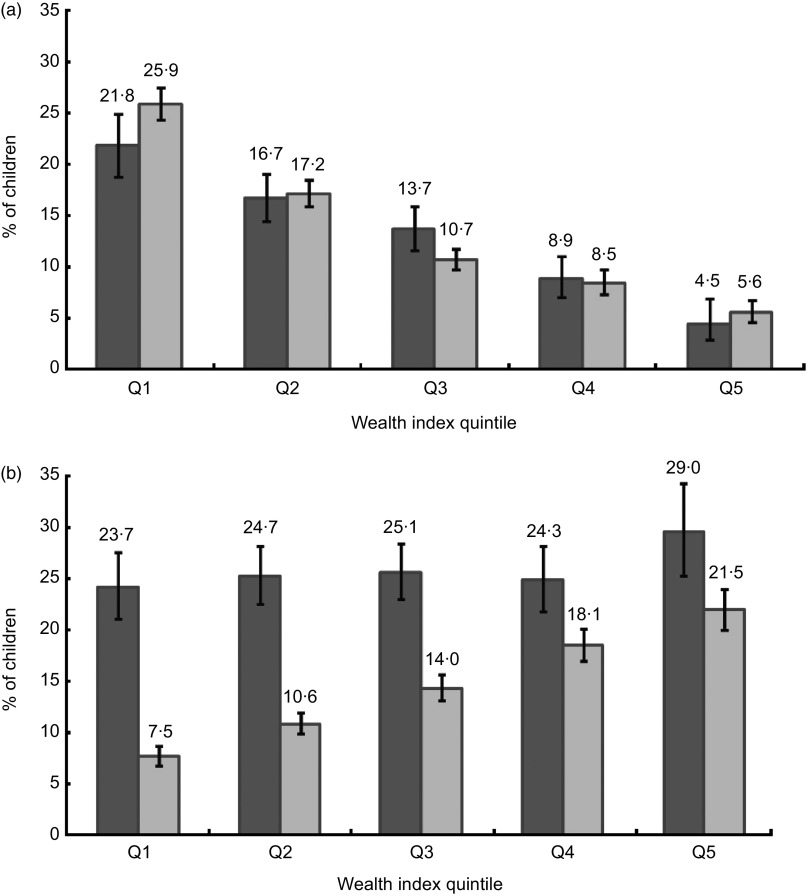
 , children <5 years of age;
  , children and adolescents aged 5–17 years), 2005 Colombian Demographic and Health Survey. Stunting = height-for-age Z-score <–2 and overweight = age- and sex-specific BMI Z-score >2 (according to 2006 WHO child growth standards for children aged <5 years(
29
) and 2007 WHO reference for children aged 5–17 years(
30
))
, children and adolescents aged 5–17 years), 2005 Colombian Demographic and Health Survey. Stunting = height-for-age Z-score <–2 and overweight = age- and sex-specific BMI Z-score >2 (according to 2006 WHO child growth standards for children aged <5 years(
29
) and 2007 WHO reference for children aged 5–17 years(
30
))References
-
- Fotso JC & Kuate-Defo B (2005) Socioeconomic inequalities in early childhood malnutrition and morbility: modification of the household-level effects by the community SES. Health Place 11, 205–225. - PubMed
-
- Menon P, Ruel MT & Morris SS (2000) Socioeconomic Differentials in Child Stunting are Consistently Larger in Urban than in Rural Areas. Food and Nutrition Discussion Paper no. 97. Washington, DC: International Food Policy Research Institute.
-
- Petrou S & Kupek E (2010) Poverty and childhood undernutrition in developing countries: a multi-national cohort study. Soc Sci Med 71, 1366–1373. - PubMed
-
- Martorell R, Kettel KL, Hughes ML et al. (2000) Overweight and obesity in preschool children from developing countries. Int J Obes Relat Metab Disord 24, 959–967. - PubMed
Publication types
MeSH terms
LinkOut - more resources
Full Text Sources
Medical
