


The Eyes Absent proteins in development and disease
- PMID: 22971774
- PMCID: PMC3568240
- DOI: 10.1007/s00018-012-1144-9
The Eyes Absent proteins in development and disease
Abstract
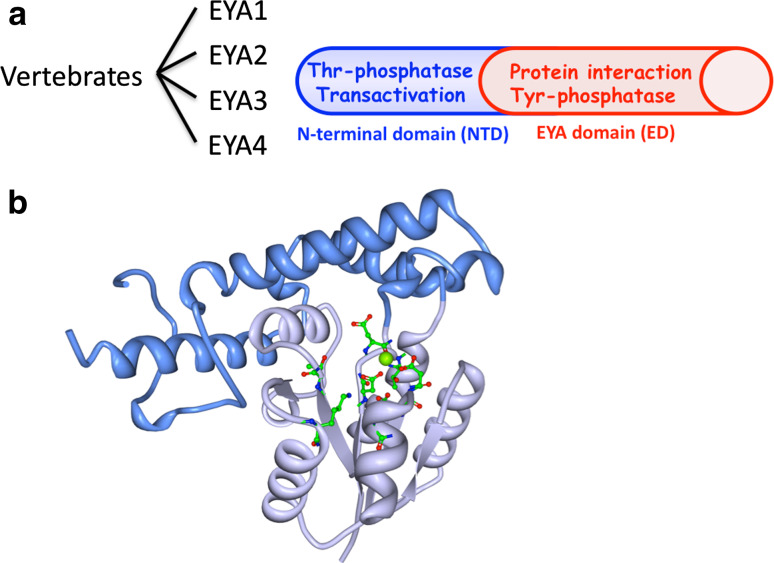
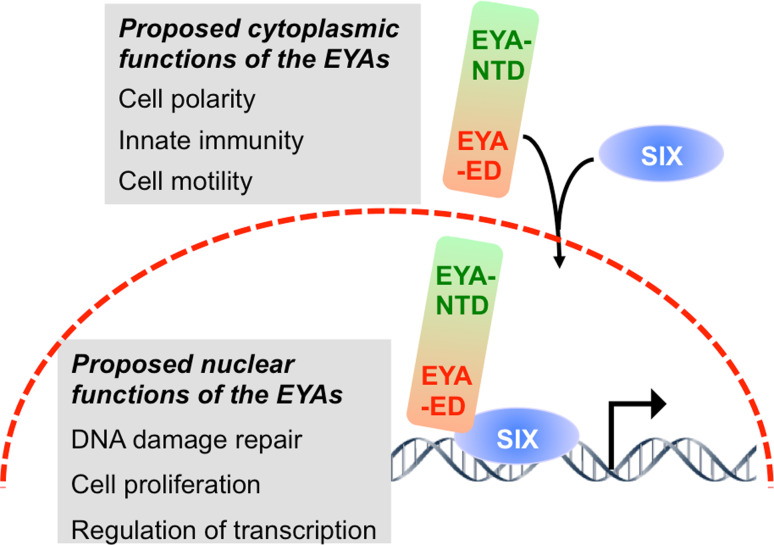
The Eyes Absent (EYA) proteins, first described in the context of fly eye development, are now implicated in processes as disparate as organ development, innate immunity, DNA damage repair, photoperiodism, angiogenesis, and cancer metastasis. These functions are associated with an unusual combination of biochemical activities: tyrosine phosphatase and threonine phosphatase activities in separate domains, and transactivation potential when associated with a DNA-binding partner. EYA mutations are linked to multiorgan developmental disorders, as well as to adult diseases ranging from dilated cardiomyopathy to late-onset sensorineural hearing loss. With the growing understanding of EYA biochemical and cellular activity, biological function, and association with disease, comes the possibility that the EYA proteins are amenable to the design of targeted therapeutics. The availability of structural information, direct links to disease states, available animal models, and the fact that they utilize unconventional reaction mechanisms that could allow specificity, suggest that EYAs are well-positioned for drug discovery efforts. This review provides a summary of EYA structure, activity, and function, as they relate to development and disease, with particular emphasis on recent findings.
Figures
References
-
- Bonini NM, Leiserson WM, Benzer S. Multiple roles of the eyes absent gene in Drosophila. Dev Biol. 1998;196(1):42–57. - PubMed
-
- Halder G, Callaerts P, Flister S, Walldorf U, Kloter U, Gehring WJ. Eyeless initiates the expression of both sine oculis and eyes absent during Drosophila compound eye development. Development. 1998;125(12):2181–2191. - PubMed
-
- Leiserson WM, Benzer S, Bonini NM. Dual functions of the Drosophila eyes absent gene in the eye and embryo. Mech Dev. 1998;73(2):193–202. - PubMed
-
- Bonini NM, Leiserson WM, Benzer S. The eyes absent gene: genetic control of cell survival and differentiation in the developing Drosophila eye. Cell. 1993;72(3):379–395. - PubMed
-
- Bonini NM, Bui QT, Gray-Board GL, Warrick JM. The Drosophila eyes absent gene directs ectopic eye formation in a pathway conserved between flies and vertebrates. Development. 1997;124(23):4819–4826. - PubMed
Publication types
MeSH terms
Substances
Grants and funding
LinkOut - more resources
Full Text Sources
Other Literature Sources
Molecular Biology Databases
