. 2012 Nov;50(11):3703-11.
doi: 10.1128/JCM.01909-12. Epub 2012 Sep 12.

Enteroaggregative Escherichia coli O78:H10, the cause of an outbreak of urinary tract infection

Affiliations

Enteroaggregative Escherichia coli O78:H10, the cause of an outbreak of urinary tract infection

Bente Olesen et al. J Clin Microbiol. 2012 Nov.

Abstract

In 1991, multiresistant Escherichia coli O78:H10 strains caused an outbreak of urinary tract infections in Copenhagen, Denmark. The phylogenetic origin, clonal background, and virulence characteristics of the outbreak isolates, and their relationship to nonoutbreak O78:H10 strains according to these traits and resistance profiles, are unknown. Accordingly, we extensively characterized 51 archived E. coli O78:H10 isolates (48 human isolates from seven countries, including 19 Copenhagen outbreak isolates, and 1 each of calf, avian, and unknown-source isolates), collected from 1956 through 2000. E. coli O78:H10 was clonally heterogeneous, comprising one dominant clonal group (61% of isolates, including all 19 outbreak isolates) from ST10 (phylogenetic group A) plus several minor clonal groups (phylogenetic groups A and D). All ST10 isolates, versus 25% of non-ST10 isolates, were identified by molecular methods as enteroaggregative E. coli (EAEC) (P < 0.001). Genes present in >90% of outbreak isolates included fimH (type 1 fimbriae; ubiquitous in E. coli); fyuA, traT, and iutA (associated with extraintestinal pathogenic E. coli [ExPEC]); and sat, pic, aatA, aggR, aggA, ORF61, aaiC, aap, and ORF3 (associated with EAEC). An outbreak isolate was lethal in a murine subcutaneous sepsis model and exhibited characteristic EAEC "stacked brick" adherence to cultured epithelial cells. Thus, the 1991 Copenhagen outbreak was caused by a tight, non-animal-associated subset within a broadly disseminated O78:H10 clonal group (ST10; phylogenetic group A), members of which exhibit both ExPEC and EAEC characteristics, whereas O78:H10 isolates overall are phylogenetically diverse. Whether ST10 O78:H10 EAEC strains are both uropathogenic and diarrheagenic warrants further investigation.


Figures
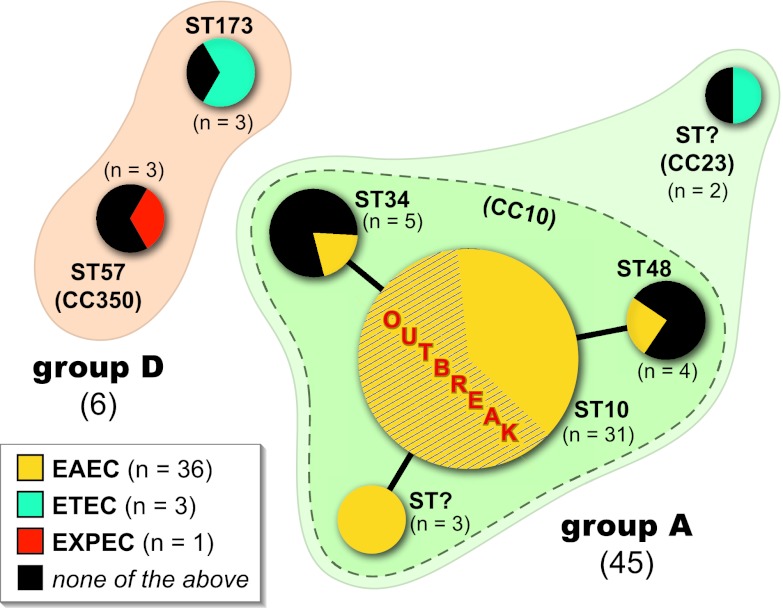
Fig 1
Fig 1
BURST diagram for 51 O78:H10 Escherichia coli isolates. Each sequence type (ST) is represented by a circle, the size of which is proportional to the number of isolates in the ST. STs belonging to the same clonal complex (CC10) are connected by solid black lines and enclosed within a medium-green-shaded zone with a dashed border. STs belonging to the same major phylogenetic group (group A or D) are enclosed within a pale-tan- or -green-shaded zone with a solid border. Different E. coli pathotypes (EAEC, enteroaggregative E. coli; ETEC, enterotoxigenic E. coli; EXPEC, extraintestinal pathogenic E. coli) are color coded within each ST circle, with the area of the circle that corresponds to coding for a particular pathotype being proportional to the number of isolates of that pathotype within the ST. The 19 Copenhagen outbreak isolates (ST10) are indicated by diagonal hash marks.
Fig 2
Fig 2
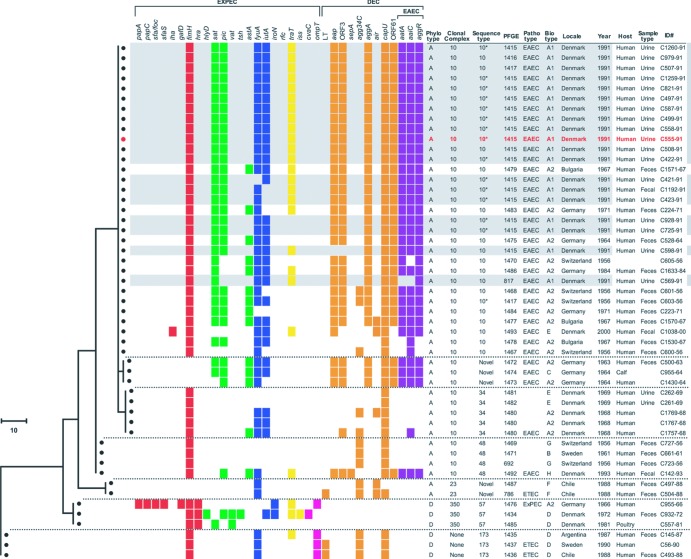
Phylogram and associated bacterial characteristics and source data among 51 isolates of Escherichia coli O78:H10. The phylogram is based on maximum-parsimony analysis of the concatenated multilocus sequence data, with sequence type (ST) ST173 used as the outgroup. The scale represents numbers of nucleotide changes. Horizontal dashed lines separate different STs. Gray shading indicates the 19 Copenhagen outbreak isolates. Red text indicates isolate C555-91, the outbreak isolate used in the adherence assay and mouse sepsis model. Colored squares, presence of virulence genes (color coded by functional category or pathotype), as defined in Table 2. Asterisks identify the presumptive ST10 isolates for which ST status was inferred based on pulsotype and sequence of fumC and adk. Pathotype abbreviations: EAEC, enteroaggregative E. coli; ETEC, enterotoxigenic E. coli; EXPEC, extraintestinal pathogenic E. coli. DEC, diarrheagenic E. coli. Phylotype, major E. coli phylogenetic group. Blank spaces for “host” and “sample type” reflect missing data. The biotypes were negative for adonitol, sorbose, salicin, inositol, and sucrose and positive for dulcitol, sorbitol, xylose, rhamnose, maltose, and lactose, except as follows: A1, rhamnose and lactose negative; A2, rhamnose negative; C, salicin and sucrose positive; D, dulcitol negative and sucrose positive; E, dulcitol negative and salicin positive; F, sorbose positive; G, dulcitol negative; and H, salicin positive.
Fig 3
Fig 3
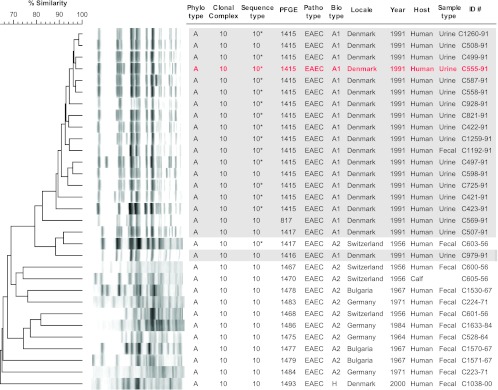
XbaI pulsed-field gel electrophoresis profiles for 31 Escherichia coli O78:H10 isolates from sequence type ST10. The tree was inferred according to the unweighted pair group method, using BioNumerics. Gray shading indicates the 19 Copenhagen outbreak isolates. Red text indicates outbreak isolate C555-91, which was used in the adherence assay and mouse sepsis model. Asterisks identify the presumptive ST10 isolates for which ST status was inferred based on pulsotype and sequence of fumC and adk. The 19 Copenhagen outbreak isolates cluster together at approximately the 79% similarity level, with a single interposed nonoutbreak isolate.

References

    1. Abe CM, et al. 2008. Uropathogenic Escherichia coli (UPEC) strains may carry virulence properties of diarrhoeagenic E. coli. FEMS Immunol. Med. Microbiol. 52:397– 406 doi: - DOI - PubMed
    1. Bert F, et al. 2010. Genetic diversity and virulence profiles of Escherichia coli isolates causing spontaneous bacterial peritonitis and bacteremia in patients with cirrhosis. J. Clin. Microbiol. 48:2709– 2714 doi: - DOI - PMC - PubMed
    1. Boisen N, et al. 2012. Genomic characterization of enteroaggregative Escherichia coli from children in Mali. J. Infect. Dis. 205:431– 444 doi: - DOI - PMC - PubMed
    1. Boisen N. 2011. Virulence characterization and epidemiology of diarrheagenic enteroaggregative Escherichia coli (EAEC). Ph.D. thesis. Faculty of Health Sciences, University of Copenhagen, Denmark:
    1. Cerna JF, Nataro JP, Estrada-Garcia T. 2003. Multiplex PCR for detection of three plasmid-borne genes of enteroaggregative Escherichia coli strains. J. Clin. Microbiol. 41:2138– 2140 - PMC - PubMed

Publication types

MeSH terms