. 2012 Oct 15;189(8):4079-87.
doi: 10.4049/jimmunol.1201061. Epub 2012 Sep 12.

Blockade of IL-10 signaling during bacillus Calmette-Guérin vaccination enhances and sustains Th1, Th17, and innate lymphoid IFN-γ and IL-17 responses and increases protection to Mycobacterium tuberculosis infection

Affiliations

Blockade of IL-10 signaling during bacillus Calmette-Guérin vaccination enhances and sustains Th1, Th17, and innate lymphoid IFN-γ and IL-17 responses and increases protection to Mycobacterium tuberculosis infection

Jonathan M Pitt et al. J Immunol. .

Abstract

Vaccination with Mycobacterium bovis bacillus Calmette-Guérin (BCG) remains the only prophylactic vaccine against tuberculosis, caused by Mycobacterium tuberculosis, but gives variable protection against pulmonary disease. The generation of host Th1 responses following BCG vaccination is accepted as the major mechanism of protection against M. tuberculosis infection. Early production of IL-17 in the lungs following M. tuberculosis challenge of mice previously vaccinated with M. tuberculosis peptides in adjuvant has been shown to be required for efficient Th1 cell recruitment. IL-10 regulates various processes involved in generation of Th1 and Th17 responses. Previous studies have shown IL-10 as a negative regulator of the immune response to primary M. tuberculosis infection, with Il10(-/-) mice having reduced lung bacterial loads. In this study we show that inhibition of IL-10 signaling during BCG vaccination enhances host-generated Ag-specific IFN-γ and IL-17A responses, and that this regimen gives significantly greater protection against aerogenic M. tuberculosis challenge in both susceptible and relatively resistant strains of mice. In M. tuberculosis-susceptible CBA/J mice, Ab blockade of IL-10R specifically during BCG vaccination resulted in additional protection against M. tuberculosis challenge of >1-log(10) compared with equivalent isotype-treated controls. The protection observed following BCG vaccination concurrent with anti-IL-10R mAb treatment was sustained through chronic M. tuberculosis infection and correlated with enhanced lung Th1 and Th17 responses and increased IFN-γ and IL-17A production by γδ T cells and an innate-like Thy1.2(+)CD3(-) lymphoid population. We show that IL-10 inhibits optimal BCG-elicited protection, therefore suggesting that antagonists of IL-10 may be of great benefit as adjuvants in preventive vaccination against tuberculosis.


Figures
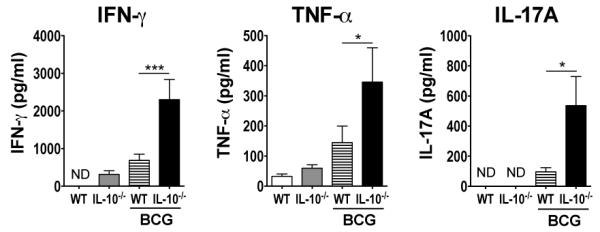
FIGURE 1
FIGURE 1
C57BL/6 Il10−/− mice have enhanced IFN-γ and IL-17 responses in the spleen after intradermal BCG vaccination. C57BL/6 or C57BL/6 Il10−/− were vaccinated with either 5 × 10⁵ CFU BCG i.d. or PBS i.d. as control. After 16 weeks, splenocytes were isolated and were restimulated with PPD as described in Materials and Methods. The level of production of IFN-γ, TNF-α, and IL-17A were measured from the supernatants of these restimulations by ELISA. ND = below the level of detection. Data shown are mean ± SEM from two combined identical experiments, totaling six mice per group. *p < 0.05, **p < 0.01, ***p < 0.001 by one-way ANOVA.
FIGURE 2
FIGURE 2
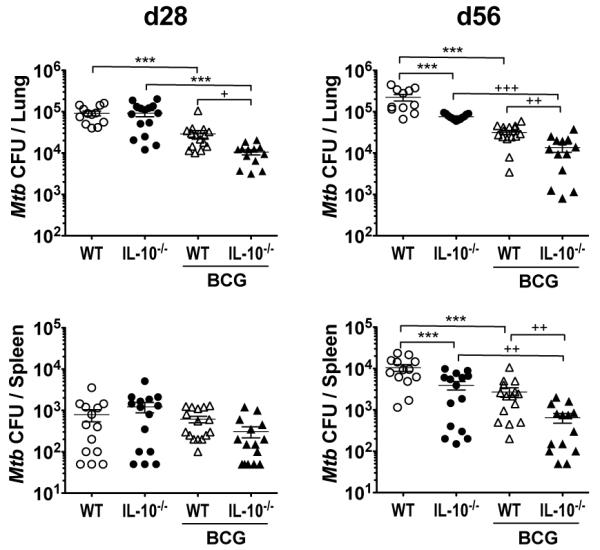
BCG-vaccinated C57BL/6 Il10−/− mice show greater protection to Mtb challenge. C57BL/6 or C57BL/6 Il10−/− mice were vaccinated with either 5 × 10⁵ CFU BCG i.d. or PBS i.d. as control. Mice were challenged by Mtb aerosol 6-weeks after vaccination, and bacterial load per lungs and spleen was determined at 28-days and 56-days post challenge. Data shown are mean ± SEM from two combined identical independent experiments (n = 5-8 per group, per experiment) totaling 12-16 per group. ***p < 0.001 by one-way ANOVA; +p < 0.05, ++p < 0.01, +++p < 0.001 by unpaired Student’s t-test.
FIGURE 3
FIGURE 3
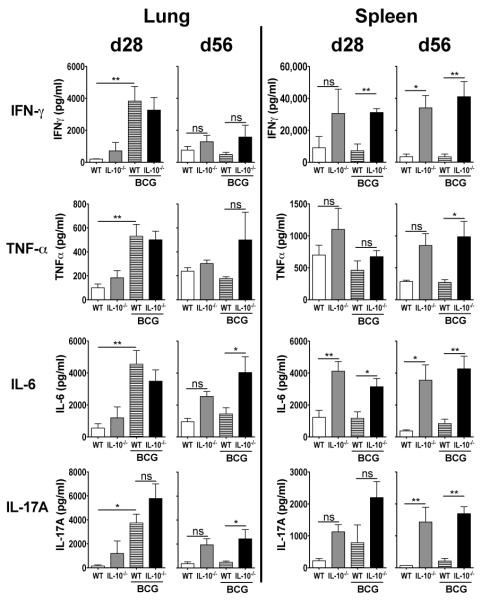
BCG-vaccinated C57BL/6 Il10−/− mice have sustained cytokine levels during Mtb challenge. C57BL/6 or C57BL/6 Il10−/− were vaccinated and Mtb-challenged as described in Fig. 2. Lung cells and splenocytes were isolated at 28- and 56-days post challenge and were restimulated with PPD as described in Materials and Methods. IFN-γ, TNF-α, IL-6, and IL-17A were measured in the supernatants of these restimulations by ELISA. Data shown are mean ± SEM from two combined identical independent experiments (n = 5-8 per group, per experiment) totaling 12-16 per group. ns = not significant. *p < 0.05, **p < 0.01, ***p < 0.001 by one-way ANOVA.
FIGURE 4
FIGURE 4
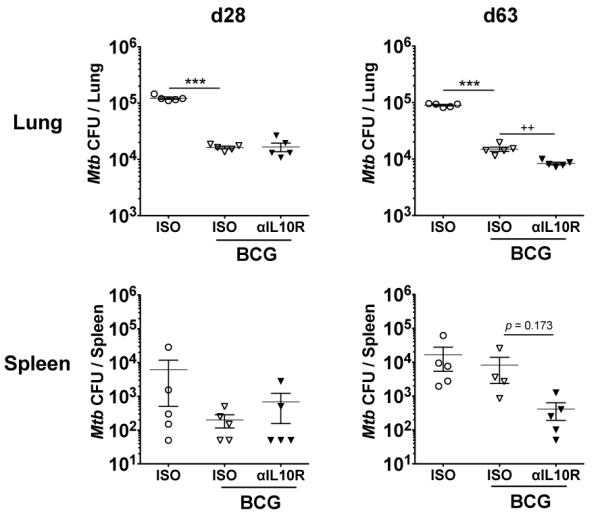
Anti-IL-10R mAb treatment during BCG vaccination increases protection against Mtb in resistant C57BL/6 mice. C57BL/6 mice were treated with 1 mg anti-IL-10R mAb or isotype control mAb i.p. and the next day vaccinated with either 5 × 10⁵ CFU BCG i.d. or PBS i.d. as control. Mice then received 0.35 mg anti-IL-10R mAb or isotype control mAb i.p. weekly following vaccination for 6-weeks. Two weeks after the final weekly mAb administration, mice were challenged by Mtb aerosol, and bacterial load per lungs and per spleen was determined at 28-days and 63-days post challenge. Data shown depict the mean ± SEM from one experiment (n = 5 per group). ***p < 0.001 by one-way ANOVA; ++p < 0.01 by unpaired Student’s t-test.
FIGURE 5
FIGURE 5
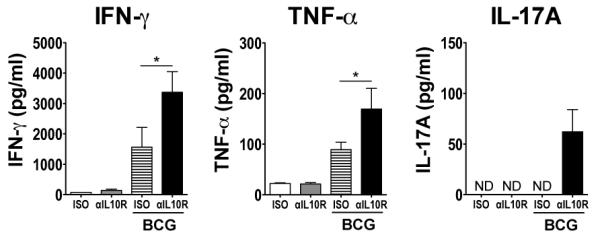
Blockade of IL-10R signaling during BCG vaccination enhances Th1- and Th17-type responses in Mtb-susceptible CBA/J mice. CBA/J mice were treated with 1 mg anti-IL-10R mAb or isotype control mAb i.p. and the next day vaccinated with either 5 × 10⁵ CFU BCG i.d. or PBS i.d. as control. Mice then received 0.35 mg anti-IL-10R mAb or isotype control mAb i.p. weekly following vaccination for 6-weeks. Seven weeks following the last mAb administration (13 weeks post BCG vaccination), splenocytes were isolated and were restimulated with PPD and anti-CD28 as described in Materials and Methods. The level of production of IFN-γ, TNF-α, and IL-17A were measured from the supernatants of these restimulations by ELISA. ND = below the level of detection. Data shown are mean ± SEM from two combined identical experiments, totaling six mice per group. *p < 0.05, **p < 0.01 by one-way ANOVA.
FIGURE 6
FIGURE 6
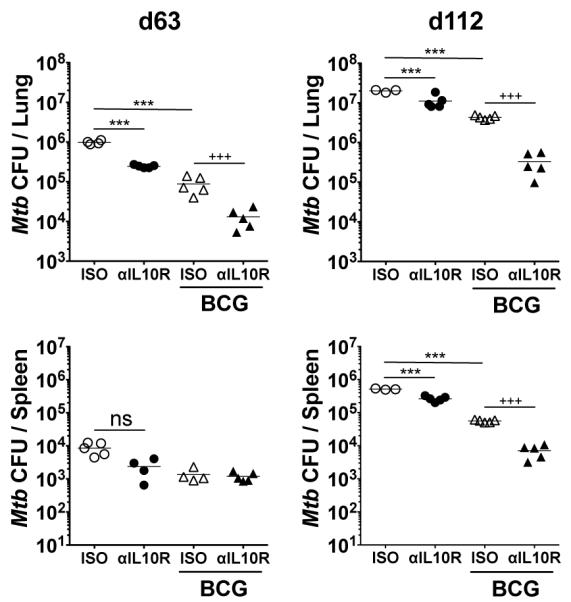
Blockade of IL-10R signaling during BCG vaccination significantly increases protection to Mtb challenge in the susceptible CBA/J strain. CBA/J mice were treated with 1 mg anti-IL-10R mAb or isotype control mAb i.p. and the next day vaccinated with either 5 × 10⁵ CFU BCG i.d. or PBS i.d. as control. Mice then received 0.35 mg anti-IL-10R mAb or isotype control mAb i.p. weekly following vaccination for 6-weeks. One week after the final weekly mAb administration, mice were challenged by Mtb aerosol, and bacterial load per lungs and per spleen was determined at 63-days and 112-days post challenge. Data shown is from one of two independent experiments (n = 5 per group) and depict the mean ± SEM. ns = not significant. ***p < 0.001 by one-way ANOVA; +++p < 0.001 by unpaired Student’s t- test.
FIGURE 7
FIGURE 7
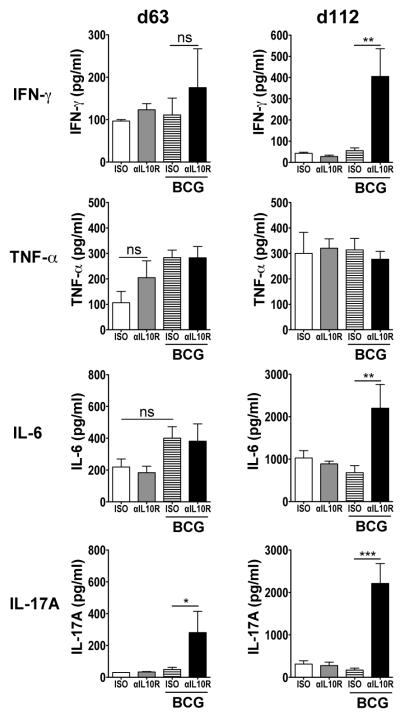
The enhanced protection in anti-IL-10R mAb-treated/BCG vaccinated CBA/J mice is accompanied by enhanced PPD-specific cytokine responses in the lung during Mtb challenge. CBA/J mice were vaccinated with either concomitant anti-IL-10R mAb or isotype control mAb, and Mtb-challenged as previously described for Fig. 6. Lung cells were isolated at 63- and 112-days post challenge and were restimulated with PPD and anti-CD28 as described in Materials and Methods. IFN-γ, TNF-α, IL-6, and IL-17A were measured in the supernatants of these restimulations by ELISA. Data shown are from one of two independent experiments (n = 5 per group) and depict the mean ± SEM. ns = not significant. *p < 0.05, **p < 0.01, ***p < 0.001 by one-way ANOVA.
FIGURE 8
FIGURE 8
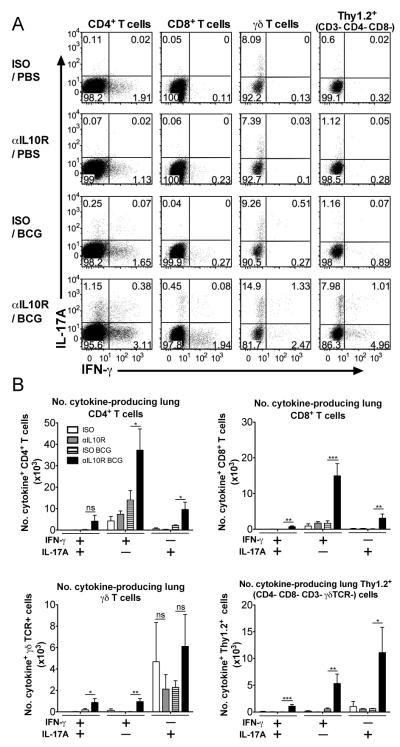
CD4+ and CD8+ T cells, and innate-like Thy1.2+CD3CD4CD8 γδTCRcells, are major sources of IFN-γ and IL-17A during Mtb challenge of BCG-vaccinated/anti-IL10R-treated CBA/J mice. CBA/J mice were BCG-vaccinated with either concomitant anti-IL-10R mAb or isotype control mAb, and Mtb-challenged as described for Fig. 6. Lung cells were isolated at 112-days post challenge and were restimulated with PPD and anti-CD28 as described in Materials and Methods, with brefeldin-A added to the culture for the last 4 h. Intracellular staining was performed to determine the percentages of IFN-γ- and IL-17A-producing lymphoid cells by flow cytometry (A), and the total numbers of cytokine-positive cells in the lung were calculated using the total cell counts acquired from each individual mouse (B). Dot plots shown are concatenated from all individuals per group (A). Data shown is from a representative experiment of two timepoints with similar results (n = 5 per group). ns = not significant. *p < 0.05, **p < 0.01, ***p < 0.001 by one-way ANOVA.

References

    1. W.H.O. Global Tuberculosis Control 2011. World Health Organisation; 2011.
    1. Dorman SE, Chaisson RE. From magic bullets back to the magic mountain: the rise of extensively drug-resistant tuberculosis. Nat Med. 2007;13:295–298. - PubMed
    1. Kaufmann SH. Future vaccination strategies against tuberculosis: thinking outside the box. Immunity. 2011;33:567–577. - PubMed
    1. Fine PE. Variation in protection by BCG: implications of and for heterologous immunity. Lancet. 1995;346:1339–1345. - PubMed
    1. Young DB, Perkins MD, Duncan K, Barry CE., 3rd Confronting the scientific obstacles to global control of tuberculosis. J Clin Invest. 2008;118:1255–1265. - PMC - PubMed

Publication types

MeSH terms