


Review
doi: 10.1186/1741-7015-10-104.
New treatments for influenza
Affiliations
- PMID: 22973873
- PMCID: PMC3523090
- DOI: 10.1186/1741-7015-10-104
Item in Clipboard
Review
New treatments for influenza
BMC Med.
.
Abstract
Influenza has a long history of causing morbidity and mortality in the human population through routine seasonal spread and global pandemics. The high mutation rate of the RNA genome of the influenza virus, combined with assortment of its multiple genomic segments, promote antigenic diversity and new subtypes, allowing the virus to evade vaccines and become resistant to antiviral drugs. There is thus a continuing need for new anti-influenza therapy using novel targets and creative strategies. In this review, we summarize prospective future therapeutic regimens based on recent molecular and genomic discoveries.
Figures
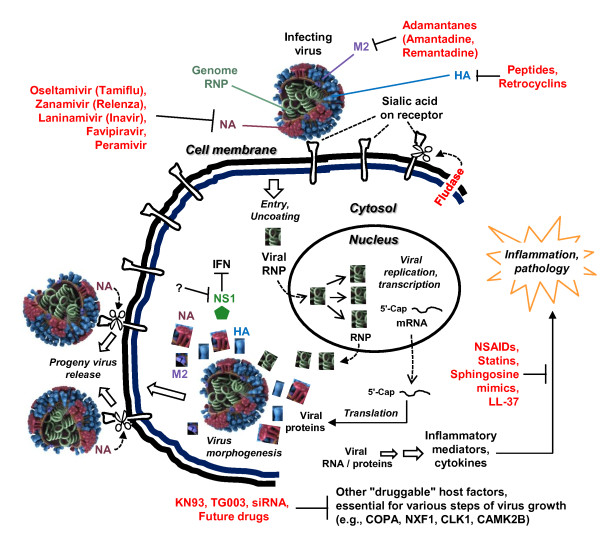
Anti-influenza drugs and their biological targets. The relevant viral proteins (color-coded) and old and new drugs targeting them are shown (not drawn to scale). The genomic ribonucleoprotein complex is shown as tightly coiled. Influenza viral RNA synthesis occurs in the infected host nucleus using this ribonucleoprotein as a template, while translation occurs in the cytoplasm. Neuraminidase (NA) and the drug candidate, Fludase, cleave the sialic acid receptor on the cell membrane, as indicated by the cutting scissors. Nonstructural proteins (only NS1 is shown) are not packaged in mature virions. Diverse viral products activate an inflammatory response that can be quelled by the use of anti-inflammatory treatments, such as non-steroidal anti-inflammatory drugs. Potential future drug regimens, targeting influenza-relevant cellular functions, are shown at the bottom. (Influenza virion image credit: Dan Higgins and Doug Jordan, CDC Public Health Photo Library, image #11822). HA: hemagglutinin; IFN: interferon; NA: neuraminidase; NS: nonstructural protein; RNP: ribonucleoprotein.
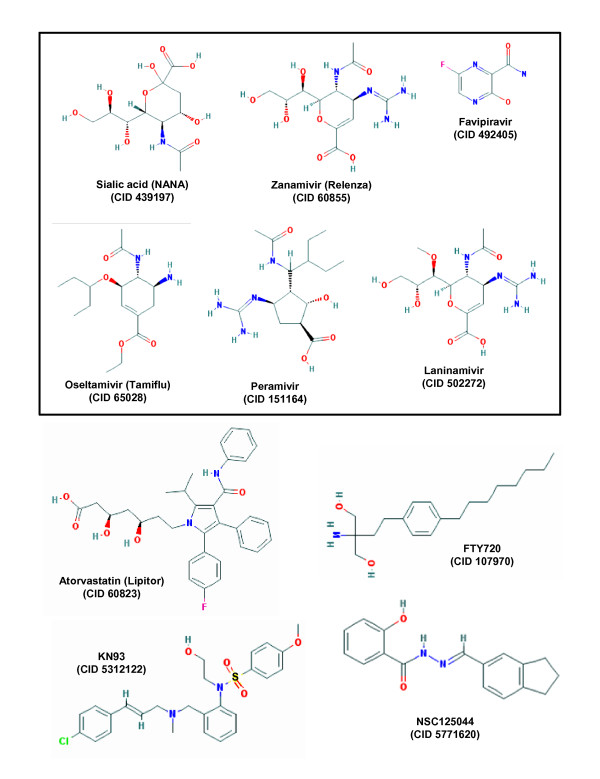
Structure of selected class-representative anti-influenza drugs, old as well as prospective ones. The neuraminidase inhibitors, and N-acetyl neuraminic acid that they mimic, are shown in the box. For all molecules, the PubChem compound numbers (CID#) are written under each name. In FTY720, one of the two -OH groups is phosphorylated to yield the bioactive phosphate derivative (not shown). The structure of AAL-4 is similar (not shown), but it has only one -OH group instead of two, which is phosphorylated much faster. M2 inhibitors are not shown for lack of space and because they are largely discontinued due to viral resistance. All structures were obtained from the free PubChem Compound Database at National Center for Biotechnology Information (accessed June 15, 2012) [44]. NANA: N-acetyl neuraminic acid.
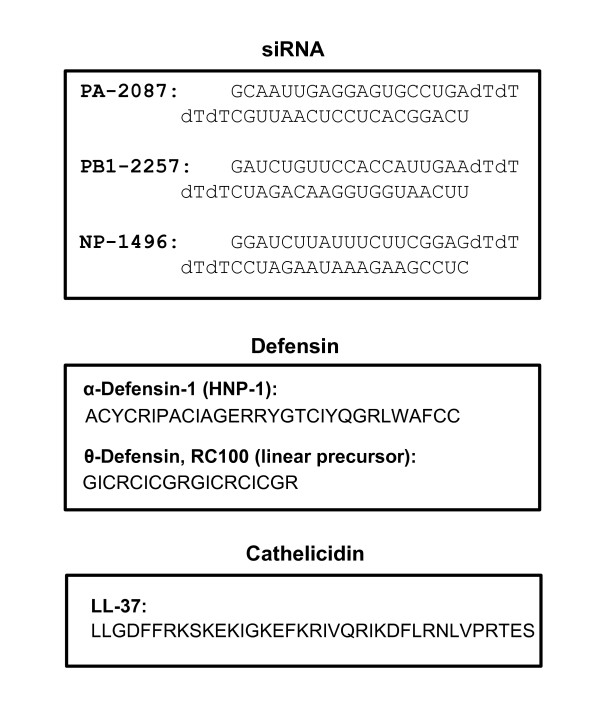
Sequences of selected anti-influenza macromolecules. Three representative classes are shown (siRNA, defensin and cathelicidin). Experimentally successful siRNA against influenza PA, PB1 and NP genes are shown in the upper box [90]. For each siRNA, the location of the sequence in the original gene is indicated by nucleotide number; thus, PA-2087 indicates an siRNA in which the first nucleotide at position 2087 of the PA gene. The upper strand is written 5′to 3′; the two deoxythymidine (dT) at the 3′-end are presumed to stabilize the siRNA [91]. The lower box shows the 37-mer peptide LL-37, written in single letter codes [92-94]. In the defensin family, note the abundance of Arg and Cys residues that are important for function [89].
References
-
- WHO. Influenza (seasonal) 2009. http://www.who.int/mediacentre/factsheets/fs211/en/
-
- Metersky ML, Masterton RG, Lode H, File TM Jr, Babinchak T. Epidemiology, microbiology, and treatment considerations for bacterial pneumonia complicating influenza. Int J Infect Dis. 2012;16:e321–331. - PubMed
-
- Palese P, Shaw ML. In: Fields Virology. 5. Knipe DM, Howley PM, editor. Philadelphia, PA: Lippincott Williams & Wilkins; 2007. Orthomyxoviridae: the viruses and their replication; pp. 1647–1689.
Publication types
MeSH terms
Substances
Grants and funding
LinkOut - more resources
Full Text Sources
Other Literature Sources
Medical
