. 2012 Oct;93(5):377-87.
doi: 10.1111/j.1365-2613.2012.00839.x.

The role of repeatedly heated soybean oil in the development of hypertension in rats: association with vascular inflammation

Affiliations

The role of repeatedly heated soybean oil in the development of hypertension in rats: association with vascular inflammation

Chun-Yi Ng et al. Int J Exp Pathol. 2012 Oct.

Abstract

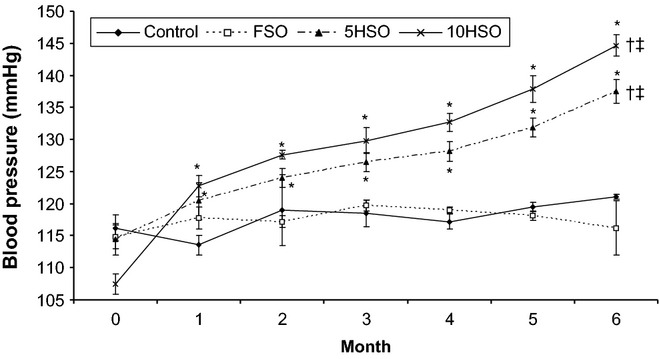
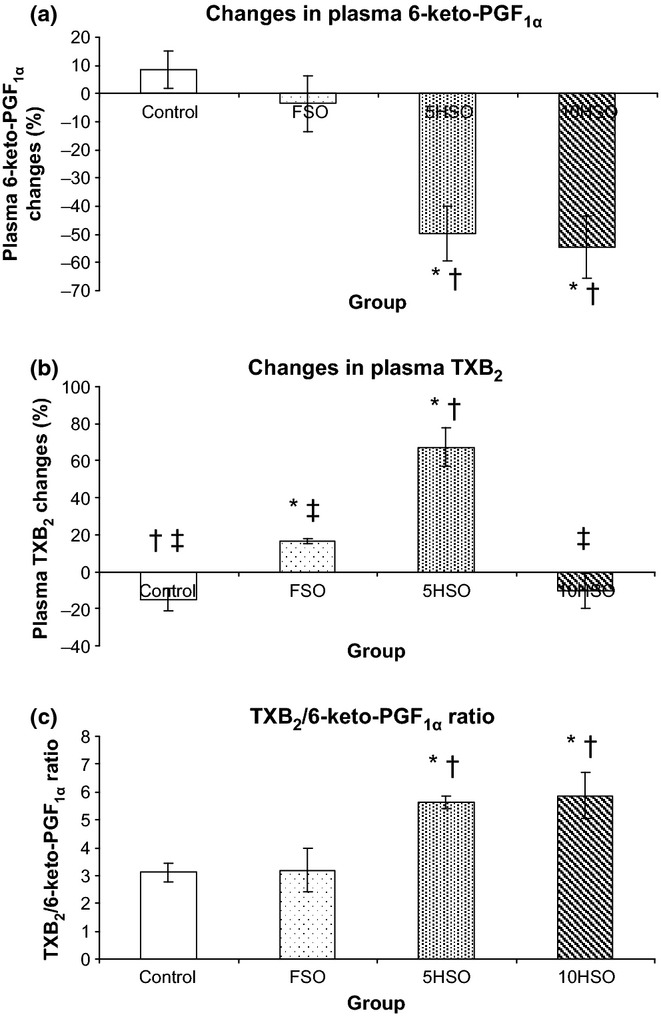
Thermally oxidized oil generates reactive oxygen species that have been implicated in several pathological processes including hypertension. This study was to ascertain the role of inflammation in the blood pressure raising effect of heated soybean oil in rats. Male Sprague-Dawley rats were divided into four groups and were fed with the following diets, respectively, for 6 months: basal diet (control); fresh soybean oil (FSO); five-time-heated soybean oil (5HSO); or 10-time-heated soybean oil (10HSO). Blood pressure was measured at baseline and monthly using tail-cuff method. Plasma prostacyclin (PGI(2) ) and thromboxane A(2) (TXA(2) ) were measured prior to treatment and at the end of the study. After six months, the rats were sacrificed, and the aortic arches were dissected for morphometric and immunohistochemical analyses. Blood pressure was increased significantly in the 5HSO and 10HSO groups. The blood pressure was maintained throughout the study in rats fed FSO. The aortae in the 5HSO and 10HSO groups showed significantly increased aortic wall thickness, area and circumferential wall tension. 5HSO and 10HSO diets significantly increased plasma TXA(2) /PGI(2) ratio. Endothelial VCAM-1 and ICAM-1 were significantly increased in 5HSO, as well as LOX-1 in 10HSO groups. In conclusion, prolonged consumption of repeatedly heated soybean oil causes blood pressure elevation, which may be attributed to inflammation.


Figures

Figure 1
Figure 1
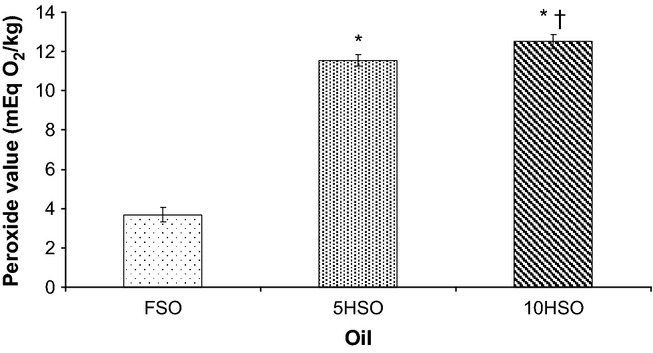
Peroxide value in oil. Data are average of three estimations (mean ± SEM). FSO, fresh soybean oil; 5HSO, five-time-heated soybean oil; 10HSO, ten-time-heated soybean oil. *Significantly different (P < 0.05) compared to FSO; Significantly differently (P < 0.05) compared to 5HSO.
Figure 2
Figure 2
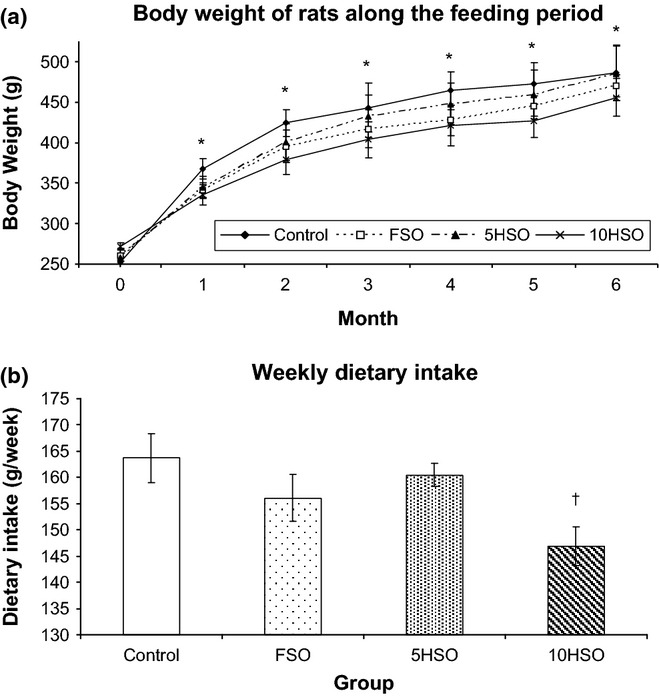
Growth performance of rats throughout the study period. Data are expressed as mean ± SEM. FSO, fresh soybean oil; 5HSO, five-time-heated soybean oil; 10HSO, ten-time-heated soybean oil. *Significantly different (P < 0.05) between pre- and post-treatment body weight for same group. Significantly different (P < 0.05) compared to control.
Figure 3
Figure 3
Blood pressure of rats throughout the study period. Data are expressed as mean ± SEM. FSO, fresh soybean oil; 5HSO, five-time-heated soybean oil; 10HSO, ten-time-heated soybean oil. *Significantly different (P < 0.05) between pre- and post-treatment values for same group; Significantly different (P < 0.05) compared to the control; Significantly different (P < 0.05) compared to the FSO group.
Figure 4
Figure 4
Changes in plasma prostanoids in rats after 6-month feeding period. Data are expressed as mean ± SEM. FSO, fresh soybean oil; 5HSO, five-time-heated soybean oil; 10HSO, ten-time-heated soybean oil; TXB2, thromboxane B2; 6-keto-PGF, 6-keto prostaglandin F. *Significantly different (P < 0.05) compared to the control; Significantly different (P < 0.05) compared to the FSO group; Significantly different (P < 0.05) compared to the 5HSO group.
Figure 5
Figure 5
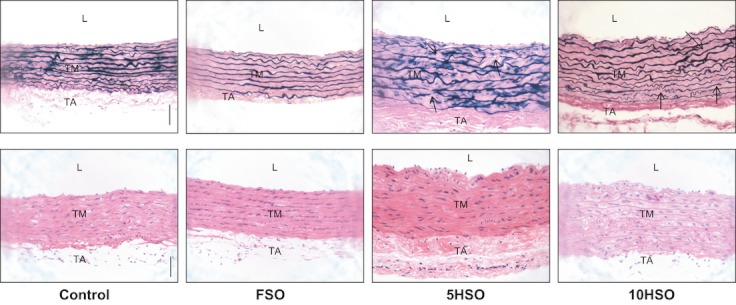
Photomicrographs of aortic sections stained with VVG or H&E. Aortic wall in 5HSO and 10HSO groups is thicker than the control and FSO groups, with an increased interlamellar space. Note the disorganization and fragmentation of the elastic lamellae in the VVG-stained tunica media (arrows). L, lumen; TM, tunica media; TA, tunica adventitia; FSO, fresh soybean oil; 5HSO, five-time-heated soybean oil; 10HSO, ten-time-heated soybean oil. (Magnification = ×200; calibration bar = 50 μm).
Figure 6
Figure 6
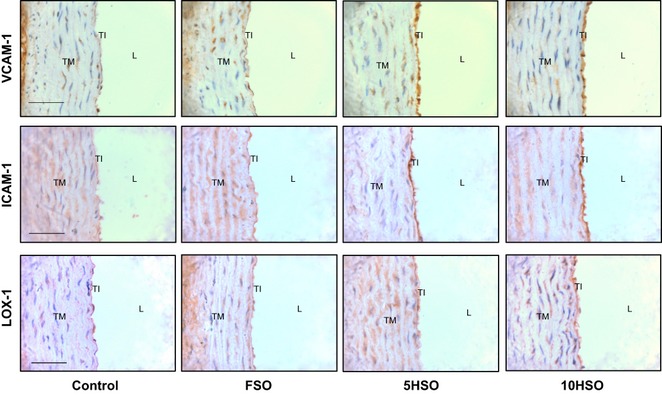
Photomicrographs of aortic sections showing immunohistochemical staining for VCAM-1, ICAM-1 and LOX-1. L, lumen; TI, tunica intima; TM, tunica media; TA, tunica adventitia; FSO, fresh soybean oil; 5HSO, five-time-heated soybean oil; 10HSO, ten-time-heated soybean oil; VCAM-1, vascular cell adhesion molecule-1; ICAM-1, intercellular adhesion molecule-1; LOX-1, lectin-like oxidized low-density lipoprotein receptor. (Magnification = ×400; calibration bar = 50 μm).
Figure 7
Figure 7
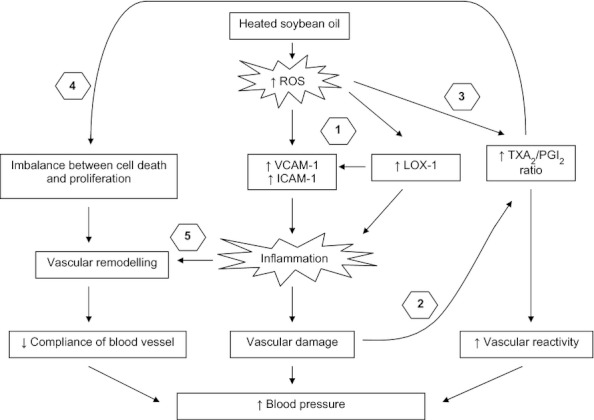
Proposed mechanisms of the blood pressure raising effects after prolonged consumption of repeatedly heated soybean oil in rats. (1) Excessive reactive oxygen species produced during the repeated heating process of soybean oil induces the endothelial VCAM-1, ICAM-1 and LOX-1, which in turn stimulate inflammatory responses, causing vascular damage. (2) Inflammation impairs endothelial function in PGI2 formation but induces TXA2 production. (3) Reactive oxygen species also alters the arachidonic acid pathway, in which by favouring the TXA2 pathway over the PGI2 pathway, resulting in an imbalance between TXA2 and PGI2. Subsequently, this situation enhances vasoconstriction and attenuates vasorelaxation of blood vessel. (4) An altered prostanoids environment causes an imbalance between the cell death and proliferation of vascular smooth muscle cells, leading to adverse vascular remodelling. Changes in vascular architecture decrease the compliance of blood vessel in regulating blood pressure. (5) Inflammation also plays a role in vascular remodelling. All these circumstances lead to an increase in blood pressure.

References

    1. Adam SK, Das S, Soelaiman IN, Nor Aini U, Jaarin K. Consumption of repeatedly heated soy oil increases the serum parameters related to arthrosclerosis in ovariectomized rats. Tohoku J. Exp. Med. 2008;215:219–226. - PubMed
    1. Alonso Á, Ruiz-Gutierrez V, Martínez-González MÁ. Monounsaturated fatty acids, olive oil and blood pressure: epidemiological, clinical and experimental evidence. Public Health Nutr. 2006;9:251–257. - PubMed
    1. Ambrosio G, Golino P, Pascucci I, et al. Modulation of platelet function by reactive oxygen metabolites. Am. J. Physiol. 1994;267:H308–H318. - PubMed
    1. Arribas SM, Hinek A, González MC. Elastic fibres and vascular structure in hypertension. Pharmacol. Ther. 2006;111:771–791. - PubMed
    1. Bansal G, Zhou W, Barlow PJ, Lo HL, Neo FL. Performance of palm olein in repeated deep frying and controlled heating processes. Food Chem. 2010;121:338–347.

Publication types