


doi: 10.1016/j.cub.2012.08.011.
Studies on Aplysia neurons suggest treatments for chronic human disorders
Affiliations
- PMID: 22975001
- PMCID: PMC9279012
- DOI: 10.1016/j.cub.2012.08.011
Item in Clipboard
Studies on Aplysia neurons suggest treatments for chronic human disorders
Curr Biol.
.
Abstract
For decades, the marine snail Aplysia has proven to be a powerful system for analyzing basic neurobiological mechanisms, particularly cellular and molecular mechanisms of neural plasticity. Three new findings on Aplysia may be relevant for the understanding and treatment of chronic human disorders. This research on this simple molluscan nervous system may lead to new therapeutic approaches for spinal cord injury, Fragile X syndrome, and genetic learning deficits more generally.
Copyright © 2012 Elsevier Ltd. All rights reserved.
Figures
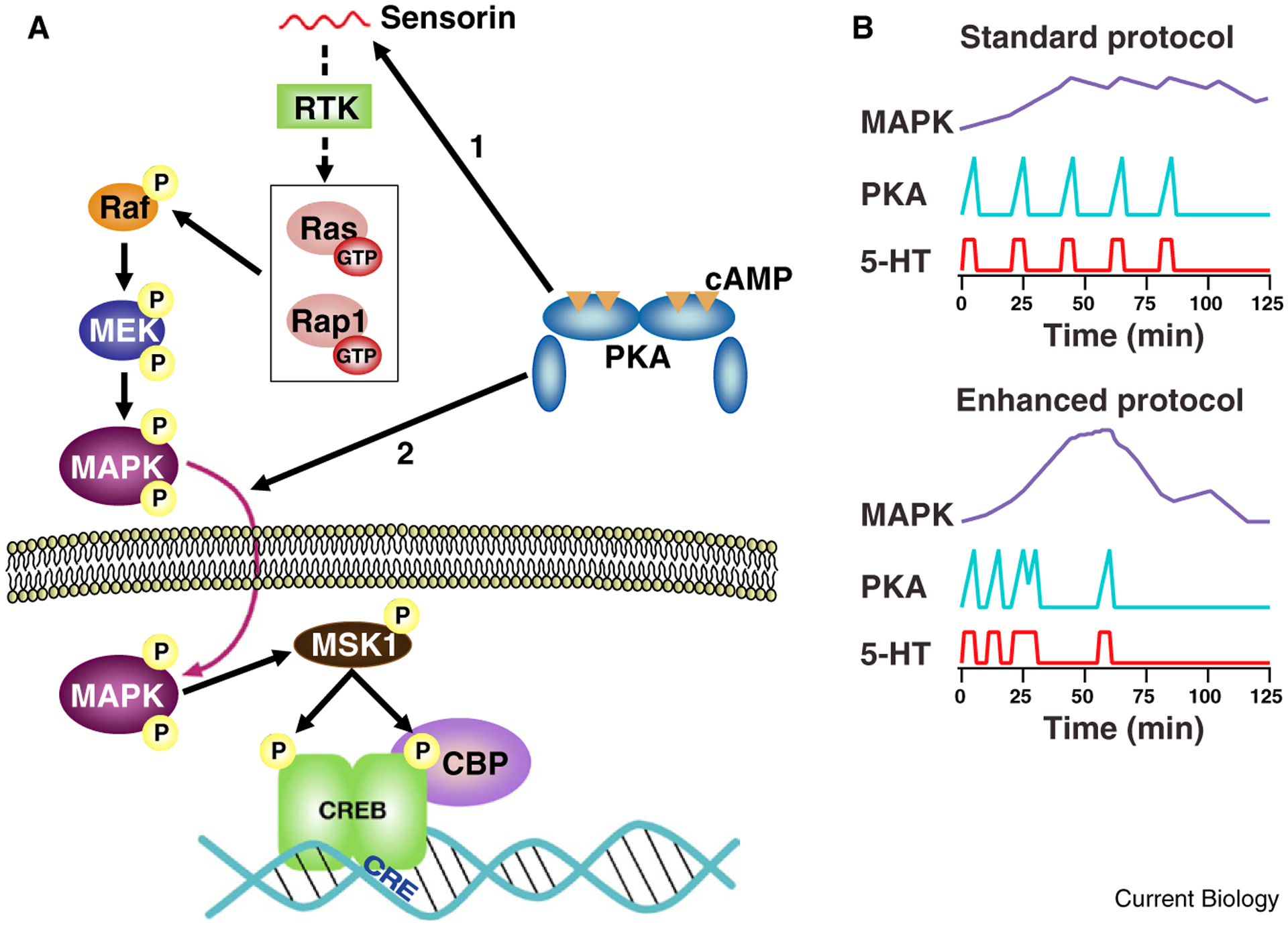
PKA and MAPK signaling pathways activated with enhanced training protocol. (A) Convergence of PKA and MAPK upstream of CREB transcription factor. The cartoon illustrates two possible loci of convergence. Tail shock releases serotonin (not shown), which stimulates adenylyl cyclase, activating PKA. PKA is shown as triggering release of the neuropeptide sensorin from sensory neurons (arrow #1) [7], which acts by binding to a receptor tyrosine kinase (RTK) to activate the MAPK pathway, via either Ras or Rap1. MAPK translocates into the nucleus where it stimulates phosphorylation of CREB by activating MSK1. PKA is also shown enhancing the translocation of MAPK (arrow #2) [6]. (Other mechanisms of interaction between the PKA and MAPK pathways, not shown here, have also been described.) CREB-binding protein (CBP) is recruited by activated CREB; CBP promotes transcription due to it’s histone acetyl transferase activity. (B) Enhanced training results in improved coincidence of activation of PKA and MAPK. Curves are simple schematized examples of activation profiles similar to those generated by the computational model of Zhang et al. [3]. Note, PKA activation is tightly temporally linked to serotonin exposure. MAPK activation develops gradually, peaking at about 45 min. With the enhanced protocol, more powerful peak activation of MAPK is achieved, which is available to interact with PKA activated by the final pulse of serotonin.
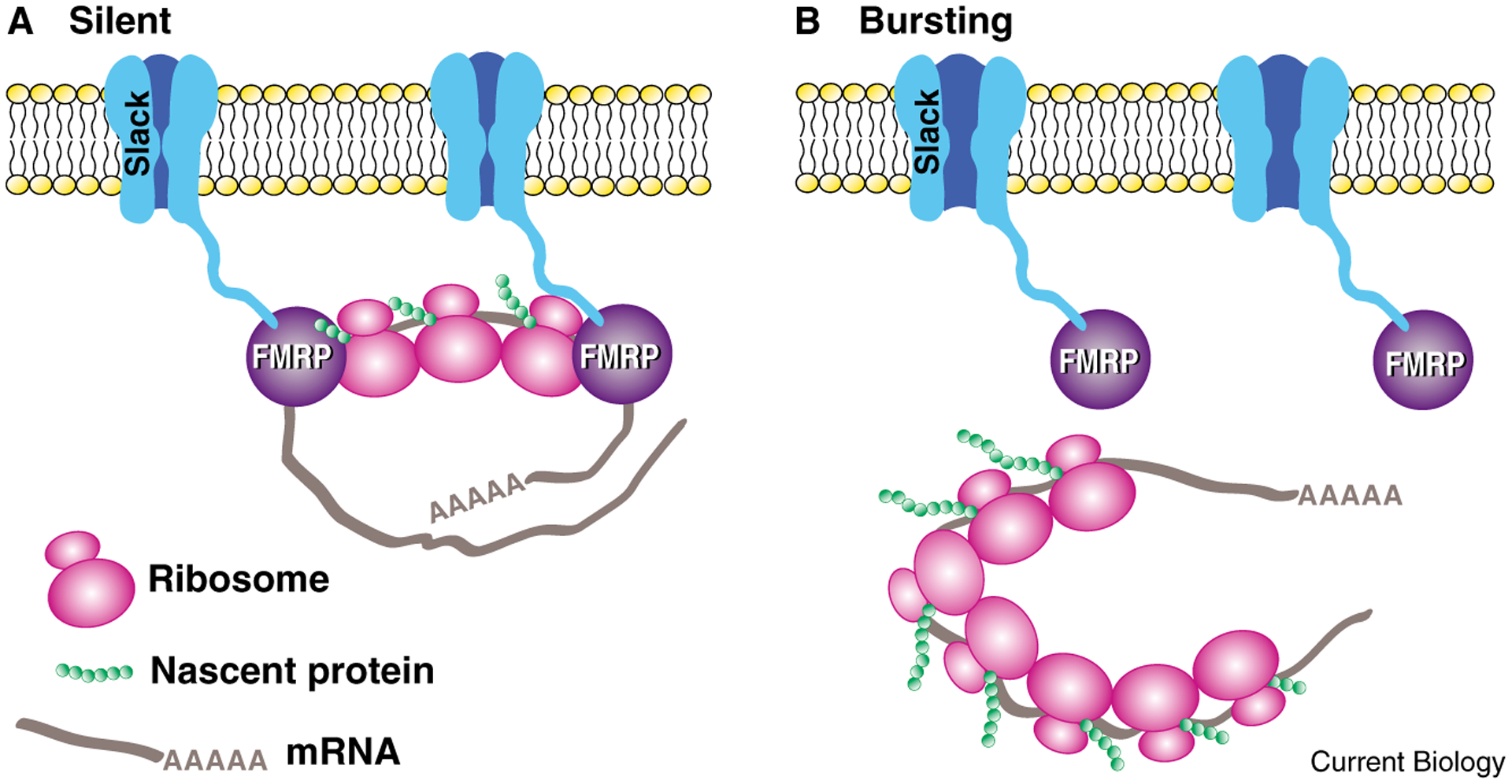
The hypothesized coupling between activity and local translation mediated by the interaction between Slack K+ channels and FMRP in the neurosecretory bag cells of Aplysia. (A) Silent neurons. FMRP inhibits local translation by binding to polyribosomes. (B) Bursting neurons. During bursting behavior (prolonged activity known as afterdischarge), Slack channels activated by depolarization trigger dissociation of FMRP from polyribosomes and mRNA, permitting initiation of translation. This locally initiated translation may mediate recovery from refractoriness at the end of afterdischarge. (Model based on results from [9].)
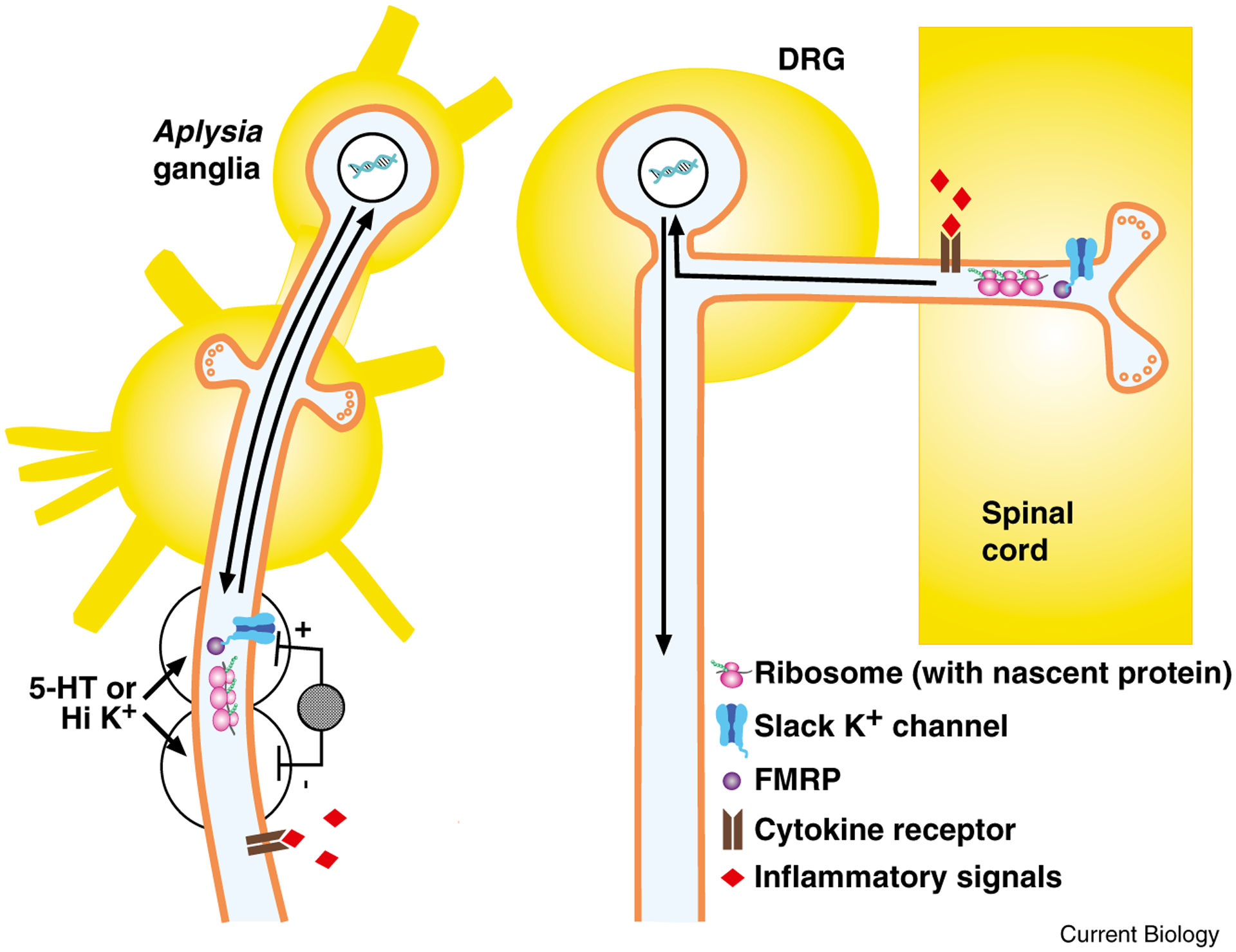
After injury, injury-activated signals trigger local translation and transcription-dependent changes to increase excitability and spontaneous activity in Aplysia sensory neurons and mammalian nociceptors. Left: sensory neuron in Aplysia. After either nerve crush or application of loose ligature, hemocytes accumulate and release inflammatory signals, such as cytokines and serotonin; these signals initiate long-term hyperexcitability in sensory neuron axons. Alternatively, local application of the inflammatory signal serotonin (5-HT) to, or depolarization with high K+ solution of a small region of axon isolated in wells produces local increase in excitability, assessed by electrical stimulation within wells, with no increase in excitability in other axonal regions. This local increase in excitability requires local protein synthesis (as indicated by ribosome, with mRNA and nascent protein) and transcription (indicated by arrows representing signal to nucleus and new gene products transported from nucleus to axon), but does not require Ca2+ influx or Ca2+ release for initiation. One possible mechanism for initiating local protein synthesis independent of Ca2+ increase is Slack K+ channel regulation of FMRP-gated translation (indicated by Slack channel bound to FMRP). Right: dorsal root ganglion (DRG) nociceptor. After spinal cord contusion, DRG nociceptors at segments above and below crush exhibit increased frequency of spontaneous activity, which is evident both in the peripheral axon and in the isolated cell body. Signaling pathways have not yet been identified, but as suggested here, inflammatory signals from microglia in spinal cord several segments away from injury may initiate the response. Because the increase in excitability is expressed in isolated cell bodies in dissociated cell culture, it is likely to involve changes in transcription (as symbolized by arrows to and from nucleus). Depolarization-induced Slack K+ channel-FMRP triggering of local translation may also contribute to increased excitability and spontaneous activity in sensory neurons; local depolarization is probable after spinal cord injury due to massive release of the excitatory neurotransmitter glutamate.
References
-
- Dash PK, Hochner B, and Kandel ER (1990). Injection of the cAMP-responsive element into the nucleus of Aplysia sensory neurons blocks long-term facilitation. Nature 345, 718–721. - PubMed
-
- Jarrard HE, Goldsmith BA, and Abrams TW (1993). In Aplysia sensory neurons, the neuropeptide SCPB and serotonin differ in efficacy both in modulating cellular properties and in activating adenylyl cyclase: implications for mechanisms underlying presynaptic facilitation. Brain Res. 616, 188–199. - PubMed
MeSH terms
Grants and funding
LinkOut - more resources
Full Text Sources
Research Materials
