Review
. 2012 Sep 11;22(17):R733-40.
doi: 10.1016/j.cub.2012.07.029.

Evolution of inflammatory diseases

Affiliations
Review

Evolution of inflammatory diseases

Daniel Okin et al. Curr Biol. .

Abstract

The association of inflammation with modern human diseases (e.g. obesity, cardiovascular disease, type 2 diabetes mellitus, cancer) remains an unsolved mystery of current biology and medicine. Inflammation is a protective response to noxious stimuli that unavoidably occurs at a cost to normal tissue function. This fundamental trade-off between the cost and benefit of the inflammatory response has been optimized over evolutionary time for specific environmental conditions. Rapid change of the human environment due to niche construction outpaces genetic adaptation through natural selection, leading increasingly to a mismatch between the modern environment and selected traits. Consequently, multiple trade-offs that affect human physiology are not optimized to the modern environment, leading to increased disease susceptibility. Here we examine the inflammatory response from an evolutionary perspective. We discuss unique aspects of the inflammatory response and its evolutionary history that can help explain the association between inflammation and modern human diseases.


Figures

Figure 1
Figure 1
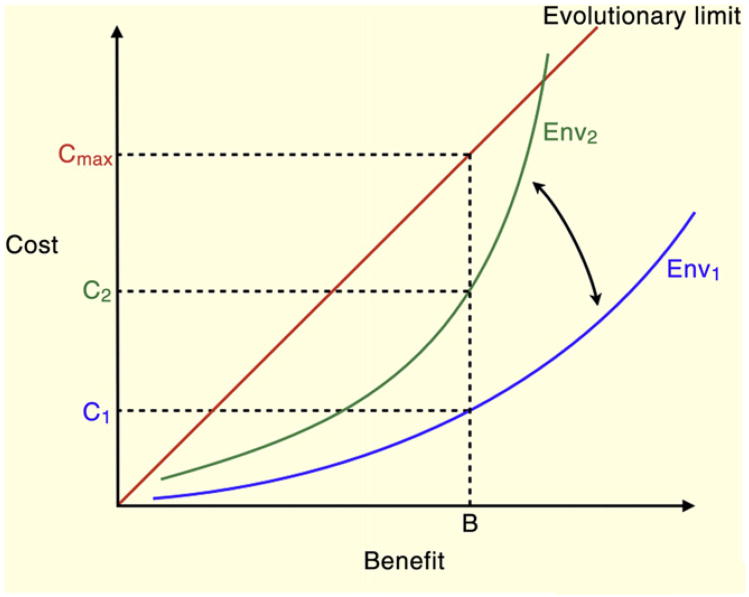
Cost–benefit trade-offs are optimized to specific environments and can be affected by environmental change. A particular trait can be selected and maintained by evolution as long as the benefit of the trait outweighs the cost. Here the trait exists in Environment 1 (Env1) with benefit B and cost C1. As the environment changes, the cost of maintaining benefit B increases to C2. In all conditions, the boundary of adaptive traits is defined by the line of cost ≤ benefit, where traits below and to the right of the line are considered adaptive and traits above and to the left of the line are maladaptive. However, there is an upper limit to the acceptable cost where the trait becomes detrimental regardless of the benefit. These traits are defined by a high absolute cost.
Figure 2
Figure 2
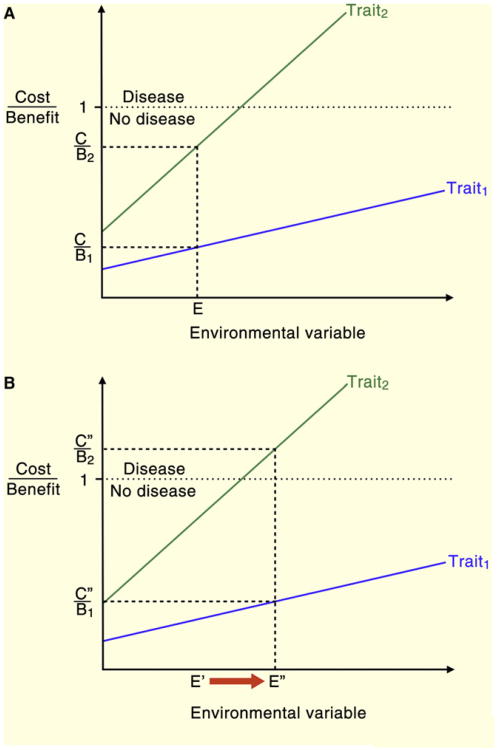
Individual traits are characterized by cost–benefit ratios (C/B). C/B < 1 is required for a trait to be adaptive. However, cost–benefit ratio is a function of the environment, and a given change in the environmental factor can affect C/B of different traits to different degrees. Here Trait1 is less sensitive than Trait2 to a given environmental change. (A) In environment E, Trait1 has C/B1 and Trait2 has C/B2, both of which are less than 1. (B) Environmental change, E′ → E″, causes a shift in the C/B ratio for both traits. Trait1 remains adaptive, with C″/B1 < 1, but Trait2 becomes maladaptive, with C″/B2 > 1.
Figure 3
Figure 3
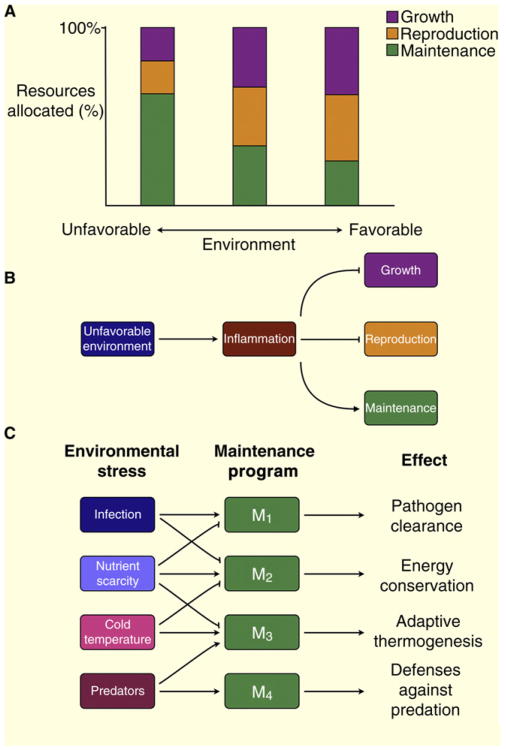
Trade-off between life history characteristics is a function of the environment. (A) Favorable environment promotes investment of resources in growth and reproduction while unfavorable environment promotes somatic maintenance at the expense of growth and reproduction. (B) Some aspects of unfavorable environment, such as infection or injury, lead to an inflammatory response that in turn promotes somatic maintenance and inhibits pathways controlling growth and reproduction. (C) Different environmental stresses activate different maintenance programs to deal with that stress and inhibit maintenance programs that are incompatible or linked by a functional or energetic trade-off.

References

    1. Hotamisligil GS, Erbay E. Nutrient sensing and inflammation in metabolic diseases. Nat Rev Immunol. 2008;8:923–934. - PMC - PubMed
    1. Libby P. Inflammation and cardiovascular disease mechanisms. Am J Clin Nut. 2006;83:456S–460S. - PubMed
    1. Wyss-Coray T, Mucke L. Inflammation in neurodegenerative disease–a double-edged sword. Neuron. 2002;35:419–432. - PubMed
    1. Trinchieri G. Cancer and inflammation: An old intuition with rapidly evolving new concepts. Annu Rev Immunol. 2012;30:677–706. - PubMed
    1. Cecil RL, Goldman L, Ausiello DA. Medicine. 23rd. Philadelphia: Saunders Elsevier; 2008.

Publication types

Substances

LinkOut - more resources