


Meta-analysis of perceived stress and its association with incident coronary heart disease
- PMID: 22975465
- PMCID: PMC3511594
- DOI: 10.1016/j.amjcard.2012.08.004
Meta-analysis of perceived stress and its association with incident coronary heart disease
Abstract
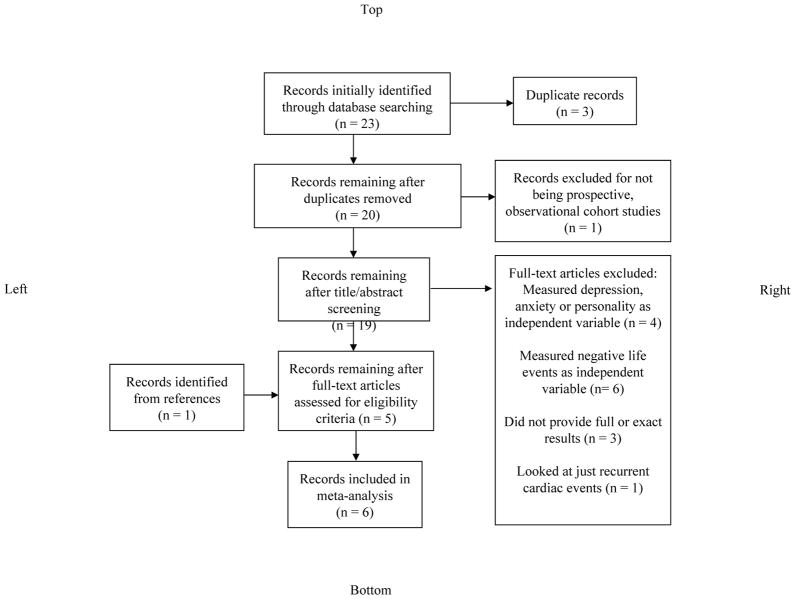
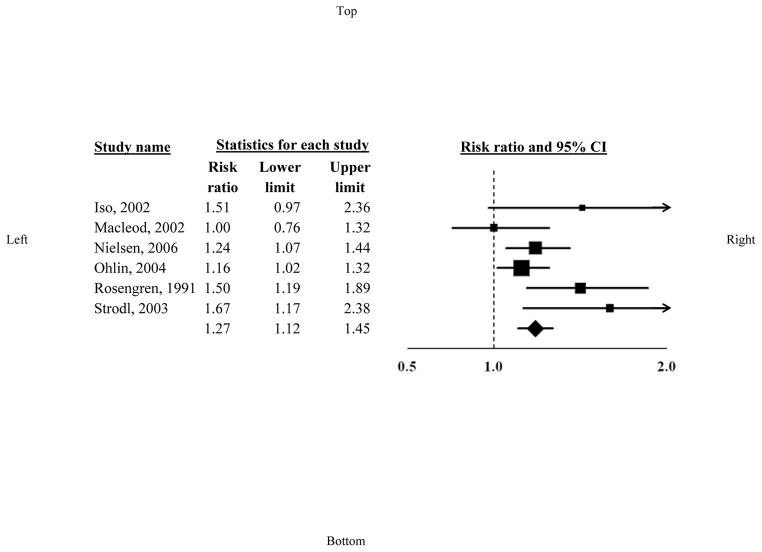
Most studies examining potential associations between psychological factors and cardiovascular outcomes have focused on depression or anxiety. The effect of perceived stress on incident coronary heart disease (CHD) has yet to be reviewed systematically. We conducted a systematic review and meta-analysis of the association between perceived stress and incident CHD. Ovid, MEDLINE, and PsycINFO were searched as data sources. Prospective observational cohort studies were selected that measured self-reported perceived stress and assessed incident CHD at ≥6 months. We extracted study characteristics and estimates of the risk of incident CHD associated with high perceived stress versus low perceived stress. We identified 23 potentially relevant articles, of which 6 met our criteria (n = 118,696). Included studies measured perceived stress with validated measurements and nonvalidated simple self-report surveys. Incident CHD was defined as new diagnosis of, hospitalization for, or mortality secondary to CHD. Meta-analysis yielded an aggregate risk ratio of 1.27 (95% confidence interval 1.12 to 1.45) for the magnitude of the relation between high perceived stress and incident CHD. In conclusion, this meta-analysis suggests that high perceived stress is associated with a moderately increased risk of incident CHD.
Copyright © 2012 Elsevier Inc. All rights reserved.
Figures
References
-
- Vitaliano PP, Scanlan JM, Zhang J, Savage MV, Hirsch IB, Siegler IC. A path model of chronic stress, the metabolic syndrome, and coronary heart disease. Psychosom Med. 2002;64:418–435. - PubMed
-
- Jenkinson C, Madeley R, Mitchell J, Turner I. The influence of psychosocial factors on survival after myocardial infarction. Public Health. 1993;107:305–317. - PubMed
-
- Eller NH, Netterstrøm B, Gyntelberg F, Kristensen TS, Nielsen F, Steptoe A, Theorell T. Work-related psychosocial factors and the development of ischemic heart disease: a systematic review. Cardiol Rev. 2009;17:83. - PubMed
-
- Eaker ED, Sullivan LM, Kelly-Hayes M, D’Agostino RB, Benjamin EJ. Marital status, marital strain, and risk of coronary heart disease or total mortality: The Framingham offspring study. Psychosom Med. 2007;69:509–513. - PubMed
Publication types
MeSH terms
Grants and funding
LinkOut - more resources
Full Text Sources
Medical
Miscellaneous
