


Dementia specialists and early adoption of amyloid imaging
- PMID: 22976071
- PMCID: PMC3640311
- DOI: 10.3233/JAD-2012-121216
Dementia specialists and early adoption of amyloid imaging
Abstract
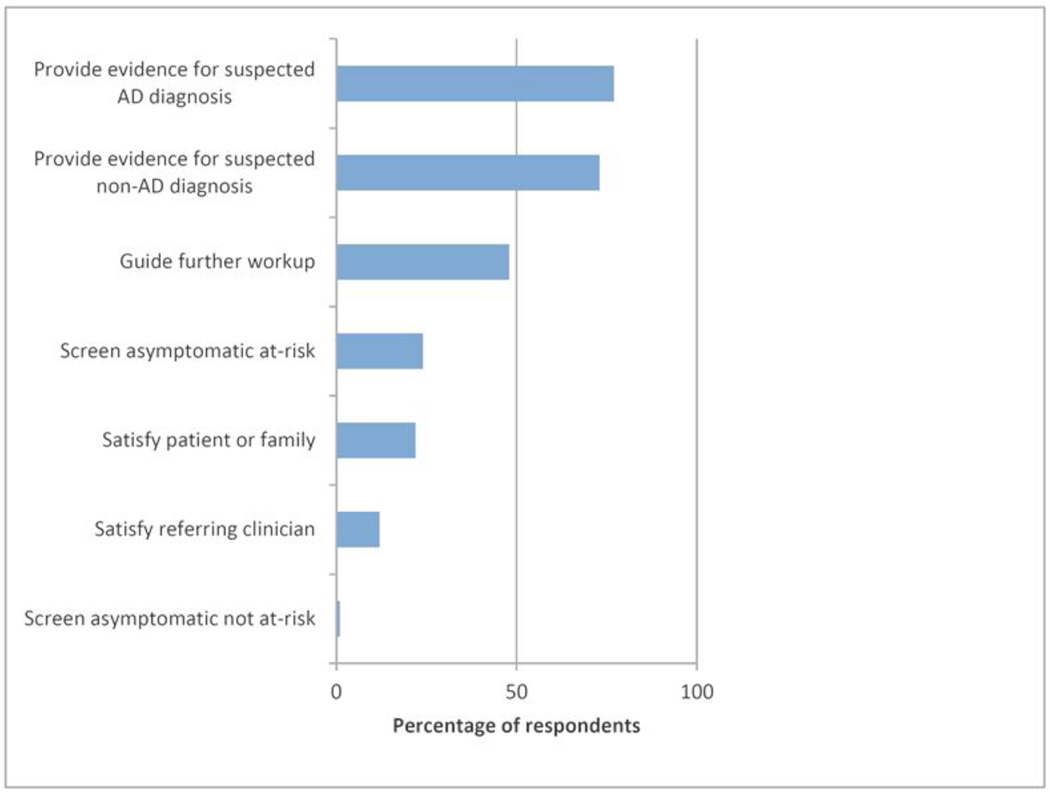
The goal of this study was to describe the attitudes of U.S. neurologists specializing in dementia toward the use of amyloid imaging in the diagnosis of Alzheimer's disease (AD). A cross-sectional electronic physician survey of dementia specialists at U.S. medical schools was performed. The response rate for the survey was 51.9% (135/260). Greater than 83% of respondents plan to use amyloid imaging to evaluate patients for AD. Most respondents intend to use amyloid imaging as an adjunctive diagnostic modality to confirm (77%) or rule-out (73%) a diagnosis of AD; 24% plan to use amyloid imaging to screen asymptomatic individuals for evidence of cerebral amyloid. Specialists who do not intend to use amyloid imaging (16%) express concern about the cost (73%), the usefulness (55%), and likelihood of patient (55%) and clinician (59%) misinterpretation of findings. The need for patient pre-test counseling was endorsed by a large percentage (92%) of dementia specialists (higher than for genetic testing (82%)). In conclusion, dementia specialists, particularly young specialists, are likely to be early adopters of amyloid imaging. Assuming ready availability, this new technology would be used as a confirmatory test in the evaluation of AD, as well as a screening tool for asymptomatic pathology. Specialists recognize the complexity of interpreting amyloid imaging findings and the need for patient counseling before undergoing testing.
Figures

References
-
- Klunk WE, Engler H, Nordberg A Yanming W, Blomqvist G, Holt DP, Bergström M, Savitcheva I, Huang G, Estrada S, Ausén B, Debnath ML, Barletta J, Price JC, Sandell J, Lopresti BJ, Wall A, Koivisto P, Antoni G, Mathis CA, Långström B. Imaging brain amyloid in Alzheimer’s disease with Pittsburgh Compound-B. Ann Neurol. 2004;55(3):306–319. - PubMed
-
- Villemagne VL, Ong K, Mulligan RS, Holl G, Pejoska S, Jones G, O’Keefe G, Ackerman U, Tochon-Danguy H, Chan JG, Reininger CB, Fels L, Putz B, Rohde B, Masters CL, Rowe CC. Amyloid imaging with 18F-florbetaben in Alzheimer disease and other dementias. J Nucl Med. 2011;52:1210–1217. - PubMed
-
- Rowe CC, Villemagne VL. Brain Amyloid Imaging. J Nucl Med. 2011;52(11):1733–1740. - PubMed
Publication types
MeSH terms
Grants and funding
LinkOut - more resources
Full Text Sources
Medical
