Diffusion tensor imaging-demonstrated differences between hemiplegic and diplegic cerebral palsy with symmetric periventricular leukomalacia
- PMID: 22976239
- PMCID: PMC7964924
- DOI: 10.3174/ajnr.A3272
Diffusion tensor imaging-demonstrated differences between hemiplegic and diplegic cerebral palsy with symmetric periventricular leukomalacia
Abstract
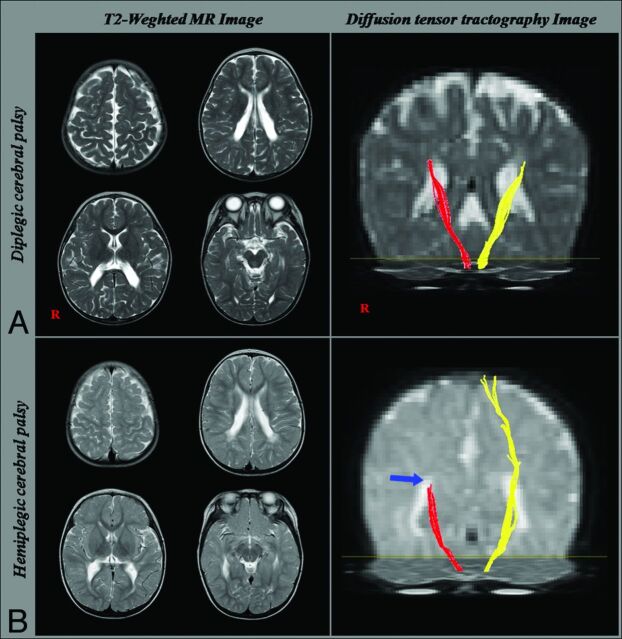
Background and purpose: Patients with cerebral palsy have variable clinical presentations such as hemiplegic, diplegic, or quadriplegic patterns though they have PVL on conventional MR images. The authors investigated whether DTT can differentiate between hemiplegic and diplegic CP in patients presenting with symmetric PVL on conventional MR images.
Materials and methods: One hundred thirteen consecutive pediatric patients with definite hemiplegic (59 patients; 30 boys, 29 girls; mean age, 34.19 months; range, 24-52 months) or diplegic (54 patients; 27 boys, 27 girls; mean age, 31.07 months; range, 24-48 months) symptoms and bilateral symmetric PVL on conventional brain MR imaging were recruited. The states of CSTs were examined by using DTT, and the asymmetries of right and left CSTs in the hemiplegic and diplegic groups were compared by using asymmetric anisotropy indexes and asymmetric mean diffusivity indexes.
Results: All patients in the hemiplegic group with asymmetric results exhibited disrupted integrities of more affected CSTs and sparing of less affected CSTs. However, diplegic patients revealed symmetric disrupted findings of the right and left CSTs at the upper periventricular level. Asymmetric anisotropy index and asymmetric mean diffusivity index values were significantly higher in the hemiplegic group than in the diplegic group (P < .05), and these results of DTT significantly corresponded with their typical clinical manifestation.
Conclusions: DTT may be very useful for the detailed estimation of the CST state in patients with bilateral symmetric PVL.
Figures
References
-
- Fan GG, Yu B, Quan SM, et al. . Potential of diffusion tensor MRI in the assessment of periventricular leukomalacia. Clin Radiol 2006;61:358–64 - PubMed
-
- Wilson-Costello D, Borawski E, Friedman H, et al. . Perinatal correlates of cerebral palsy and other neurologic impairment among very low birth weight children. Pediatrics 1998;102:315–22 - PubMed
-
- Stewart AL, Reynolds EO, Hope PL, et al. . Probability of neurodevelopmental disorders estimated from ultrasound appearance of brains of very preterm infants. Dev Med Child Neurol 1987;29:3–11 - PubMed
-
- Kuban KC, Leviton A. Cerebral palsy. N Engl J Med 1994;330:188–95 - PubMed
-
- Folkerth RD. Periventricular leukomalacia: overview and recent findings. Pediatr Dev Pathol 2006;9:3–13 - PubMed
Publication types
MeSH terms
LinkOut - more resources
Full Text Sources
Medical
Miscellaneous