


Induction chemoradiotherapy is superior to induction chemotherapy for the survival of non-small-cell lung cancer patients with pathological mediastinal lymph node metastasis
- PMID: 22976995
- PMCID: PMC3501315
- DOI: 10.1093/icvts/ivs412
Induction chemoradiotherapy is superior to induction chemotherapy for the survival of non-small-cell lung cancer patients with pathological mediastinal lymph node metastasis
Abstract
Objectives: The purpose of this study was to compare the clinical outcomes of induction chemoradiotherapy and chemotherapy and to identify the prognostic factors for non-small-cell lung cancer patients with mediastinal lymph node metastasis who were treated with induction therapy.
Methods: Between August 1995 and December 2010, 50 non-small-cell lung cancer patients with pathological mediastinal lymph node metastasis were scheduled to receive induction therapy followed by surgery. Irinotecan plus cisplatin was used for induction chemotherapy from June 1995 to April 1999, and docetaxel plus cisplatin with concurrent radiation at a dose of 40-46 Gy has been used for induction chemoradiotherapy since May 1999.
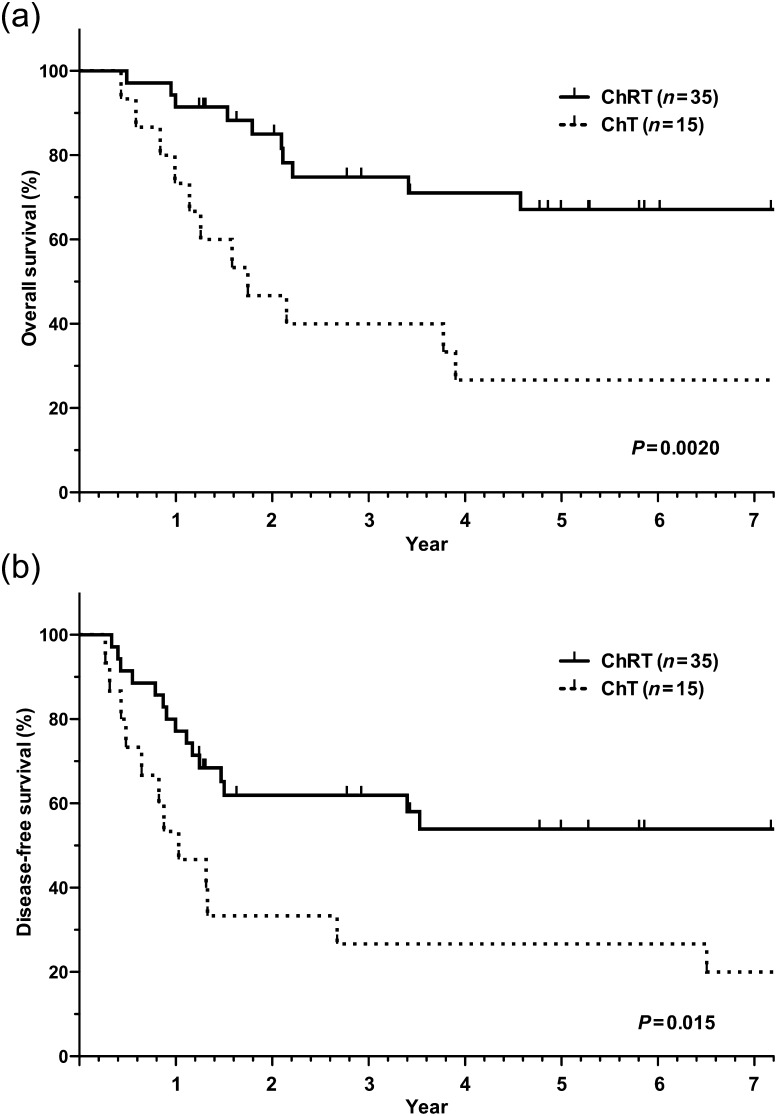
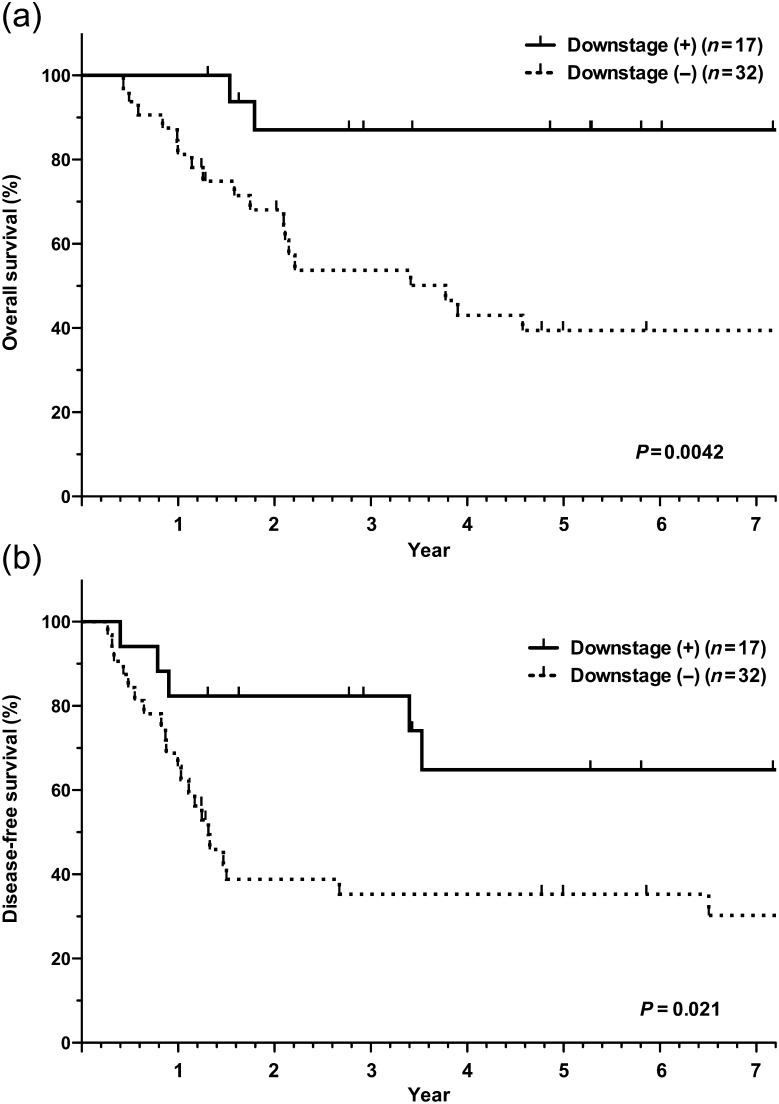
Results: Thirty-five patients were treated with induction chemoradiotherapy and 15 were treated with induction chemotherapy. For the entire population, the 3-year and 5-year overall survival rates were 64.1 and 53.9%, respectively, and the 1-year and 2-year disease-free survival rates were 70.0 and 53.1%, respectively. Among the clinicopathological factors, the chemoradiotherapy group exhibited longer overall survival and disease-free survival than the chemotherapy group (overall survival, P = 0.0020; disease-free survival, P = 0.015). Pathological downstaging was also significantly associated with favorable overall survival (P = 0.0042) and disease-free survival (P = 0.021). A multivariate analysis showed that chemoradiotherapy (P = 0.0099) and pathological downstaging (P = 0.039) were independent prognostic factors.
Conclusions: Our results indicated that induction chemoradiotherapy was superior to induction chemotherapy with regard to the outcome of non-small-cell lung cancer patients with mediastinal lymph node metastasis.
Figures
References
-
- Detterbeck FC, Jantz MA, Wallace M, Vansteenkiste J, Silvestri GA. Invasive mediastinal staging of lung cancer: ACCP evidence-based clinical practice guidelines (2nd edition) Chest. 2007;132:202S–20S. doi:10.1378/chest.07-1362. - DOI - PubMed
-
- Albain KS, Rusch VW, Crowley JJ, Rice TW, Turrisi AT, 3rd, Weick JK, et al. Concurrent cisplatin/etoposide plus chest radiotherapy followed by surgery for stages IIIA (N2) and IIIB non-small-cell lung cancer: mature results of Southwest Oncology Group phase II study 8805. J Clin Oncol. 1995;13:1880–92. - PubMed
-
- Eberhardt W, Wilke H, Stamatis G, Stuschke M, Harstrick A, Menker H, et al. Preoperative chemotherapy followed by concurrent chemoradiation therapy based on hyperfractionated accelerated radiotherapy and definitive surgery in locally advanced non-small-cell lung cancer: mature results of a phase II trial. J Clin Oncol. 1998;16:622–34. - PubMed
-
- Furuse K, Fukuoka M, Kawahara M, Nishikawa H, Takada Y, Kudoh S, et al. Phase III study of concurrent versus sequential thoracic radiotherapy in combination with mitomycin, vindesine, and cisplatin in unresectable stage III non-small-cell lung cancer. J Clin Oncol. 1999;17:2692–9. - PubMed
-
- Kiura K, Ueoka H, Segawa Y, Tabata M, Kamei H, Takigawa N, et al. Phase I/II study of docetaxel and cisplatin with concurrent thoracic radiation therapy for locally advanced non-small-cell lung cancer. Br J Cancer. 2003;89:795–802. doi:10.1038/sj.bjc.6601217. - DOI - PMC - PubMed
Publication types
MeSH terms
Substances
LinkOut - more resources
Full Text Sources
Medical
Miscellaneous
