


Ostrich produce cross-reactive neutralization antibodies against pandemic influenza virus A/H1N1 following immunization with a seasonal influenza vaccine
- PMID: 22977467
- PMCID: PMC3440658
- DOI: 10.3892/etm.2010.180
Ostrich produce cross-reactive neutralization antibodies against pandemic influenza virus A/H1N1 following immunization with a seasonal influenza vaccine
Abstract
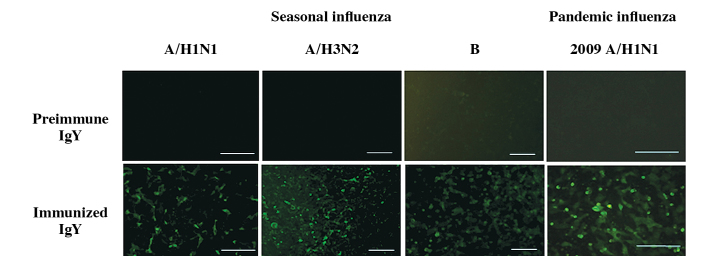
An outbreak of influenza in 2009 was found to be caused by a novel strain of influenza virus designated as pandemic influenza A/H1N1 2009. Vaccination with recent seasonal influenza vaccines induced little or no cross-reactive antibody response to the pandemic influenza virus A/H1N1 2009 in any age group in human populations. Accordingly, most people had low immunity against this pathogen, thus resulting in the worldwide spread of the infection to produce a so-called 'pandemic'. This report presents the important finding that ostrich eggs generate cross-reactive antibodies to the pandemic influenza virus A/H1N1 following immunization of female ostrich with a seasonal influenza vaccine. This simple method produced a large amount of antibodies against influenza viruses by one female ostrich. An enzyme-linked immunosorbent assay (ELISA) and immunocytochemistry indicated that the ostrich antibodies possessed strong cross-reactivity to the pandemic A/H1N1 as well as to the seasonal A/H1N1, A/H3N2 and B viruses. The hemaggregation activities of erythrocytes induced by this pandemic strain were also inhibited by the ostrich antibodies. In addition, the cytopathological effects of infection with a pandemic virus on MDCK cells were clearly inhibited in co-cultures with the ostrich antibodies, thereby indicating the neutralization of viral infectivity in the cells. In conclusion, cross-reactive neutralization antibodies against pandemic influenza virus A/H1N1 2009 were successfully generated in ostrich eggs produced by females immunized with seasonal influenza viral vaccine.
Figures
References
-
- Garten RJ, Davis CT, Russell CA, Shu B, Lindstrom S, Balish A, Sessions WM, Xu X, Skepner E, Deyde V, Okomo-Adhiambo M, Gubareva L, Barnes J, Smith CB, Emery SL, Hillman MJ, Rivailler P, Smagala J, De Graaf M, Burke DF, Fouchier RA, Pappas C, Alpuche-Aranda CM, López-Gatell H, Olivera H, López I, Myers CA, Faix D, Blair PJ, Yu C, Keene KM, Dotson PD, Jr, Boxrud D, Sambol AR, Abid SH, St George K, Bannerman T, Moore AL, Stringer DJ, Blevins P, Demmler-Harrison GJ, Ginsberg M, Kriner P, Waterman S, Smole S, Guevara HF, Belongia EA, Clark PA, Beatrice ST, Donis R, Katz J, Finelli L, Bridges CB, Shaw M, Jernigan DB, Uyeki TM, Smith DJ, Klimov AI, Cox NJ. Antigenic and genetic characteristics of swine-origin 2009 A(H1N1) influenza viruses circulating in humans. Science. 2009;325:197–201. - PMC - PubMed
-
- Novel Swine-Origin Influenza A (H1N1) Virus Investigation Team Emergence of a novel swine-origin influenza A (H1N1) virus in humans. N Engl J Med. 2009;360:2605–2615. - PubMed
-
- Hancock K, Veguilla V, Lu X, Zhong W, Butler EN, Sun H, Liu F, Dong L, DeVos J, Gargiullo PM, Brammer TL, Cox NJ, Tumpey TM, Katz JM. Cross-reactive antibody responses to the 2009 pandemic H1N1 influenza virus. N Engl J Med. 2009;361:1945–1952. - PubMed
-
- Adachi K, Handharyani E, Sari DK, Takama K, Fukuda K, Endo I, Yamamoto R, Sawa M, Tanaka M, Konisi I, Tsukamoto Y. Development of neutralization antibodies against highly pathogenic H5N1 avian influenza virus using ostrich (Struthio camelus) yolk. Mol Med Rep. 2008;1:203–209. - PubMed
LinkOut - more resources
Full Text Sources
Other Literature Sources