


Expression of p-AKT and p-mTOR in a large series of bronchopulmonary neuroendocrine tumors
- PMID: 22977576
- PMCID: PMC3440723
- DOI: 10.3892/etm.2011.291
Expression of p-AKT and p-mTOR in a large series of bronchopulmonary neuroendocrine tumors
Abstract
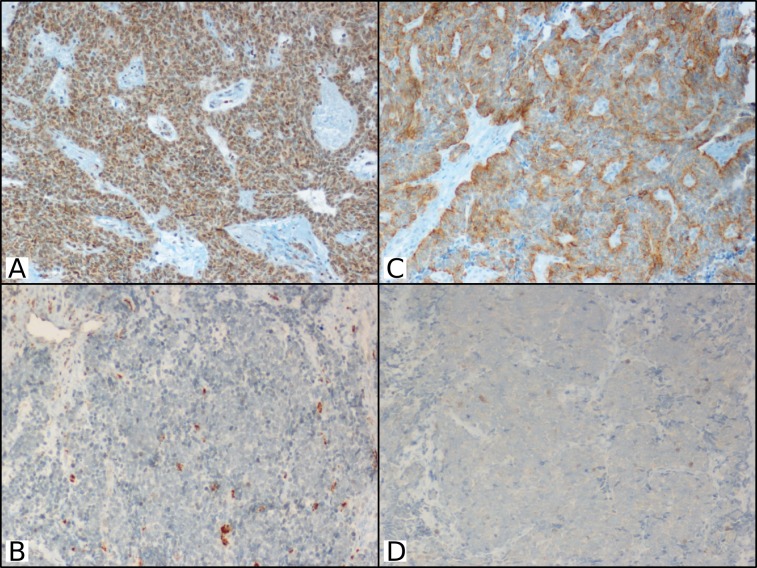
Bronchopulmonary neuroendocrine tumors (BP-NETs) are separated into four subgroups: typical carcinoid tumor (TC), atypical carcinoid tumor (AC), large-cell neuroendocrine carcinoma (LCNEC) and small-cell lung carcinoma (SCLC). The signaling pathway involving AKT/mammalian target of rapamycin (mTOR) is crucial to the regulation of cell growth, proliferation and survival, and is frequently activated in human cancers. Consequently, mTOR is considered an attractive target for anticancer agents. The present study aimed to evaluate the expression of phosphorylated AKT and mTOR in a series of BP-NETs, and to analyze the correlations with clinicopathological parameters. p-AKT and p-mTOR levels were determined by immunohistochemistry in a series of 210 BP-NETs, including 85 SCLCs, 17 LCNECs, 26 ACs, 75 TCs and 7 tumorlets. Higher p-AKT and p-mTOR expression levels were identified in the majority of tumorlets and carcinoids in comparison to the LCNECs (P=0.0001) and SCLCs (P=0.0002). Furthermore, a significant association was observed between p-mTOR expression and tumor size (T) in SCLCs (P=0.04) and LCNECs (P=0.03): T3-T4 tumors exhibited significantly lower p-mTOR expression compared to T1-T2 tumors. In conclusion, most of the BP-NETs examined in this study expressed p-AKT and p-mTOR, suggesting that the AKT/mTOR pathway plays an important role in these tumors. Additionally, our results confirm that low- to intermediate-grade tumors are more closely associated to each other than to high-grade tumors, despite sharing common classification and a common origin from neuroendocrine cells. These findings improve our knowledge of the biological characterization of these tumors and indicate new therapeutic opportunities for the treatment of BP-NETs.
Figures
References
-
- Travis WD, Brambilla E, Muller-Hermelink HK, Harris CC. World Health Organization Classification of Tumours. Pathology and Genetics of Tumours of the Lung, Pleura, Thymus and Heart. IARC Press; Lyon: 2004.
-
- Travis WD, Rush W, Flieder DB, Falk R, Fleming MV, Gal AA, Koss MN. Survival analysis of 200 pulmonary neuroendocrine tumors with clarification of criteria for atypical carcinoid and its separation from typical carcinoid. Am J Surg Pathol. 1998;22:934–944. - PubMed
-
- Canessa PA, Santini D, Zanelli M, Capecchi V. Pulmonary tumourlets and microcarcinoids in bronchiectasis. Monaldi Arch Chest Dis. 1997;52:138–139. - PubMed
-
- Watanabe H, Kobayashi H, Honma K, Ohnishi Y, Iwafuchi M. Diffuse panbronchiolitis with multiple tumorlets. A quantitative study of the Kultschitzky cells and the clusters. Acta Pathol Jpn. 1985;35:1221–1231. - PubMed
-
- Granberg D, Wilander E, Oberg K, Skogseid B. Prognostic markers in patients with typical bronchial carcinoid tumors. J Clin Endocrinol Metab. 2000;85:3425–3430. - PubMed
LinkOut - more resources
Full Text Sources
Molecular Biology Databases
Miscellaneous