


Risk assessment of PM(2.5) to child residents in Brazilian Amazon region with biofuel production
- PMID: 22978271
- PMCID: PMC3465199
- DOI: 10.1186/1476-069X-11-64
Risk assessment of PM(2.5) to child residents in Brazilian Amazon region with biofuel production
Abstract
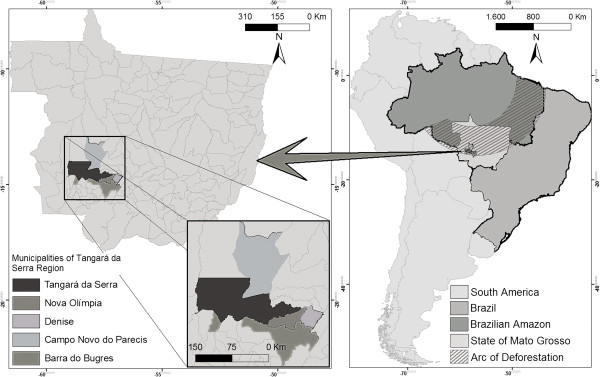
Background: Exposure to fine fractions of particulate matter (PM(2.5)) is associated with increased hospital admissions and mortality for respiratory and cardiovascular disease in children and the elderly. This study aims to estimate the toxicological risk of PM(2.5) from biomass burning in children and adolescents between the age of 6 and 14 in Tangará da Serra, a municipality of Subequatorial Brazilian Amazon.
Methods: Risk assessment methodology was applied to estimate the risk quotient in two scenarios of exposure according to local seasonality. The potential dose of PM(2.5) was estimated using the Monte Carlo simulation, stratifying the population by age, gender, asthma and Body Mass Index (BMI).
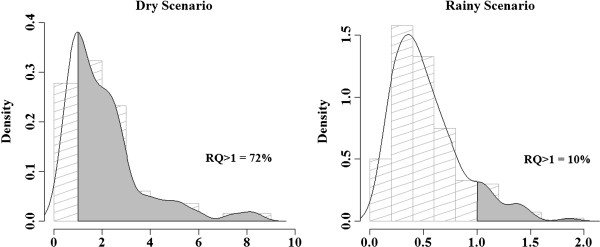
Results: Male asthmatic children under the age of 8 at normal body rate had the highest risk quotient among the subgroups. The general potential average dose of PM(2.5) was 1.95 μg/kg.day (95% CI: 1.62 - 2.27) during the dry scenario and 0.32 μg/kg.day (95% CI: 0.29 - 0.34) in the rainy scenario. During the dry season, children and adolescents showed a toxicological risk to PM(2.5) of 2.07 μg/kg.day (95% CI: 1.85 - 2 .30).
Conclusions: Children and adolescents living in the Subequatorial Brazilian Amazon region were exposed to high levels of PM(2.5) resulting in toxicological risk for this multi-pollutant. The toxicological risk quotients of children in this region were comparable or higher to children living in metropolitan regions with PM(2.5) air pollution above the recommended limits to human health.
Figures
References
-
- Brauer M, Amann M, Burnett RT, Cohen A, Dentener F, Ezzati M, Henderson SB, Krzyzanowski M, Martin RV, Van Dingenen, van Donkelaar A, Thurston DG. Exposure assessment for estimation of the global burden of disease attributable to outdoor air pollution. Environ Sci Technol. 2012;46:652–660. doi: 10.1021/es2025752. - DOI - PMC - PubMed
-
- Ignotti E, Hacon Sde S, Junger WL, Mourão D, Longo K, Freitas S, Artaxo P, Leon AC. Air pollution and hospital admissions for respiratory diseases in the subequatorial Amazon: a time-series approach. Cad Saúde Pública. 2010;26:747–776. - PubMed
-
- Fearnside PM. Desmatamento na Amazônia: Dinâmica, impactos e controle. Acta Amaz. 2006;36:395–400.
Publication types
MeSH terms
Substances
LinkOut - more resources
Full Text Sources
Medical
