


Differences in the biokinetics of inhaled nano- versus micrometer-sized particles
- PMID: 22980029
- PMCID: PMC3556515
- DOI: 10.1021/ar300043r
Differences in the biokinetics of inhaled nano- versus micrometer-sized particles
Abstract
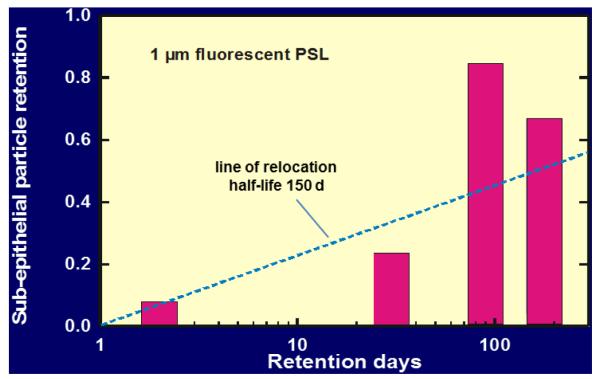
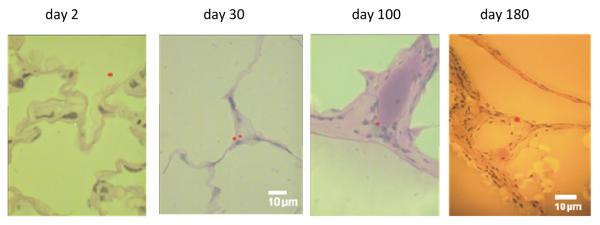
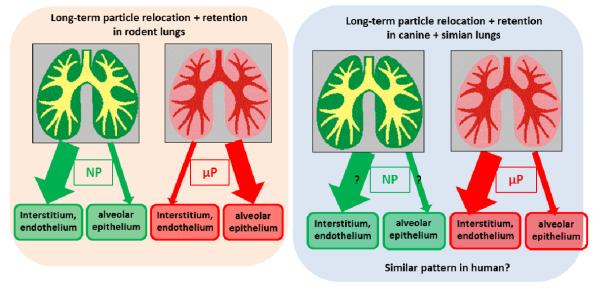
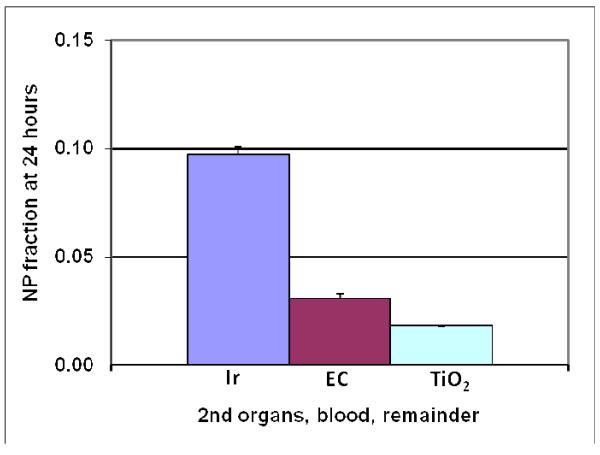
Researchers need to study the biokinetics of inhaled biopersistent nano- and micrometer-sized particles (NPs and μPs) to assess their toxicity and to develop an understanding of their potential risks. When particles are inhaled, they do not necessarily remain at their sites of deposition in the respiratory tract. Instead they can undergo numerous transport processes within the various tissues of the lungs, including clearance from the lungs. In this context, we would like to understand how the biokinetic studies performed in animals can be extrapolated to humans. Interestingly, the particle retention is much shorter in rodent lungs and declines much faster than it does in human, simian, and canine lungs. The predominant long-term clearance pathway for both NPs and μPs in humans and other animal species is macrophage-mediated particle transport from the peripheral lungs toward ciliated airways and the larynx. However, the transport rate is 10 times higher in rodents than in other species. In addition to particle clearance out of the lung, we also observe particle redistribution from the epithelium toward and within the interstitium and lymph nodes of the lung and particle translocation to blood circulation leading to subsequent accumulation in secondary organs. While μPs have limited access to interstitial spaces in the rodent lungs, NPs rapidly relocate in the epithelium and the underlying interstitium. By contrast, indirect evidence shows that both NPs and μPs are relocated into the epithelium and interstitial spaces of the human, simian, and canine lungs. Only NPs translocate into the circulatory system and subsequently accumulate in the secondary organs and tissues of the body. Translocated NP fractions are rather low, but they depend strongly on the physicochemical properties of the NP and their surface properties. Growing evidence indicates that the binding and conjugation of proteins to NPs play an essential role in translocation across cellular membranes and organ barriers. In summary, particle biokinetics result from a multitude of highly dynamic processes, which depend not only on physicochemical properties of the particles but also on a multitude of cellular and molecular responses and interactions. Given the rather small accumulation in secondary organs after acute inhalation exposures, it appears likely that adverse effects caused by NPs accumulated in secondary organs may only occur after chronic exposure over extended time periods. Therefore adverse health effects in secondary organs such as the cardiovascular system that are associated with chronic exposure of ambient urban air pollution are less likely to result from particle translocation. Instead, chronic particle inhalation could trigger or modulate the autonomous nervous system or the release of soluble mediators into circulation leading to adverse health effects.
Figures
References
-
- ICRP Human respiratory tract model for radiological protection. A report of a Task Group of the International Commission on Radiological Protection. Ann. ICRP. 1994;24:1–482. - PubMed
-
- US-EPA Particulate Matter (PM) Standards Revision - 2006. Vol. 2006. US Government; 2006.
-
- Stone KC, Mercer RR, Gehr P, Stockstill B, Crapo JD. Allometric relationships of cell numbers and size in the mammalian lung. Am. J. Respir. Cell Mol. Biol. 1992;6:235–243. - PubMed
-
- Kreyling WG, Scheuch G. Clearance of particles deposited in the lungs. In: Gehr P, Heyder J, editors. Particle-Lung Interactions. Marcel Bekker,Inc.; New York; Basel: 2000. pp. 323–376.
Publication types
MeSH terms
Grants and funding
LinkOut - more resources
Full Text Sources
Miscellaneous
