


Asthma and proinflammatory conditions: a population-based retrospective matched cohort study
- PMID: 22980164
- PMCID: PMC3538394
- DOI: 10.1016/j.mayocp.2012.05.020
Asthma and proinflammatory conditions: a population-based retrospective matched cohort study
Abstract
Objective: To determine the association between asthma and proinflammatory conditions.
Participants and methods: This population-based retrospective matched cohort study enrolled all asthmatic patients among Rochester, Minnesota, residents between January 1, 1964, and December 31, 1983. For each asthmatic patient, 2 age-and sex-matched nonasthmatic individuals were drawn from the same population. The asthmatic and nonasthmatic cohorts were followed forward in the Rochester Epidemiology Project diagnostic index for inflammatory bowel disease (IBD), rheumatoid arthritis (RA), diabetes mellitus (DM), and coronary heart disease (CHD) as outcome events. Data were fitted to Cox proportional hazards models.
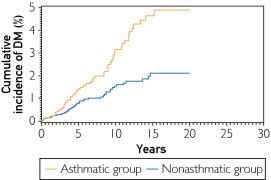
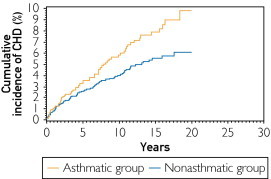
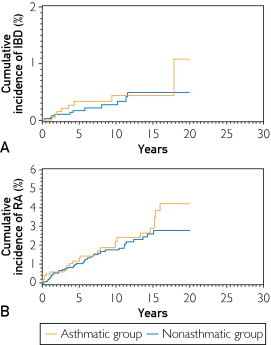
Results: We identified 2392 asthmatic patients and 4784 nonasthmatic controls. Of the asthmatic patients, 1356 (57%) were male, and mean age at asthma onset was 15.1 years. Incidence rates of IBD, RA, DM, and CHD in nonasthmatic controls were 32.8, 175.9, 132.0, and 389.7 per 100,000 person-years, respectively; those for asthmatic patients were 41.4, 227.9, 282.6, and 563.7 per 100,000 person-years, respectively. Asthma was associated with increased risks of DM (hazard ratio, 2.11; 95% confidence interval, 1.43-3.13; P<.001) and CHD (hazard ratio, 1.47; 95% confidence interval, 1.05-2.06; P=.02) but not with increased risks of IBD or RA.
Conclusion: Although asthma is a helper T cell type 2-predominant condition, it may increase the risks of helper T cell type 1-polarized proinflammatory conditions, such as CHD and DM. Physicians who care for asthmatic patients need to address these unrecognized risks in asthmatic patients.
Copyright © 2012 Mayo Foundation for Medical Education and Research. Published by Elsevier Inc. All rights reserved.
Figures
Comment in
-
Should we consider asthma as a risk factor for diabetes mellitus?Mayo Clin Proc. 2013 Feb;88(2):211. doi: 10.1016/j.mayocp.2012.11.009. Mayo Clin Proc. 2013. PMID: 23374624 No abstract available.
-
In reply.Mayo Clin Proc. 2013 Feb;88(2):211-2. doi: 10.1016/j.mayocp.2012.11.008. Mayo Clin Proc. 2013. PMID: 23374625 No abstract available.
References
-
- Lethbridge-Cejku M., Vickerie J. National Center for Health Statistics; Hyattsville, MD: 2005. Summary of Health Statistics for US Adults: National Health Interview Survey, 2003. - PubMed
-
- Centers for Disease Control and Prevention (CDC) Forecasted state-specific estimates of self-reported asthma prevalence—United States, 1998. MMWR Morb Mortal Wkly Rep. 1998;47(47):1022–1025. - PubMed
-
- World Health Organization Fact sheet for asthma No. 307. http://www.who.int/mediacentre/factsheets/fs307/en/index.html Accessed October 26, 2006.
-
- Anandan C., Nurmatov U., van Schayck O.C.P., Sheikh A. Is the prevalence of asthma declining? systematic review of epidemiological studies. Allergy. 2010;65(2):152–167. - PubMed
-
- Centers for Disease Control and Prevention (CDC) Vital signs: asthma prevalence, disease characteristics, and self-management education—United States, 2001-2009. MMWR Morb Mortal Wkly Rep. 2011;60(17):547–552. - PubMed
