Review
. 2012 Nov;33(11):611-20.
doi: 10.1016/j.tips.2012.08.003. Epub 2012 Sep 14.

Anxioselective anxiolytics: on a quest for the Holy Grail

Affiliations
Review

Anxioselective anxiolytics: on a quest for the Holy Grail

Phil Skolnick. Trends Pharmacol Sci. 2012 Nov.

Abstract

The discovery of benzodiazepine receptors provided the impetus to discover and develop anxioselective anxiolytics ('Valium without the side effects'). The market potential for an anxioselective based on the γ-aminobutyric acid A (GABA(A)) receptor resulted in clinical trials of multiple compounds. In contrast to the anxioselective profile displayed in preclinical models, compounds such as bretazenil, TPA023, and MRK 409 produced benzodiazepine-like side effects (sedation, dizziness) in Phase I studies, whereas alpidem and ocinaplon exhibited many of the characteristics of an anxioselective in the clinic. Alpidem was briefly marketed for the treatment of anxiety, but was withdrawn because of liver toxicity. Reversible elevations in liver enzymes halted development of ocinaplon in Phase III. The clinical profiles of these two molecules demonstrate that it is possible to develop GABA(A) receptor-based anxioselectives. However, despite the formidable molecular toolbox at our disposal, we are no better informed about the GABA(A) receptors responsible for an anxioselective profile in the clinic. Here, I discuss the evolution of a quest, spanning four decades, for molecules that retain the rapid and robust anti-anxiety actions of benzodiazepines without the side effects that limit their usefulness.


Figures

Fig. 1
Fig. 1
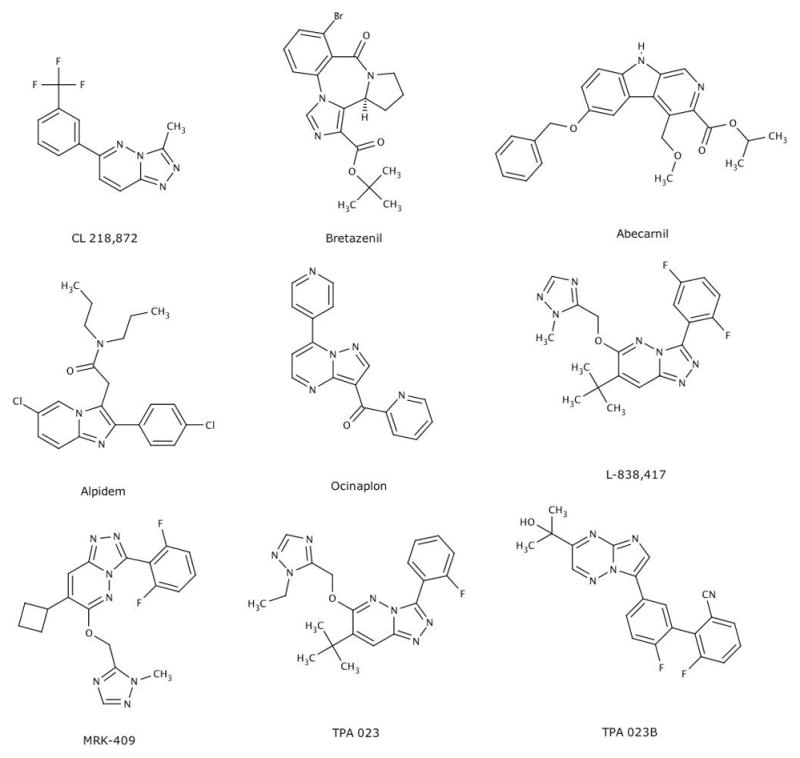
Representative molecules exhibiting anxioselective profiles in preclinical models. Among the nine compounds illustrated here, six (bretazenil, abecarnil, alpidem, ocinaplon, MRK 409, TPA023, TPA 023B) were advanced to the clinic.
Fig.2
Fig.2
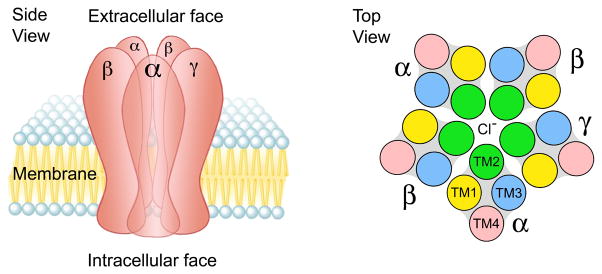
Schematic representation of a GABAA receptor. This GABAA receptor is constituted as an αβγ heteropentamer with 3 different subunits. Left panel: side view in a postsynaptic membrane. Right panel: top view. The second transmembrane domain (TM2) of each subunit forms the lumen of the GABA-gated chloride channel. The binding site for BZs and the other molecules highlighted in Fig. 1 is formed by the extracellular domains of the α and γ subunits *8,24+. This figure is adapted from Berezhnoy, et al. [24].
Figure 3
Figure 3
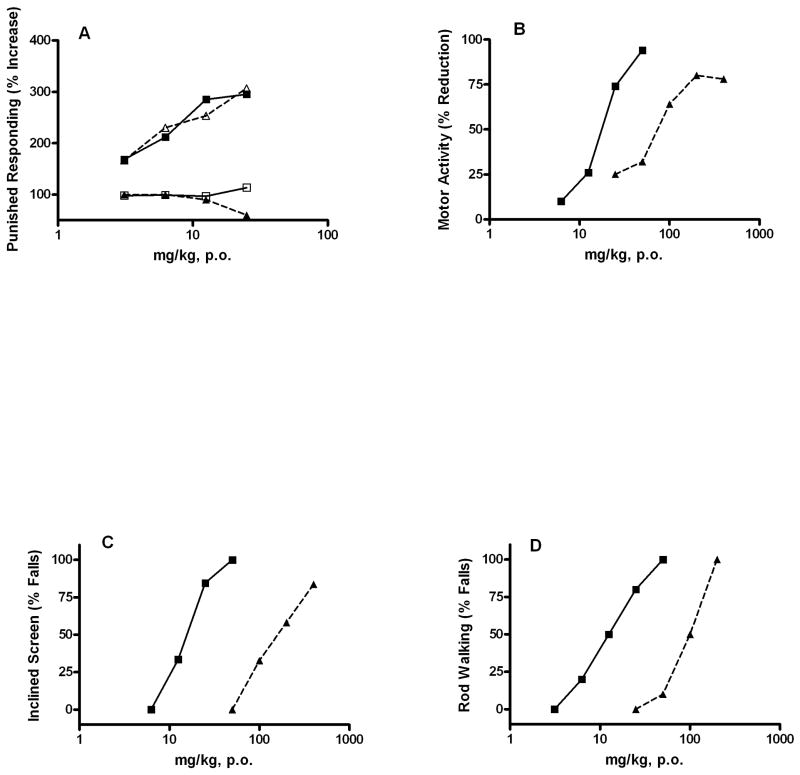
Comparison of the pharmacological properties of ocinaplon and diazepam: Adult, male CD rats (Charles River) were administered vehicle, ocinaplon or diazepam by gavage. Panel A: Anticonflict actions of ocinaplon and diazepam: blockade by flumazenil. Animals were evaluated 60 min. later in the “thirsty rat conflict” test, essentially as described [31]). In brief, rats were water deprived for 48 hours and food deprived for 24 hours prior to testing. Rats were placed in the test chamber, and a 10% glucose solution made available through a stainless steel spout. After locating the spout, the rat was allowed 25 seconds of free (no shock) drinking. A circuit was then activated which applied a mild electric shock through the spout in a 5-seconds “on” 5-seconds “off” schedule for 5 minutes. The number of shocks delivered (the animal must be in contact with the spout to receive a shock) is recorded. Parallel groups received flumazenil (12.5 mg/kg, i.p.) 30 min. prior to testing. This dose of flumazenil does not affect performance in the thirsty rat conflict test (data not shown). The minimum effective dose (MED; the first dose producing a statistically significant difference from vehicle treated rats) of ocinaplon and diazepam was 3.1 mg/kg. Values represent the mean (n ≥ 8 animals/dose) % increase in punished responding compared to vehicle treated rats. Symbols: open triangles, ocinaplon; closed squares, diazepam; closed triangles, ocinaplon+flumazenil; open squares squares: diazepam+flumazenil. Panel B: Effects of ocinaplon and diazepam on motor activity in rats. Compounds were evaluated 60 minutes after oral administration. Values represent the mean % decrease in motor activity of 12–24 rats/dose compared to vehicle treated animals. The ED50 of diazepam and ocinaplon was 17.5 and 81.7 mg/kg, respectively. Symbols: Open triangles, ocinaplon; closed squares, diazepam. Panel C: Effects of ocinaplon and diazepam on the inclined screen: The effect of diazepam and ocinaplon was evaluated on the ability of rats to remain on an inclined (60°) screen for 30 min. The ED50 of diazepam and ocinaplon was 15.5 (3.5–24.9, 95% C.I.) and 172.2 (123.3–244.5, 95% C.I.) mg/kg, respectively. Symbols as in Panel B. Panel D: Effects of ocinaplon and diazepam on rod walking: Animals were trained to traverse a rod inclined at 17°. Values represent the mean of 10 rats/dose. The ED50 of diazepam and ocinaplon was 13.8 (2.7–20.4, 95% C.I.) and 92 (68–124, 95% C.I.) mg/kg, respectively. Symbols: as in Panel B. These data are redrawn from Lippa, et al. [30].

Comment in

References

    1. Stahl S. Don’t ask, don’t tell, but benzodiazepines are still the leading treatments for anxiety disorder. The Journal of clinical psychiatry. 2002;63:756–757. - PubMed
    1. Nash JR, Nutt D. Pharmacotherapy of anxiety. In: Sibley DR, et al., editors. Handbook of Contemporary Neuropharmacology. John Wiley & Sons; 2007. pp. 59–91.
    1. Wittchen HU, Hoyer J. General anxiety disorder: nature and course. J Clinical Psychiatry. 2011;62(Suppl 11):15–21. - PubMed
    1. Pollack MH. Paroxetine in the treatment of generalized anxiety disorder: results of a placebo-controlled, flexible-dosage trial. The Journal of clinical psychiatry. 2001;62:350–357. - PubMed
    1. Pande A, et al. Pregabalin in generalized anxiety disorder: a placebo-controlled trial. The American journal of psychiatry. 2003;160:533–540. - PubMed

MeSH terms