


The future of human DNA vaccines
- PMID: 22981627
- PMCID: PMC3511659
- DOI: 10.1016/j.jbiotec.2012.08.012
The future of human DNA vaccines
Abstract
DNA vaccines have evolved greatly over the last 20 years since their invention, but have yet to become a competitive alternative to conventional protein or carbohydrate based human vaccines. Whilst safety concerns were an initial barrier, the Achilles heel of DNA vaccines remains their poor immunogenicity when compared to protein vaccines. A wide variety of strategies have been developed to optimize DNA vaccine immunogenicity, including codon optimization, genetic adjuvants, electroporation and sophisticated prime-boost regimens, with each of these methods having its advantages and limitations. Whilst each of these methods has contributed to incremental improvements in DNA vaccine efficacy, more is still needed if human DNA vaccines are to succeed commercially. This review foresees a final breakthrough in human DNA vaccines will come from application of the latest cutting-edge technologies, including "epigenetics" and "omics" approaches, alongside traditional techniques to improve immunogenicity such as adjuvants and electroporation, thereby overcoming the current limitations of DNA vaccines in humans.
Copyright © 2012 Elsevier B.V. All rights reserved.
Conflict of interest statement
The authors are employees or directors of Vaxine Pty Ltd, a company developing vaccine technologies including Advax™ adjuvant.
Figures
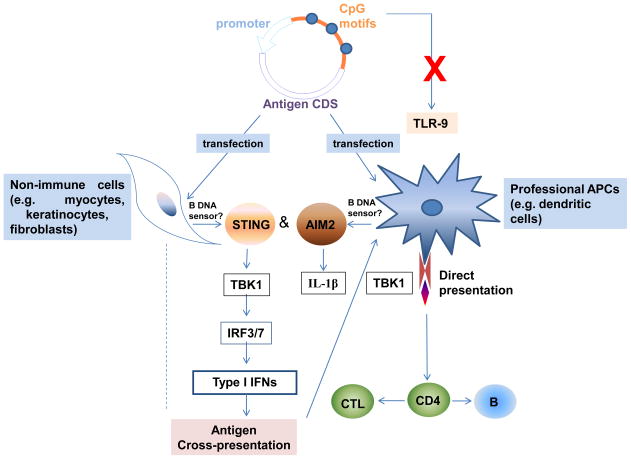
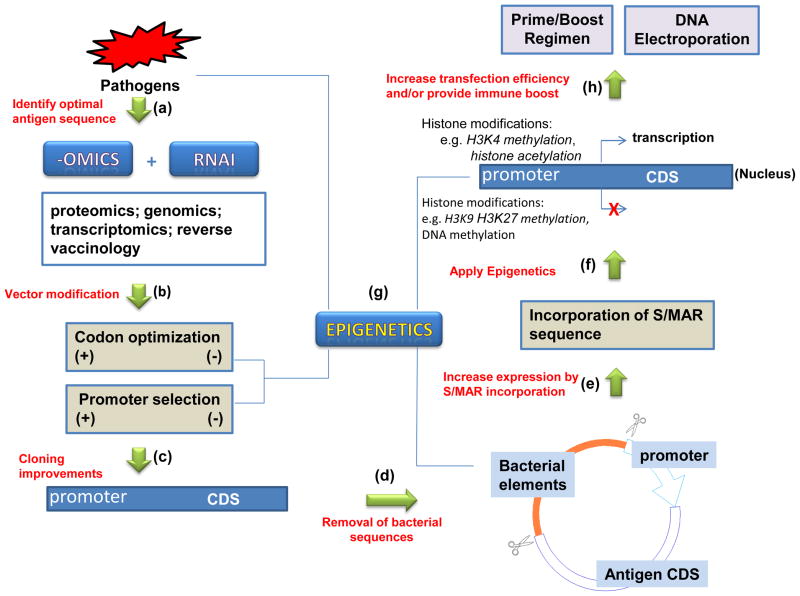
References
-
- Anwar A, Chandrasekaran A, Ng ML, Marques E, August JT. West Nile premembrane-envelope genetic vaccine encoded as a chimera containing the transmembrane and cytoplasmic domains of a lysosome-associated membrane protein: increased cellular concentration of the transgene product, targeting to the MHC II compartment, and enhanced neutralizing antibody response. Virology. 2005;332:66–77. - PubMed
-
- Argilaguet JM, Perez-Martin E, Gallardo C, Salguero FJ, Borrego B, Lacasta A, Accensi F, Diaz I, Nofrarias M, Pujols J, Blanco E, Perez-Filgueira M, Escribano JM, Rodriguez F. Enhancing DNA immunization by targeting ASFV antigens to SLA-II bearing cells. Vaccine. 2011;29:5379–5385. - PubMed
-
- Argyros O, Wong SP, Fedonidis C, Tolmachov O, Waddington SN, Howe SJ, Niceta M, Coutelle C, Harbottle RP. Development of S/MAR minicircles for enhanced and persistent transgene expression in the mouse liver. J Mol Med (Berl) 2011;89:515–529. - PubMed
-
- Barber GN. Cytoplasmic DNA innate immune pathways. Immunol Rev. 2011;243:99–108. - PubMed
Publication types
MeSH terms
Substances
Grants and funding
LinkOut - more resources
Full Text Sources
Other Literature Sources
