


Signal transduction via the T cell antigen receptor in naïve and effector/memory T cells
- PMID: 22981631
- PMCID: PMC3532926
- DOI: 10.1016/j.biocel.2012.08.023
Signal transduction via the T cell antigen receptor in naïve and effector/memory T cells
Abstract
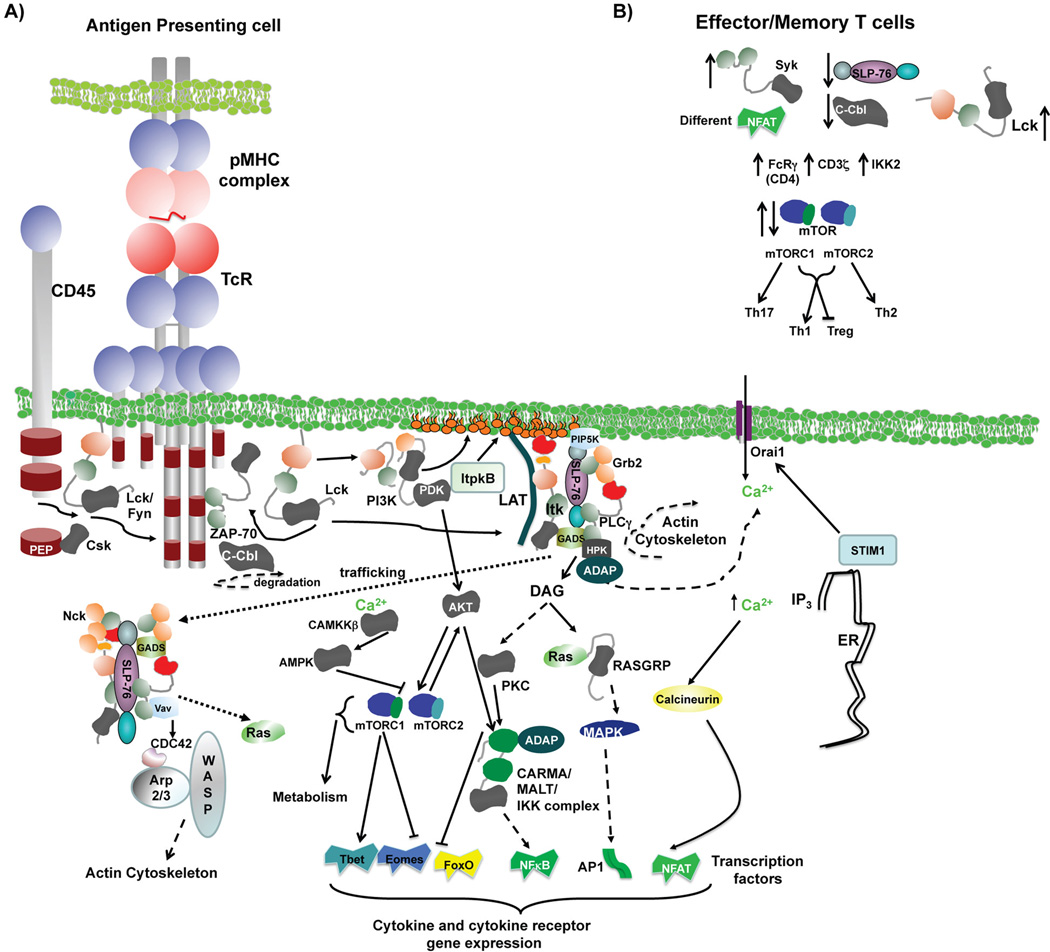
T cells play an indispensable role in immune defense against infectious agents, but can also be pathogenic. These T cells develop in the thymus, are exported into the periphery as naïve cells and participate in immune responses. Upon recognition of antigen, they are activated and differentiate into effector and memory T cells. While effector T cells carry out the function of the immune response, memory T cells can last up to the life time of the individual, and are activated by subsequent antigenic exposure. Throughout this life cycle, the T cell uses the same receptor for antigen, the T cell Receptor, a complex multi-subunit receptor. Recognition of antigen presented by peptide/MHC complexes on antigen presenting cells unleashes signaling pathways that control T cell activation at each stage. In this review, we discuss the signals regulated by the T cell receptor in naïve and effector/memory T cells.
Copyright © 2012 Elsevier Ltd. All rights reserved.
Conflict of interest statement
The authors have no conflicting financial interests.
Figures
References
-
- Anderson G, Moore N, Owen J, Jenkinson EJ. Cellular interactions in thymocyte development. Annu. Rev. Immunol. 1996a;14:73–99. - PubMed
-
- Anderson G, Moore NC, Owen JJ, Jenkinson EJ. Cellular interactions in thymocyte development. Annu Rev Immunol. 1996b;14:73–99. - PubMed
-
- Anderson KA, Ribar TJ, Lin F, Noeldner PK, Green MF, Muehlbauer MJ, Witters LA, Kemp BE, Means AR. Hypothalamic CaMKK2 contributes to the regulation of energy balance. Cell Metab. 2008;7:377–388. - PubMed
Publication types
MeSH terms
Substances
Grants and funding
LinkOut - more resources
Full Text Sources
Research Materials
