


Educational attainment and late life telomere length in the Health, Aging and Body Composition Study
- PMID: 22981835
- PMCID: PMC3543785
- DOI: 10.1016/j.bbi.2012.08.014
Educational attainment and late life telomere length in the Health, Aging and Body Composition Study
Abstract
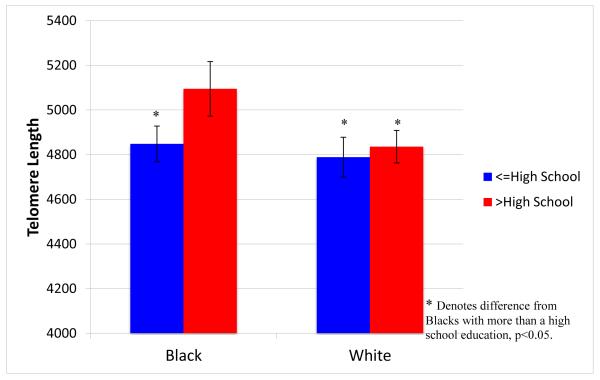
Morbidity and mortality are greater among socially disadvantaged racial/ethnic groups and those of lower socioeconomic status (SES). Greater chronic stress exposure in disadvantaged groups may contribute to this by accelerating cellular aging, indexed by shorter age-adjusted telomere length. While studies consistently relate shorter leukocyte telomere length (LTL) to stress, the few studies, mostly from the UK, examining associations of LTL with SES have been mixed. The current study examined associations between educational attainment and LTL among 2599 high-functioning black and white adults age 70-79 from the Health, Aging and Body Composition Study. Multiple regression analyses tested associations of race/ethnicity, educational attainment and income with LTL, adjusting for potential confounders. Those with only a high school education had significantly shorter mean LTL (4806 basepairs) than those with post-high school education (4926 basepairs; B=125, SE=47.6, p=.009). A significant interaction of race and education (B=207.8, SE=98.7, p=.035) revealed more beneficial effects of post-high school education for blacks than for whites. Smokers had shorter LTL than non-smokers, but the association of education and LTL remained significant when smoking was covaried (B=119.7, SE=47.6, p=.012). While higher income was associated with longer LTL, the effect was not significant (p>.10). This study provides the first demonstration of an association between educational attainment and LTL in a US population where higher education appears to have a protective effect against telomere shortening, particularly in blacks.
Copyright © 2012 Elsevier Inc. All rights reserved.
Figures
Comment on
-
A stepforward in understanding the association between social attainment and health disparities: evidence from late life telomere length and educational level.Brain Behav Immun. 2013 Jan;27(1):13-4. doi: 10.1016/j.bbi.2012.09.005. Epub 2012 Sep 23. Brain Behav Immun. 2013. PMID: 23010453 No abstract available.
References
-
- Adler NE, Snibbe AC. The role of psychosocial processes in explaining the gradient between socioeconomic status and health. Current Directions in Psychological Science. 2003;12:119–123.
-
- Adler NE, Stewart J. Health disparities across the lifespan: meaning, methods, and mechanisms. Ann. N. Y. Acad. Sci. 2010;1186:5–23. - PubMed
-
- Adler NE. Cell aging and social disadvantage: perspectives on mechanisms underlying health disparities from “across the pond”. Brain Behav. Immun. 2011;25:1290–1291. - PubMed
-
- Ainsworth BE, Haskell WL, Leon AS, Jacobs DR, Jr, Montoye HJ, Sallis JF, Paffenbarger RS., Jr. Compendium of physical activities: classification of energy costs of human physical activities. Med. Sci. Sports. Exerc. 1993;25:71–80. - PubMed
-
- Batty GD, Wang Y, Brouilette SW, Shiels P, Packard C, Moore J, Samani NJ, Ford I. Socioeconomic status and telomere length: the West of Scotland Coronary Prevention Study. J. Epidemiol. Community Health. 2009;63:839–41. - PubMed
Publication types
MeSH terms
Grants and funding
LinkOut - more resources
Full Text Sources
Other Literature Sources
Medical
