Review
. 2013 Jan;1829(1):84-97.
doi: 10.1016/j.bbagrm.2012.08.008. Epub 2012 Sep 7.

Transcription-associated histone modifications and cryptic transcription

Affiliations
Review

Transcription-associated histone modifications and cryptic transcription

Michaela Smolle et al. Biochim Biophys Acta. 2013 Jan.

Abstract

Eukaryotic genomes are packaged into chromatin, a highly organized structure consisting of DNA and histone proteins. All nuclear processes take place in the context of chromatin. Modifications of either DNA or histone proteins have fundamental effects on chromatin structure and function, and thus influence processes such as transcription, replication or recombination. In this review we highlight histone modifications specifically associated with gene transcription by RNA polymerase II and summarize their genomic distributions. Finally, we discuss how (mis-)regulation of these histone modifications perturbs chromatin organization over coding regions and results in the appearance of aberrant, intragenic transcription. This article is part of a Special Issue entitled: RNA polymerase II Transcript Elongation.


Figures

Figure 1
Figure 1
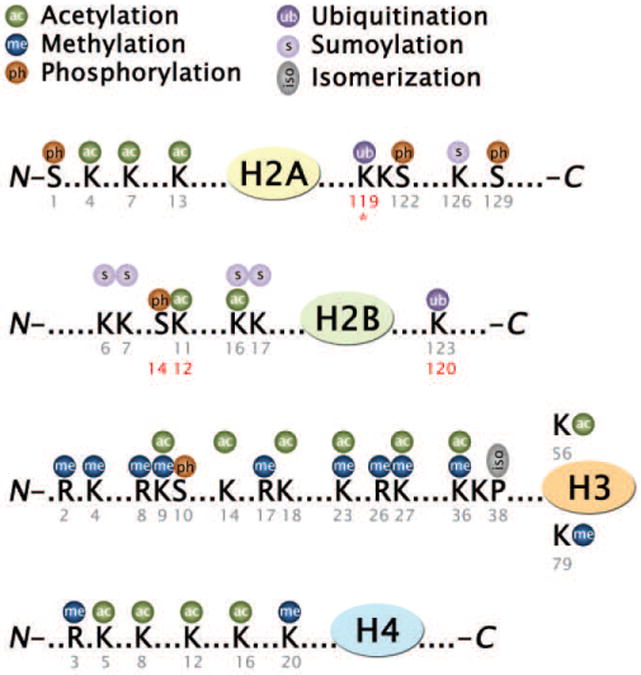
Posttranslational modifications associated with yeast histones. Alternative residue numbers that refer to mammalian histones are shown in red. Ubiquitination of histone H2A on K119 does not exist in yeast (*).
Figure 2
Figure 2
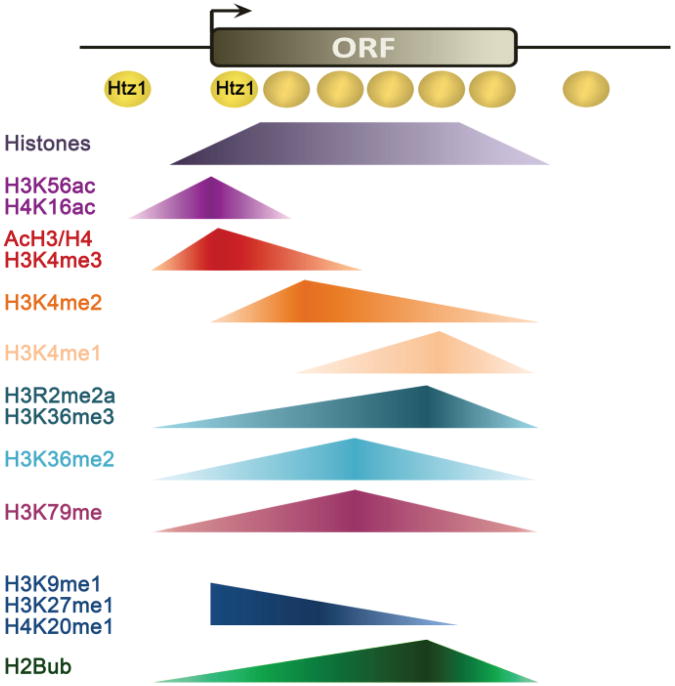
Genome-wide distribution patterns of histone modifications involved in transcription. Distributions are shown relative to an average yeast gene: the promoter, transcription start site (arrow), coding sequence (ORF) and 3′ intergenic region are shown. All data sets refer to yeast with the exception of H3K9, H3K27 and H4K20 methylation.
Figure 3
Figure 3
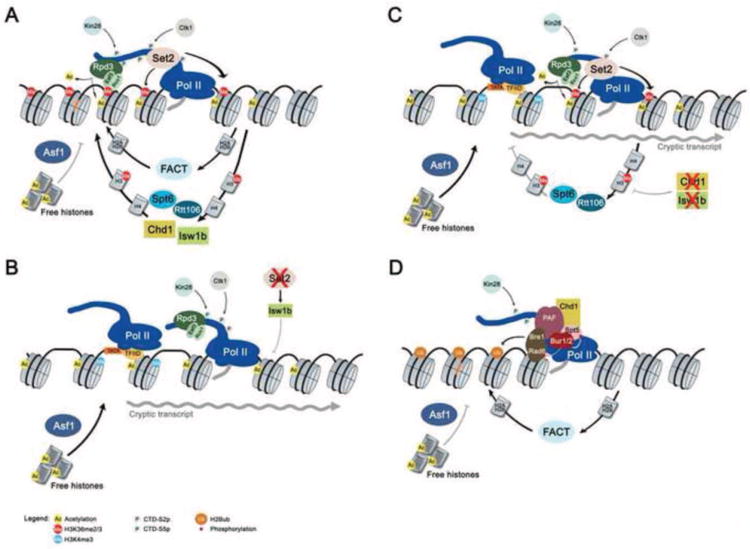
Perturbation of chromatin structure leads to aberrant intragenic transcription. (A) Histone chaperones like FACT, Spt6 and Rtt106 aid transcription elongation by disassembly of nucleosomes in front of Pol II and subsequent reassembly in its wake. Kin28 and Ctk1 specifically phosphorylate Ser5 and Ser2 within the CTD heptad repeats, respectively. Set2 is recruited to the elongating polymerase through the Ser2 phosphorylated form of the CTD and methylates Lys36 on histone H3. Methylated H3K36 recruits chromatin remodelers such as Isw1b and ensures the retention of these nucleosomes over ORFs . Maintaining H3K36 methylated nucleosomes disfavours incorporation of free, acetylated histones in their stead. Any remaining histone acetylation is removed by the Rpd3S histone deacetylase. Rpd3S associates with the Ser5 phosphorylated form of the Pol II CTD and recognizes methylated H3K36 through the chromo- and PHD-domains of its Eaf3 and Rco1 subunits, respectively. H3K36 di- and trimethylation stimulates Rpd3S activity and hence the removal of acetyl marks from transcribed chromatin [171]. (B) Mutations in key proteins involved in this pathway lead to perturbations in chromatin structure. Deletion of SET2 completely abolishes H3K36 methylation and simultaneously allows for the incorporation of free, acetylated histones. Rpd3S is still recruited to ORFs through its association with Pol II. However, in the absence of H3K36 methylation it can no longer catalyze the removal of acetyl marks from histones H3 and H4. Alterations in the chromatin architecture and increased exposure of internal promoter-like sites lead to PIC formation and initiation of cryptic transcription from inside of open reading frames. (C) Absence of chromatin remodelers Isw1b and/or Chd1impairs the retention of H3K36-methylated nucleosomes in cis and leads to increased incorporation of free, acetylated histones over ORFs despite continued Set2 and Rpd3S activities. The resulting alterations in chromatin structure lead to PIC formation and cryptic transcription. (D) H2Bub exerts a stabilizing influence on nucleosomes. Establishment requires a complex cascade of factors: H2Bub requires active Pol II transcription as shown by its dependence on Ser5 CTD phosphorylation by Kin28. Transcribing Pol II further stimulates recruitment of the PAF complex through its association with phosphorylated Spt5 [61, 62]. PAF in turn associates with the Rad6/Bre1 ubiquitin ligase. Both Spt5 and Rad6 are also regulated by the Bur1/Bur2 protein kinase complex, further linking PAF binding and H2B ubiquitination. Chd1 may also be involved in this pathway since it is known to interact both with PAF and Spt5 [164]. Disruption of this cascade is envisaged to result in lower levels of H2Bub over ORFs and consequently reduced nucleosome occupancy which is thought to expose cryptic promoters.

References

    1. Luger K, Mader AW, Richmond RK, Sargent DF, Richmond TJ. Crystal structure of the nucleosome core particle at 2.8 A resolution. Nature. 1997;389:251–260. - PubMed
    1. Olins AL, Olins DE. Spheroid chromatin units (v bodies) Science. 1974;183:330–332. - PubMed
    1. Clark DJ, Felsenfeld G. A nucleosome core is transferred out of the path of a transcribing polymerase. Cell. 1992;71:11–22. - PubMed
    1. Studitsky VM, Kassavetis GA, Geiduschek EP, Felsenfeld G. Mechanism of transcription through the nucleosome by eukaryotic RNA polymerase. Science. 1997;278:1960–1963. - PubMed
    1. Nechaev S, Adelman K. Pol II waiting in the starting gates: Regulating the transition from transcription initiation into productive elongation. Biochim Biophys Acta. 2011;1809:34–45. - PMC - PubMed

LinkOut - more resources