. 2012 Oct 15;11(20):3887-95.
doi: 10.4161/cc.22133. Epub 2012 Sep 14.

The transcription factor CREBZF is a novel positive regulator of p53

Affiliations

The transcription factor CREBZF is a novel positive regulator of p53

Irene López-Mateo et al. Cell Cycle. .

Abstract

CREBZF is a member of the mammalian ATF/CREB family of transcription factors. Here, we describe a novel functional interaction between CREBZF and the tumor suppressor p53. CREBZF was identified in a yeast two-hybrid screen using HEY1, recently characterized as an indirect p53 activator, as bait. CREBZF interacts in vitro with both HEY1 and p53, and CREBZF expression stabilizes and activates p53. Moreover, CREBZF cooperates synergistically with HEY1 to enhance p53 transcriptional activity. On the other hand, partial depletion of endogenous CREBZF diminishes p53 protein levels and inhibits HEY1-mediated activation of p53. CREBZF-positive effects on p53 signaling may reflect, at least in part, an observed induction of posttranslational modifications in p53 known to prevent its degradation. CREBZF expression protects HCT116 cells from UV radiation-induced cell death. In addition, CREBZF expression confers sensitivity to 5-fluorouracil, a p53-activating chemotherapeutic drug. Our study suggests that CREBZF may participate in the modulation of p53 tumor suppressor function.


Figures
None
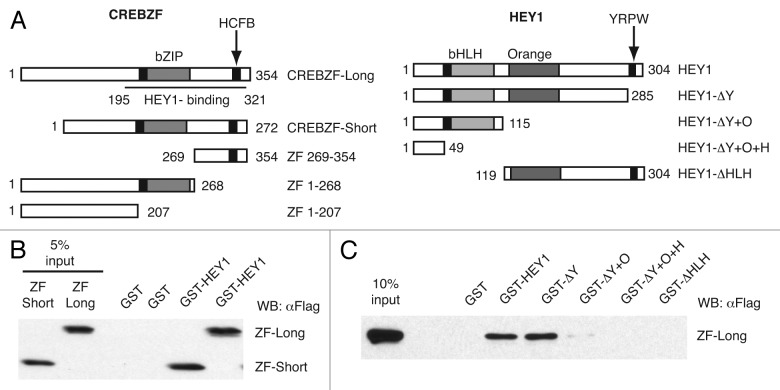
Figure 1. In vitro interaction of CREBZF with HEY1. (A) Schematic representation of full-length CREBZF, full-length HEY1 and the deletion mutants used in this study. (B) Whole-cell extracts from COS-1 cells previously transfected with expression vectors for flag-tagged CREBZF-long (ZF-long) or CREBZF-short (ZF-short) were incubated with GST fusion proteins of HEY1 coupled with Sepharose beads. The associated proteins were detected by western blotting using anti-Flag antibody. (C) Whole-cell extracts from COS-1 cells previously transfected with expression vectors for flag-tagged ZF-long were incubated with GST fusion proteins of full-length HEY1 or deletion mutants coupled with Sepharose beads. Bound proteins were detected by western blotting using anti-Flag antibody.
None
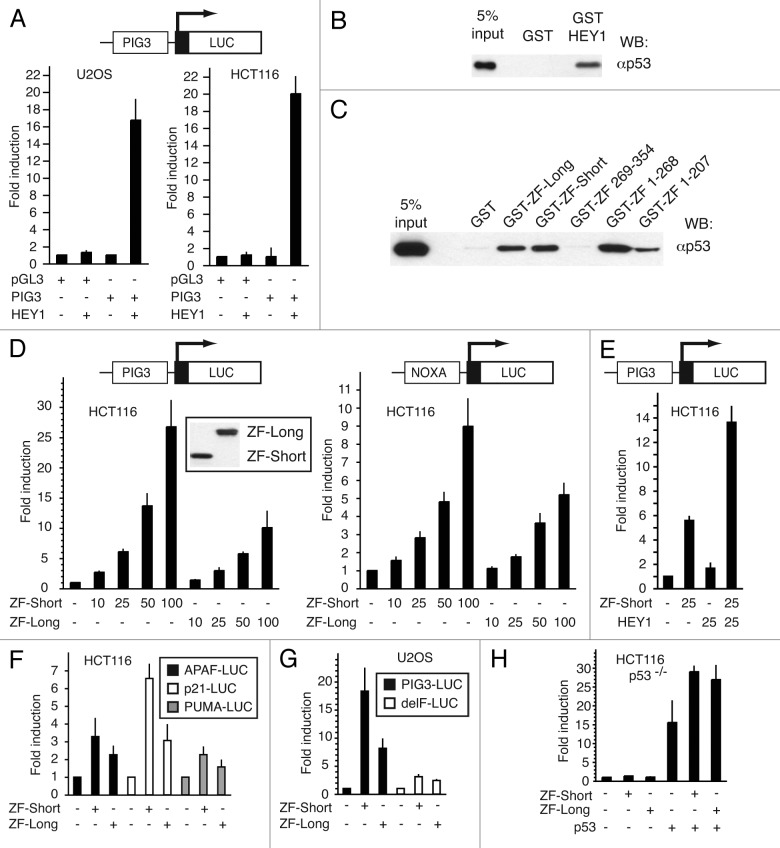
Figure 2. CREBZF positively regulates p53-dependent transactivation. (A) HEY1 greatly enhances PIG3-luciferase reporter activity. U2OS or HCT116 cells were transfected with 100 ng of empty pGL3 plasmid or PIG3-Luc in the presence or absence of 200 ng of expression vector for HEY1. (B) In vitro interaction of HEY1 with p53. Whole-cell extracts from COS-1 cells previously transfected with an expression vector for p53 were incubated with GST fusion proteins of HEY1 coupled with Sepharose beads. The associated proteins were detected by western blotting using anti-p53 antibody. (C) In vitro interaction of CREBZF with p53. Whole-cell extracts from COS-1 cells previously transfected with expression vectors for p53 were incubated with GST fusion proteins of CREBZF-long, CREBZF-short or deletion mutants coupled with Sepharose beads. The associated proteins were detected by western blotting using anti-p53 antibody. (D) HCT116 cells were transfected with 100 ng of PIG3-Luc reporter or 100 ng of NOXA-Luc reporter in the presence of increasing amounts (indicated in ng) of expression vector for CREBZF-long or Short (ZF-long or ZF-short). (E) HCT116 cells were transfected with 100 ng of PIG3-Luc in the presence or absence of 25 ng of expression vector for ZF-short, HEY1 or both together. (F) HCT116 cells were transfected with 100 ng of PIG3-Luc, p21-Luc or PUMA-LUC in the presence or absence of 100 ng of expression vector for ZF-long or ZF-short. (G) Deletion of the p53 binding site in PIG3 impairs CREBZF positive effect. U2OS cells were transfected with 100 ng of PIG3-Luc or PIG3 delF-Luc and 200 ng of expression vector for ZF-long or ZF-short. (H) CREBZF positive effect on PIG3 promoter depends on the p53 status. HCT116 p53−/− cells were transfected with 100 ng PIG3-Luc and expression vectors for ZF-long or ZF-short (200 ng) and p53 (5 ng) as indicated. In every case, after transfection, cells were washed and incubated 24 h. Subsequently, cell lysates were assayed using a dual luciferase reporter system. Normalized values are expressed relative to the activity of the reporter in the absence of HEY1 (A) or relative to the activity of the reporter in the absence of CREBZF (D–F) or relative to the activity of reporter in the absence CREBZF and p53 (G). The results shown represent the averages of results of three independent experiments assayed in duplicate + s.d.
None
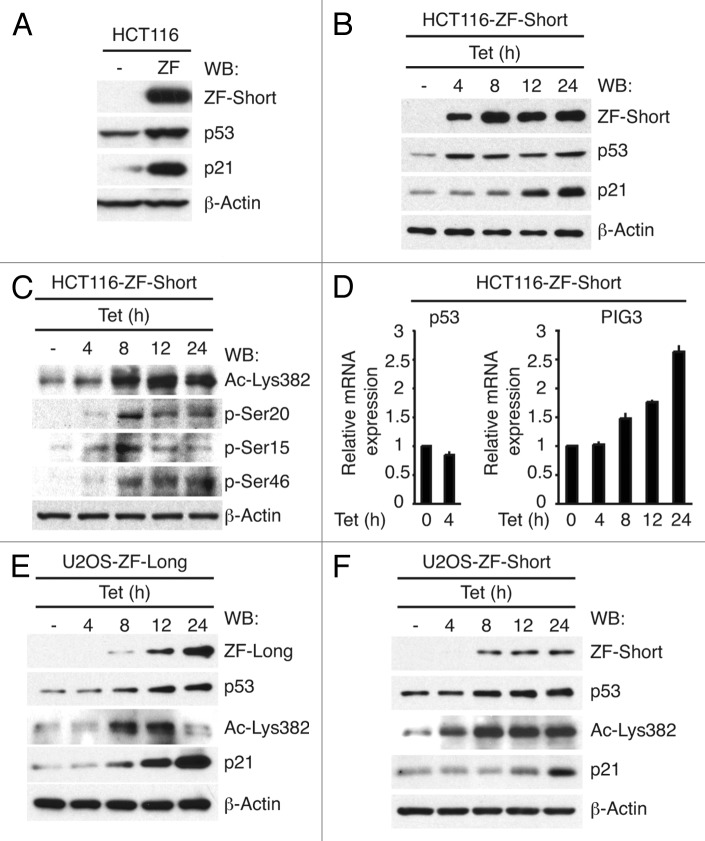
Figure 3. CREBZF expression stabilizes and activates p53. (A) HCT116 cells were transfected with expression vector for ZF-short and the levels of the indicated proteins were determined 24 h later by immunobloting. (B) Immunoblot expression of ZF-short, p53, p21 and β-actin in stable HCT116 cell lines expressing inducible CREBZF-short (HCT116-ZF-short) treated with 1 µg/ml tetracycline (Tet) for 4, 8, 12 or 24 h. (C) Induction of p53 phosphorylation and acetylation by ZF-short expression. HCT116-ZF-short cells were treated with 1 µg/ml tetracycline (Tet) for 4, 8, 12 or 24 h and proteins were analyzed by immunobloting with the indicated p53 phospho-specific antibodies, anti-Ac-Lys382-p53 or anti-β-actin. (D) Quantitative RT-PCR analysis for the expression of p53 and PIG3 transcripts in HCT116-ZF-short cells treated with 1 µg/ml tetracycline (Tet) for the indicated times. (E) Immunoblot expression of ZF-long, p53, Ac-Lys382-p53, p21 and β-actin in stable U2OS cell lines expressing inducible CREBZF-long (U2OS-ZF-long) treated with 1 µg/ml tetracycline (Tet) for 4, 8, 12 or 24 h. (F) Immunoblot expression of ZF-short, p53, Ac-Lys382-p53, p21 and β-actin in stable U2OS cell lines expressing inducible CREBZF-short (U2OS-short) treated with 1 µg/ml tetracycline (Tet) for 4, 8, 12 or 24 h.
None
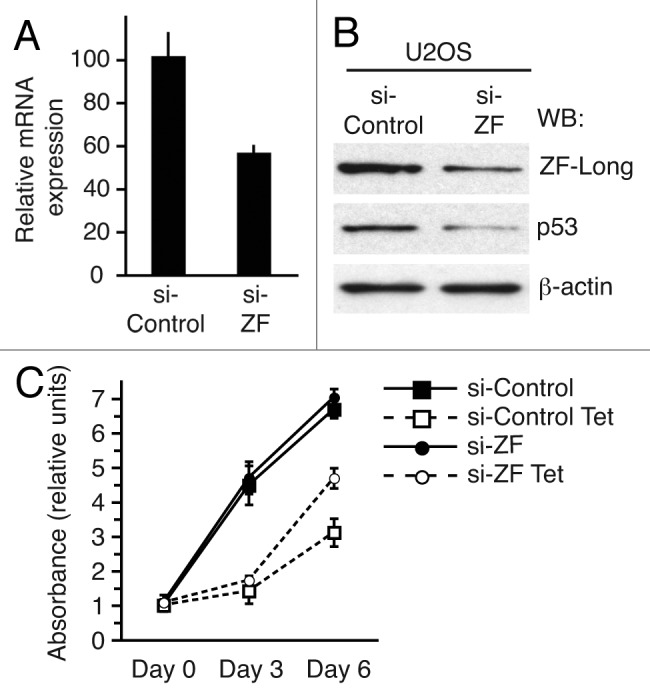
Figure 4. Partial CREBZF depletion diminishes cellular p53 protein levels. (A) Quantitative RT-PCR analysis for the expression of CREBZF transcript in U2OS cells 48 h after transfection with either human CREBZF on-target plus smart pool siRNA (si-ZF) or with non-targeting pool negative control siRNA (si-Control). (B) Immunoblot expression of ZF-long, p53, and β-actin in U2OS cells 48 h after transfection with either human CREBZF on-target plus smart pool siRNA (si-ZF) or with non-targeting pool negative control siRNA (si-Control). (C) U2OS-HEY1 cells transfected with CREBZF-specific on-target plus smart pool siRNA (si-ZF) or non-targeting pool negative control siRNA (si-Control) were untreated or treated with 1 µg/ml tetracycline (Tet) to induce HEY1 expression. Cell proliferation was monitored at different time points by using MTS assay. Results from a representative experiment assayed in quadruplicate are shown.
None
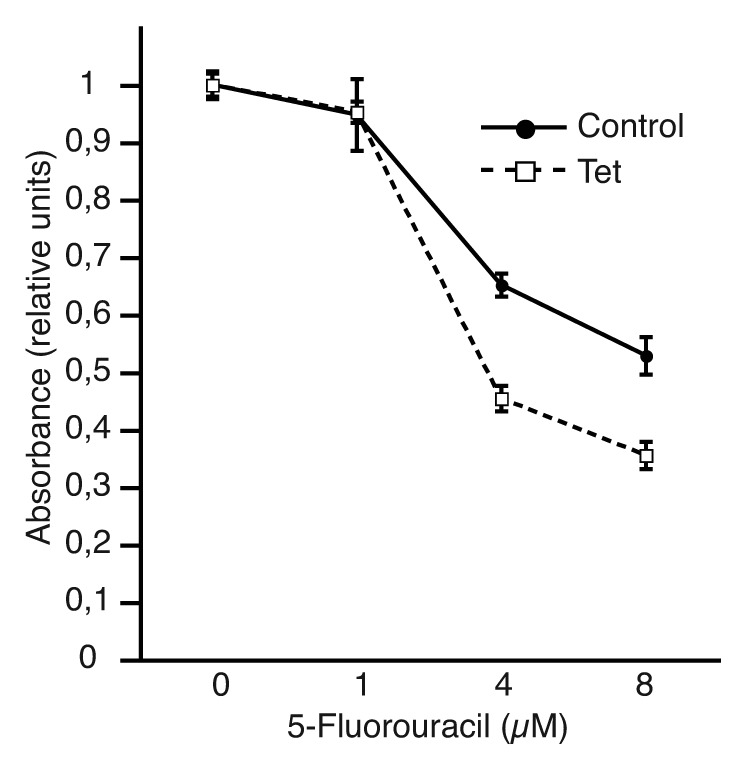
Figure 6. The expression of ZF-short leads to increased sensitivity to the chemotherapy agent 5-fluorouracil. U2OS-ZF-short cells were untreated (control) or treated with 1 µg/ml tetracycline (Tet) to induce ZF-short expression. After 24 h, the cells were cultured with varying concentrations of 5-fluorouracil for another 72 h in the presence or absence of tetracycline. Subsequently, cell viability was assayed using an MTS-based assay. Data were plotted relative to the drug-free controls. The results shown represent the averages of results of two independent experiments assayed in quadruplicate ± s.d.
None
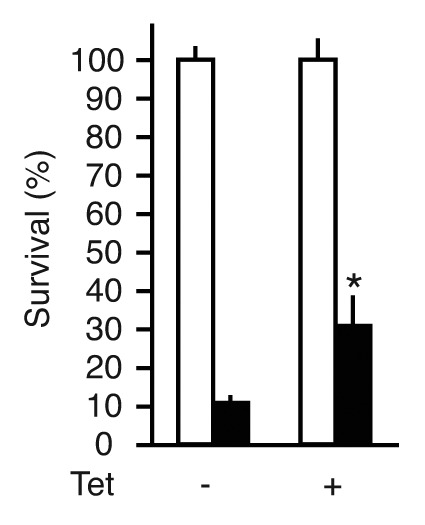
Figure 5. CREBZF expression promotes cell survival upon UV light radiation. HCT116-ZF-short cells were untreated or treated with 1 µg/ml tetracycline (Tet) to induce ZF-short expression. Twenty-four hours after tetracycline treatment cells were seeded at low density and irradiated with 30 mJ/cm2 UV light-C (UVC) as described in Materials and Methods. The cells were cultured for another 4 d in the presence or absence of tetracycline and cell survival was determined counting the number of control cells (white bars) or UVC-irradiated cells (black bars). Normalized values are expressed relative to non-irradiated cells. The results shown represent the averages of results of three independent experiments assayed in quadruplicate + s.d. *p < 0.05 relative to control (Student’s t-test).

References

    1. Dotto GP. Crosstalk of Notch with p53 and p63 in cancer growth control. Nat Rev Cancer. 2009;9:587–95. doi: 10.1038/nrc2675. - DOI - PMC - PubMed
    1. Huang Q, Raya A, DeJesus P, Chao SH, Quon KC, Caldwell JS, et al. Identification of p53 regulators by genome-wide functional analysis. Proc Natl Acad Sci USA. 2004;101:3456–61. doi: 10.1073/pnas.0308562100. - DOI - PMC - PubMed
    1. Villaronga MA, Lavery DN, Bevan CL, Llanos S, Belandia B. HEY1 Leu94Met gene polymorphism dramatically modifies its biological functions. Oncogene. 2010;29:411–20. doi: 10.1038/onc.2009.309. - DOI - PMC - PubMed
    1. Ban J, Bennani-Baiti IM, Kauer M, Schaefer KL, Poremba C, Jug G, et al. EWS-FLI1 suppresses NOTCH-activated p53 in Ewing’s sarcoma. Cancer Res. 2008;68:7100–9. doi: 10.1158/0008-5472.CAN-07-6145. - DOI - PMC - PubMed
    1. DeMarzo AM, Nelson WG, Isaacs WB, Epstein JI. Pathological and molecular aspects of prostate cancer. Lancet. 2003;361:955–64. doi: 10.1016/S0140-6736(03)12779-1. - DOI - PubMed

Publication types

MeSH terms