Nematode-bacterium symbioses--cooperation and conflict revealed in the "omics" age
- PMID: 22983035
- PMCID: PMC3508788
- DOI: 10.1086/BBLv223n1p85
Nematode-bacterium symbioses--cooperation and conflict revealed in the "omics" age
Abstract
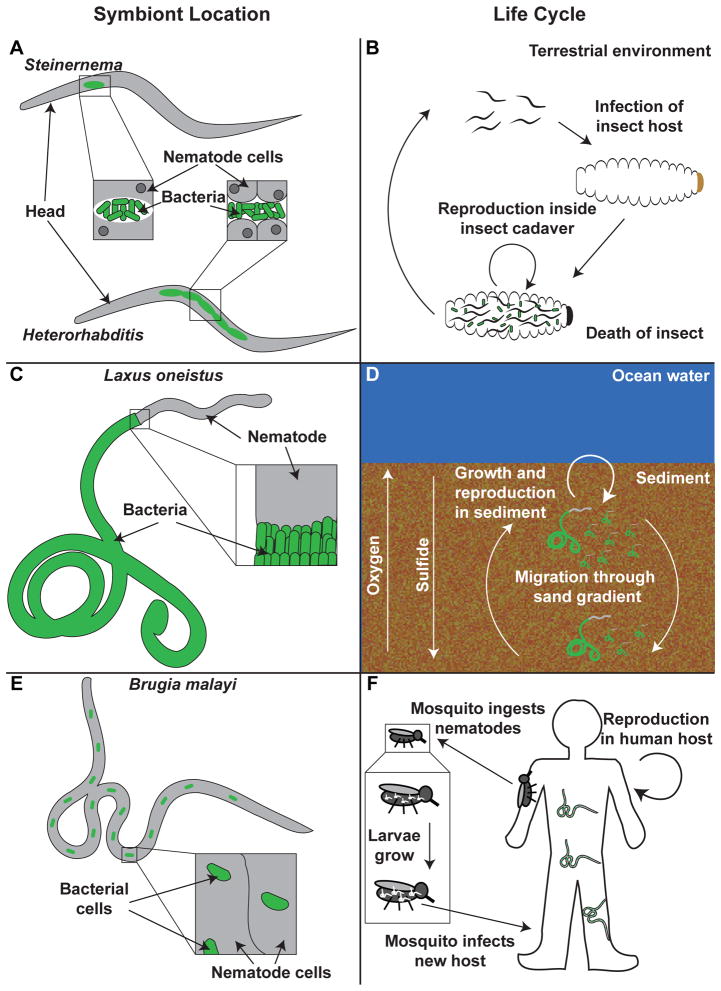
Nematodes are ubiquitous organisms that have a significant global impact on ecosystems, economies, agriculture, and human health. The applied importance of nematodes and the experimental tractability of many species have promoted their use as models in various research areas, including developmental biology, evolutionary biology, ecology, and animal-bacterium interactions. Nematodes are particularly well suited for the investigation of host associations with bacteria because all nematodes have interacted with bacteria during their evolutionary history and engage in a variety of association types. Interactions between nematodes and bacteria can be positive (mutualistic) or negative (pathogenic/parasitic) and may be transient or stably maintained (symbiotic). Furthermore, since many mechanistic aspects of nematode-bacterium interactions are conserved, their study can provide broader insights into other types of associations, including those relevant to human diseases. Recently, genome-scale studies have been applied to diverse nematode-bacterial interactions and have helped reveal mechanisms of communication and exchange between the associated partners. In addition to providing specific information about the system under investigation, these studies also have helped inform our understanding of genome evolution, mutualism, and innate immunity. In this review we discuss the importance and diversity of nematodes, "omics"' studies in nematode-bacterial systems, and the wider implications of the findings.
Figures
References
-
- Abad P, Gouzy J, Aury JM, Castagnone-Sereno P, Danchin EG, Deleury E, Perfus-Barbeoch L, Anthouard V, Artiguenave F, Blok VC, Caillaud MC, Coutinho PM, Dasilva C, De Luca F, Deau F, Esquibet M, Flutre T, Goldstone JV, Hamamouch N, Hewezi T, Jaillon O, Jubin C, Leonetti P, Magliano M, Maier TR, Markov GV, McVeigh P, Pesole G, Poulain J, Robinson-Rechavi M, Sallet E, Segurens B, Steinbach D, Tytgat T, Ugarte E, van Ghelder C, Veronico P, Baum TJ, Blaxter M, Bleve-Zacheo T, Davis EL, Ewbank JJ, Favery B, Grenier E, Henrissat B, Jones JT, Laudet V, Maule AG, Quesneville H, Rosso MN, Schiex T, Smant G, Weissenbach J, Wincker P. Genome sequence of the metazoan plant-parasitic nematode Meloidogyne incognita. Nat Biotechnol. 2008;26:909–915. - PubMed
-
- Aboobaker AA, Blaxter ML. Medical significance of Caenorhabditis elegans. Ann Med. 2000;32:23–30. - PubMed
Publication types
MeSH terms
Grants and funding
LinkOut - more resources
Full Text Sources