. 2012 Nov;78(22):8112-21.
doi: 10.1128/AEM.02214-12. Epub 2012 Sep 14.

Novel system for efficient isolation of Clostridium double-crossover allelic exchange mutants enabling markerless chromosomal gene deletions and DNA integration

Affiliations

Novel system for efficient isolation of Clostridium double-crossover allelic exchange mutants enabling markerless chromosomal gene deletions and DNA integration

Mohab A Al-Hinai et al. Appl Environ Microbiol. 2012 Nov.

Abstract

Isolation of Clostridium mutants based on gene replacement via allelic exchange remains a major limitation for this important genus. Use of a heterologous counterselection marker can facilitate the identification of the generally rare allelic exchange events. We report on the development of an inducible counterselection marker and describe its utility and broad potential in quickly and efficiently generating markerless DNA deletions and integrations at any genomic locus without the need for auxotrophic mutants or the use of the mobile group II introns. This system is based on a codon-optimized mazF toxin gene from Escherichia coli under the control of a lactose-inducible promoter from Clostridium perfringens. This system is potentially applicable to almost all members of the genus Clostridium due to their similarly low genomic GC content and comparable codon usage. We isolated all allelic-exchange-based gene deletions (ca_p0167, sigF, and sigK) or disruptions (ca_p0157 and sigF) we attempted and integrated a 3.6-kb heterologous DNA sequence (made up of a Clostridium ljungdahlii 2.1-kb formate dehydrogenase [fdh] gene plus a FLP recombination target [FRT]-flanked thiamphenicol resistance marker) into the Clostridium acetobutylicum chromosome. Furthermore, we report on the development of a plasmid system with inducible segregational instability, thus enabling efficient deployment of the FLP-FRT system to generate markerless deletion or integration mutants. This enabled expeditious deletion of the thiamphenicol resistance marker from the fdh integrant strain as well as the sigK deletion strain. More generally, our system can potentially be applied to other organisms with underdeveloped genetic tools.


Figures

Fig 1
Fig 1
Mode of action of the MazF mRNA interferase. MazF is part of the toxin-antitoxin system of E. coli coded by the mazEF operon. Under normal conditions, the antitoxin MazE binds to and inhibits the MazF protein. Once the cells are subjected to stress, the MazE protein is degraded by cellular proteases, and the MazF protein is relieved from inhibition. MazF then targets mRNA at ACA sequences, thus leading to growth arrest, followed by cell death. P, promoter.
Fig 2
Fig 2
bgaR-PbgaL promoter reporter activity in response to 30 min of induction by lactose and toxicity of MazF in C. acetobutylicum. (A) Schematic diagram showing the arrangement of the lactose-inducible promoter (PbgaL) and divergent regulator (BgaR) upstream of the β-glucuronidase (gusA) gene. (B) Specific activity of the reporter in response to lactose addition. The average activities (n = 2) were 0.6 U/mg, 8.0 U/mg, and 13.0 U/mg when 0 mM, 1 mM, and 10 mM lactose were added, respectively. (C) Schematic diagram of the pKRAH1_mazF expression plasmid, whereby the codon-optimized mazF gene was placed under the control of the lactose-inducible promoter and cloned into C. acetobutylicum. Ori+, Gram-positive origin of replication; Ori, Gram-negative origin of replication. (D) Plates showing the effects of mazF expression in C. acetobutylicum. Cells harboring the pKRAH1_mazF plasmid were grown in the absence of lactose (−lactose) and in the presence of lactose (+lactose). Without lactose in the medium, cells grow abundantly on the plate, but no growth is observed when lactose is added to the medium, and thus, mazF is expressed. One of two biological replicates is shown.
Fig 3
Fig 3
Gene replacement via allelic exchange at the sigK and ca_p0167 loci. (A) Selection of unmarked sigK double-crossover deletion mutants. The boxed regions of the ca_c1688 and pilT genes show the approximate regions of homology (∼1 kb each) incorporated in the knockout (KO) vector. After the cells were placed on plates containing thiamphenicol (Th) and lactose to negatively select against cells bearing the plasmid, putative deletion mutants were selected and screened by PCR with the indicated primers. (B) Isolation of ca_p0167 deletion mutants. The boxed areas of the adc and amyA genes indicate the approximate locations of the two regions of homology (∼1 kb each). Colonies growing on plates containing Th plus lactose were isolated, and mutants were confirmed with the indicated primers. (C) PCR confirmation of double-crossover sigK deletion mutants in panel A with primers that anneal to the chromosome as indicated. Three of the six colonies isolated and screened contained the desired double-crossover recombination. One of the three colonies is shown. Additionally, the Thr marker was excised by the FLP recombinase as described in the text, thus creating an unmarked sigK deletion (ΔsigK_um). Lane M, 2-log DNA ladder (0.1 to 10 kb) (NEB). (D) PCR confirmation of deletion mutants in panel B with the indicated primers. Out of 10 colonies screened, 8 contained the expected double-crossover integration. One of the eight colonies is shown.
Fig 4
Fig 4
Isolation of unmarked chromosomal integration of the fdh gene in the sigK locus. RH1 and RH2 indicate the first and second regions of homology, respectively. (A) Schematic diagram showing the WT, marked, and unmarked fdh integration sites in the C. acetobutylicum M5 sigK locus and the expected amplicon sizes with the indicated primers. (B) PCR screening and confirmation of integration mutants with the primers indicated in panel A. Three integrants were isolated immediately following transformation of the pKOSIGK::FDH_mazF plasmid on plates containing Th and lactose, and data for one integrant are shown. The unmarked (sigK::fdh_um) strain and WT strain are also shown. Lanes: MW, λ HindIII-digested ladder (NEB); M, 2-log DNA ladder (0.1 to 10 kb) (NEB). (C) sq-RT-PCR confirming expression of the integrated fdh gene in the sigK locus of strain M5. Primers were designed to amplify 700 bp in the middle of the fdh transcript. Two biological replicates (replicates A and B) are shown for both the integration strain as well as the control M5 strain. Lane M, 2-log DNA ladder (0.1 to 10 kb) (NEB). (D) Effectiveness of asRNA-based induction of segregational plasmid instability shown by the loss of the plasmid expressing FLP recombinase after induction with lactose to express the asRNA against the repL origin of replication. After six serial transfers in liquid CGM, with and without lactose, equal volumes were plated onto solid media supplemented with Em (encoded on the plasmid backbone). Following incubation, the plates were visually inspected for growth. As anticipated, the culture that was induced with lactose did not show any growth, while the uninduced culture showed growth.
Fig 5
Fig 5
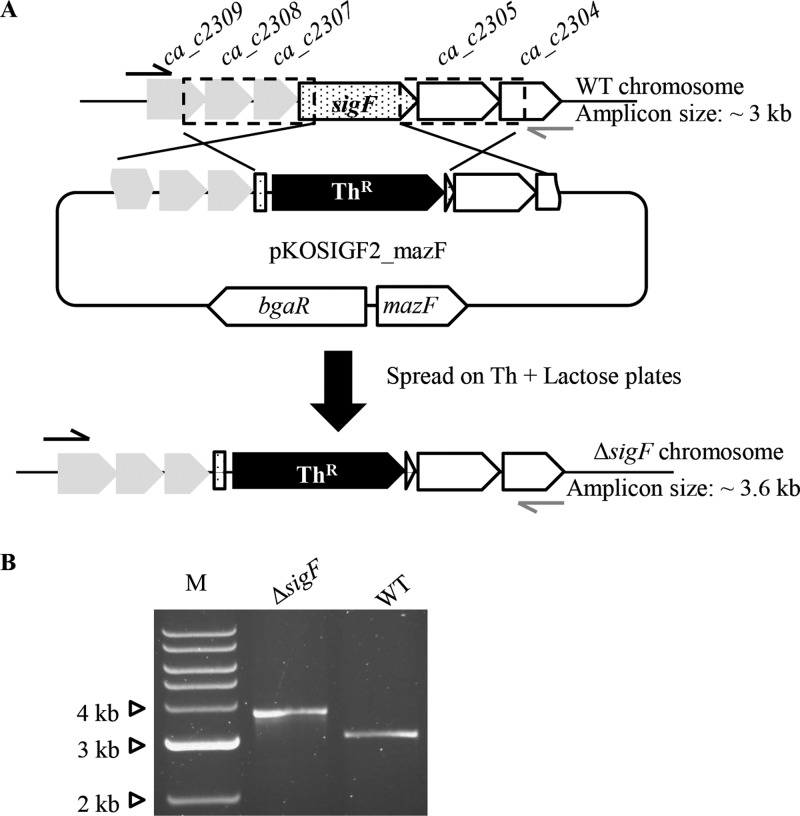
Gene replacement via homologous recombination at the sigF locus without recU expression. (A) Schematic diagram showing the KO vector design and isolation of sigF deletion mutants. The boxed areas (outlined by a broken line) indicate the approximate locations of the two regions of homology (∼1 kb each). (B) Colonies appearing on plates containing Th and lactose immediately after transformation were isolated, and mutants were confirmed with the primers indicated in panel A. Of the 14 colonies screened, 8 showed the correct PCR product sizes indicating a double crossover as shown in panel A. Data for one colony are shown. Lane M, 2-log DNA ladder (0.1 to 10 kb) (NEB).

References

    1. Awad MM, Bryant AE, Stevens DL, Rood JI. 1995. Virulence studies on chromosomal alpha-toxin and theta-toxin mutants constructed by allelic exchange provide genetic evidence for the essential role of alpha-toxin in Clostridium perfringens-mediated gas gangrene. Mol. Microbiol. 15: 191–202 - PubMed
    1. Baba T, et al. 2006. Construction of Escherichia coli K-12 in-frame, single-gene knockout mutants: the Keio collection. Mol. Syst. Biol. 2: 2006.0008 - PMC - PubMed
    1. Bi CH, Jones SW, Hess DR, Tracy BP, Papoutsakis ET. 2011. SpoIIE is necessary for asymmetric division, sporulation, and expression of σF, σE, and σG but does not control solvent production in Clostridium acetobutylicum ATCC 824. J. Bacteriol. 193: 5130–5137 - PMC - PubMed
    1. Boeke JD, Trueheart J, Natsoulis G, Fink GR. 1987. 5-Fluoroorotic acid as a selective agent in yeast molecular genetics. Methods Enzymol. 154: 164–175 - PubMed
    1. Bruggemann H, et al. 2003. The genome sequence of Clostridium tetani, the causative agent of tetanus disease. Proc. Natl. Acad. Sci. U. S. A. 100: 1316–1321 - PMC - PubMed

Publication types

MeSH terms

Associated data

LinkOut - more resources