


Evolving righteousness in a corrupt world
- PMID: 22984510
- PMCID: PMC3440392
- DOI: 10.1371/journal.pone.0044432
Evolving righteousness in a corrupt world
Abstract
Punishment offers a powerful mechanism for the maintenance of cooperation in human and animal societies, but the maintenance of costly punishment itself remains problematic. Game theory has shown that corruption, where punishers can defect without being punished themselves, may sustain cooperation. However, in many human societies and some insect ones, high levels of cooperation coexist with low levels of corruption, and such societies show greater wellbeing than societies with high corruption. Here we show that small payments from cooperators to punishers can destabilize corrupt societies and lead to the spread of punishment without corruption (righteousness). Righteousness can prevail even in the face of persistent power inequalities. The resultant righteous societies are highly stable and have higher wellbeing than corrupt ones. This result may help to explain the persistence of costly punishing behavior, and indicates that corruption is a sub-optimal tool for maintaining cooperation in human societies.
Conflict of interest statement
Figures
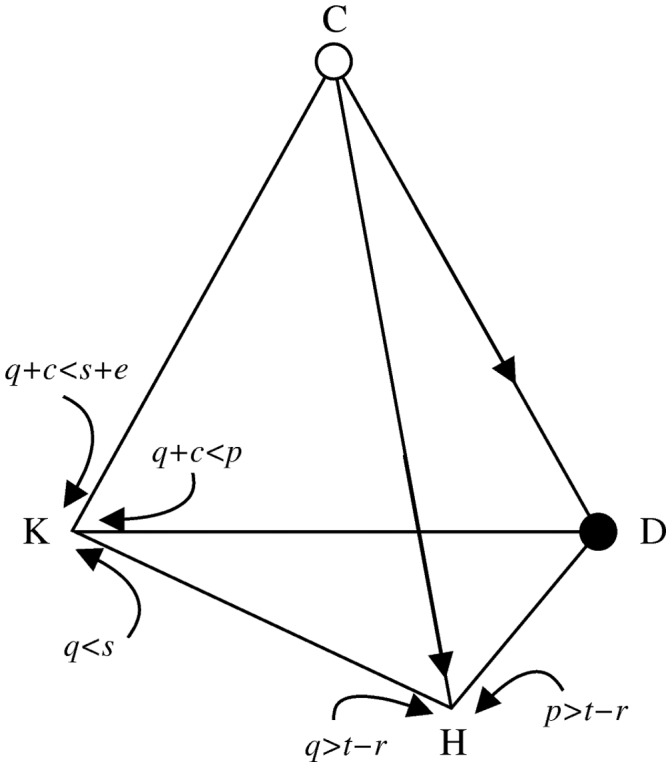
 is always stable, denoted by the filled circle, while
  is always unstable, denoted by the open circle. While many equilibria at the edges of the simplex may be stable in the reduced games, we reserve filled circles to indicate globally stable equilibria (i.e. equilibria that are stable in the full game with the four strategies.).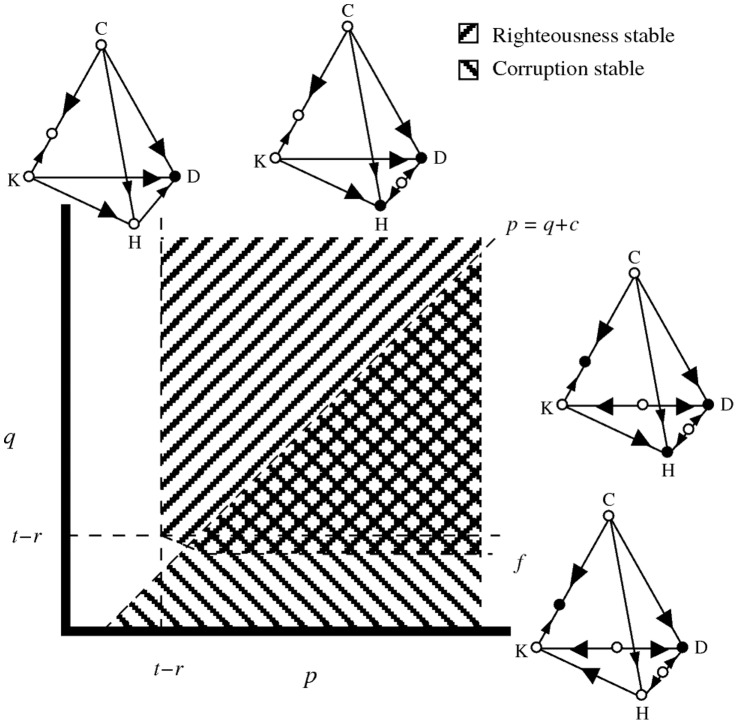
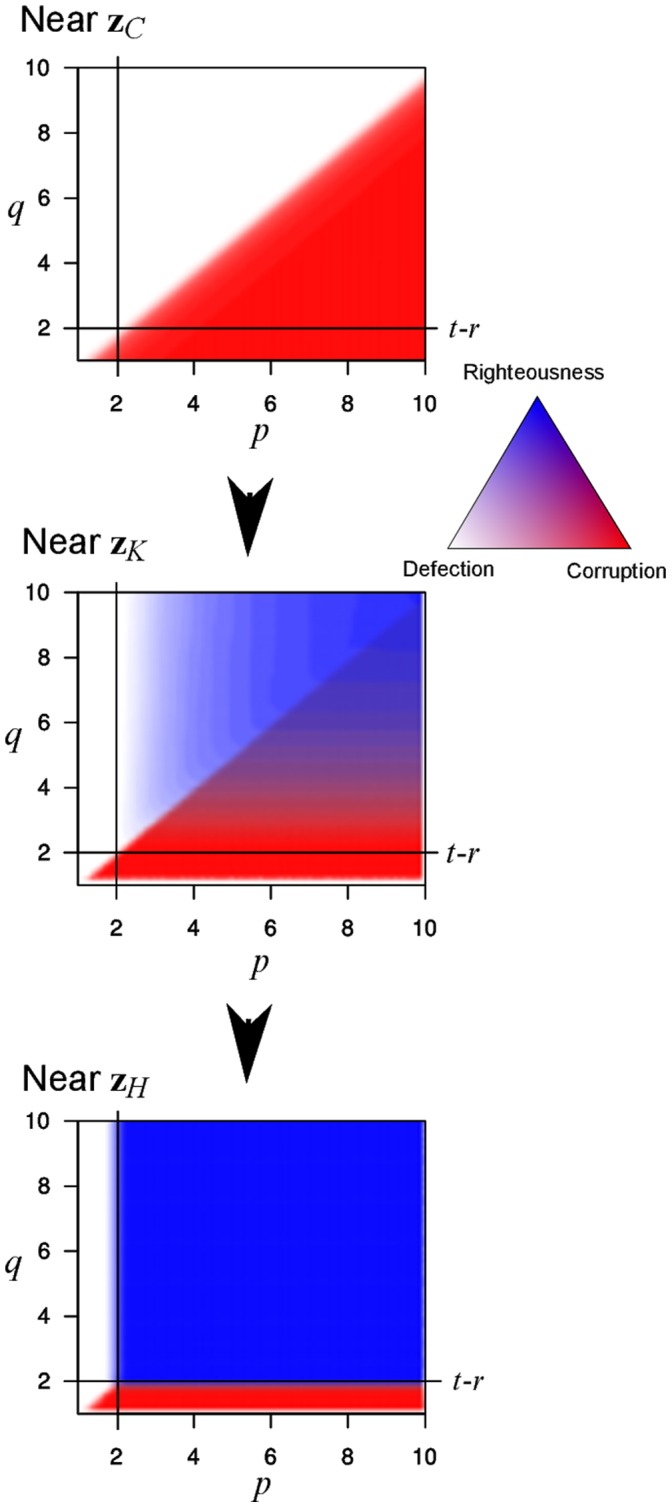
 . The vertical axis corresponds to the value of
  . Isoclines represent the proportion of runs converging to corruption (red) and righteousness (blue). All runs that do not converge to either corruption or righteousness end up in defection (white).
References
-
- Hamilton WD (1963) The evolution of altruistic behavior. Am Nat 97: 354–356.
-
- Axelrod R (1984) The Evolution of Cooperation. Basic Books, New York.
-
- Sachs JL, Mueller UG, Wilcox TP, Bull JJ (2004) The evolution of cooperation. The Q Rev Biol 79: 135–160. - PubMed
-
- West SA, Griffin AS, Gardner A (2007) Evolutionary explanations for cooperation. Curr Biol 17: R661–R672. - PubMed
-
- Axelrod R (1986) An evolutionary approach to norms. American Political Science Review 80: 1095–1111.
Publication types
MeSH terms
Grants and funding
LinkOut - more resources
Full Text Sources
