


Sentinel surveillance of influenza-like illness in two hospitals in Maracay, Venezuela: 2006-2010
- PMID: 22984519
- PMCID: PMC3439372
- DOI: 10.1371/journal.pone.0044511
Sentinel surveillance of influenza-like illness in two hospitals in Maracay, Venezuela: 2006-2010
Abstract
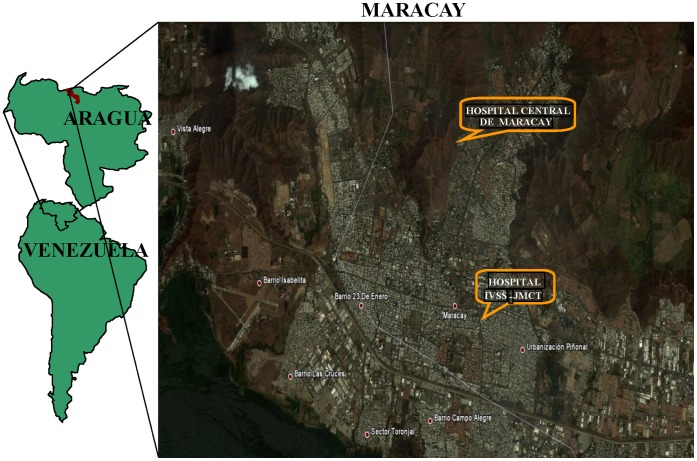
Background: Limited information exists on the epidemiology of acute febrile respiratory illnesses in tropical South American countries such as Venezuela. The objective of the present study was to examine the epidemiology of influenza-like illness (ILI) in two hospitals in Maracay, Venezuela.
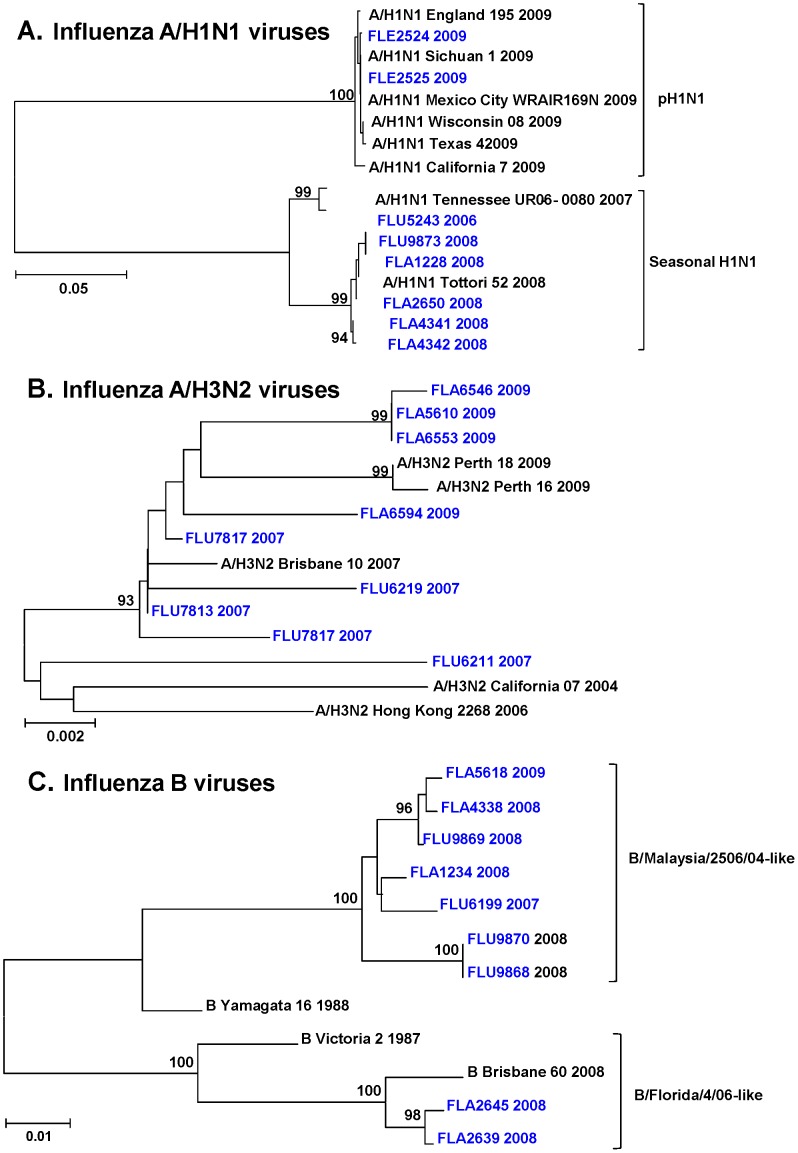
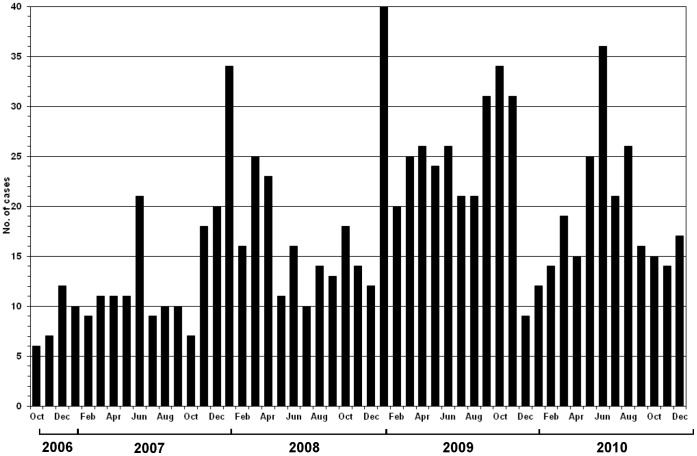
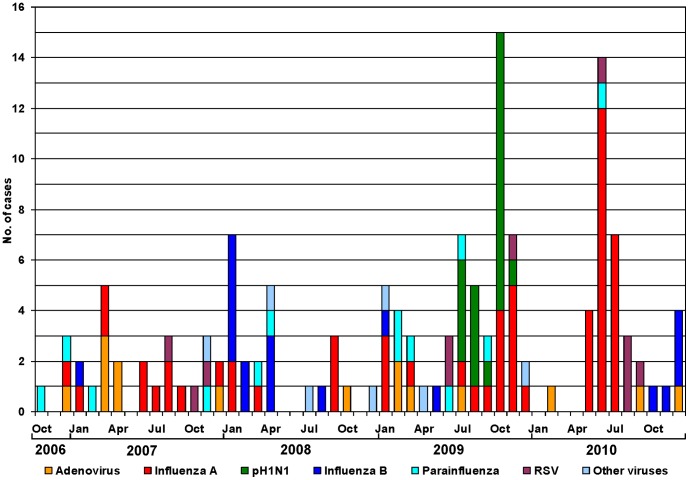
Methodology/principal findings: We performed a prospective surveillance study of persons with ILI who presented for care at two hospitals in Maracay, Venezuela, from October 2006 to December 2010. A respiratory specimen and clinical information were obtained from each participant. Viral isolation and identification with immunofluorescent antibodies and molecular methods were employed to detect respiratory viruses such as adenovirus, influenza A and B, parainfluenza, and respiratory sincytial virus, among others. There were 916 participants in the study (median age: 17 years; range: 1 month--86 years). Viruses were identified in 143 (15.6%) subjects, and one participant was found to have a co-infection with more than one virus. Influenza viruses, including pandemic H1N1 2009, were the most frequently detected pathogens, accounting for 67.4% (97/144) of the viruses detected. Adenovirus (15/144), parainfluenza virus (13/144), and respiratory syncytial virus (11/144) were also important causes of ILI in this study. Pandemic H1N1 2009 virus became the most commonly isolated influenza virus during its initial appearance in 2009. Two waves of the pandemic were observed: the first which peaked in August 2009 and the second--higher than the preceding - that peaked in October 2009. In 2010, influenza A/H3N2 re-emerged as the most predominant respiratory virus detected.
Conclusions/significance: Influenza viruses were the most commonly detected viral organisms among patients with acute febrile respiratory illnesses presenting at two hospitals in Maracay, Venezuela. Pandemic H1N1 2009 influenza virus did not completely replace other circulating influenza viruses during its initial appearance in 2009. Seasonal influenza A/H3N2 was the most common influenza virus in the post-pandemic phase.
Conflict of interest statement
Figures
Similar articles
-
Sentinel Enhanced Dengue Surveillance System - Puerto Rico, 2012-2022.MMWR Surveill Summ. 2024 May 30;73(3):1-29. doi: 10.15585/mmwr.ss7303a1. MMWR Surveill Summ. 2024. PMID: 38805389 Free PMC article.
-
Epidemiology and viral etiology of the influenza-like illness in corsica during the 2012-2013 Winter: an analysis of several sentinel surveillance systems.PLoS One. 2014 Jun 24;9(6):e100388. doi: 10.1371/journal.pone.0100388. eCollection 2014. PLoS One. 2014. PMID: 24959929 Free PMC article.
-
[Epidemiological features of prevalent influenza A viruses in children with influenza-like illness during the 2004-2017 season in Beijing].Zhonghua Er Ke Za Zhi. 2018 Jun 2;56(6):429-434. doi: 10.3760/cma.j.issn.0578-1310.2018.06.005. Zhonghua Er Ke Za Zhi. 2018. PMID: 29886605 Chinese.
-
Influenza viruses in Nigeria, 2009-2010: results from the first 17 months of a national influenza sentinel surveillance system.J Infect Dis. 2012 Dec 15;206 Suppl 1:S121-8. doi: 10.1093/infdis/jis584. J Infect Dis. 2012. PMID: 23169957
-
Distinguishing viruses responsible for influenza-like illness.J Theor Biol. 2022 Jul 21;545:111145. doi: 10.1016/j.jtbi.2022.111145. Epub 2022 Apr 29. J Theor Biol. 2022. PMID: 35490763
Cited by
-
Seasonal Activity of Influenza in Iran: Application of Influenza-like Illness Data from Sentinel Sites of Healthcare Centers during 2010 to 2015.J Epidemiol Glob Health. 2018 Dec;8(1-2):29-33. doi: 10.2991/j.jegh.2018.08.100. J Epidemiol Glob Health. 2018. PMID: 30859784 Free PMC article.
-
Human rhinoviruses and enteroviruses in influenza-like illness in Latin America.Virol J. 2013 Oct 11;10:305. doi: 10.1186/1743-422X-10-305. Virol J. 2013. PMID: 24119298 Free PMC article.
-
Laboratory surveillance of influenza-like illness in seven teaching hospitals, South Korea: 2011-2012 season.PLoS One. 2013 May 22;8(5):e64295. doi: 10.1371/journal.pone.0064295. Print 2013. PLoS One. 2013. PMID: 23717587 Free PMC article.
-
Respiratory viruses and torque teno virus in adults with acute respiratory infections.Intervirology. 2015;58(1):57-68. doi: 10.1159/000369211. Intervirology. 2015. PMID: 25890989 Free PMC article.
-
Implementation of influenza-like illness sentinel surveillance in Togo.BMC Public Health. 2014 Sep 20;14:981. doi: 10.1186/1471-2458-14-981. BMC Public Health. 2014. PMID: 25239536 Free PMC article.
References
-
- Denny FW, Loda FA (1986) Acute respiratory infections are the leading cause of death in children in developing countries. Am J Trop Med Hyg 35: 1–2. - PubMed
-
- WHO (2008) The global burden of disease: 2004 update. Available: http://www.who.int/healthinfo/global_burden_disease/2004_report_update/en/. Accessed 2011 Oct 1.
-
- Monto AS (2004) Occurrence of respiratory virus: time, place and person. Pediatr Infect Dis J 23: s58–s64. - PubMed
Publication types
MeSH terms
LinkOut - more resources
Full Text Sources
Medical
