


SVMTriP: a method to predict antigenic epitopes using support vector machine to integrate tri-peptide similarity and propensity
- PMID: 22984622
- PMCID: PMC3440317
- DOI: 10.1371/journal.pone.0045152
SVMTriP: a method to predict antigenic epitopes using support vector machine to integrate tri-peptide similarity and propensity
Abstract
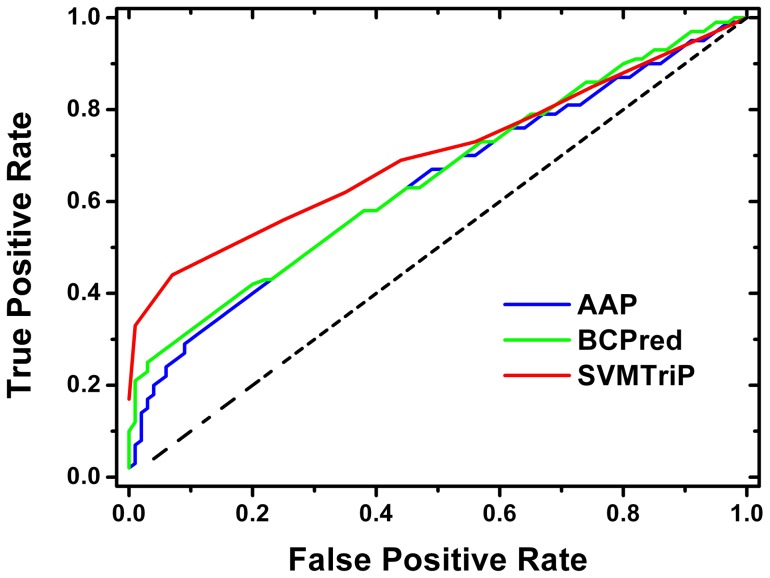
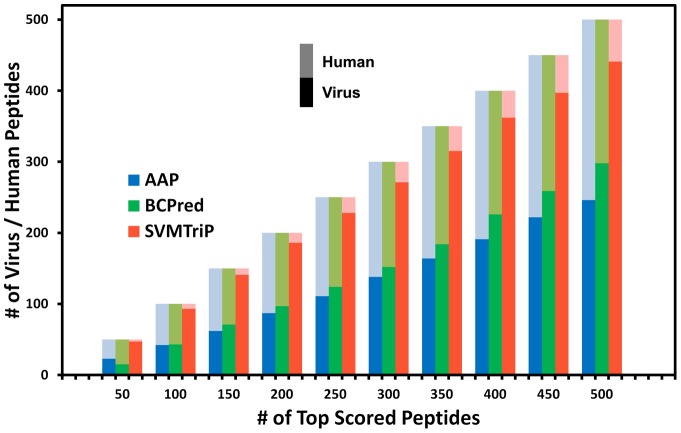
Identifying protein surface regions preferentially recognizable by antibodies (antigenic epitopes) is at the heart of new immuno-diagnostic reagent discovery and vaccine design, and computational methods for antigenic epitope prediction provide crucial means to serve this purpose. Many linear B-cell epitope prediction methods were developed, such as BepiPred, ABCPred, AAP, BCPred, BayesB, BEOracle/BROracle, and BEST, towards this goal. However, effective immunological research demands more robust performance of the prediction method than what the current algorithms could provide. In this work, a new method to predict linear antigenic epitopes is developed; Support Vector Machine has been utilized by combining the Tri-peptide similarity and Propensity scores (SVMTriP). Applied to non-redundant B-cell linear epitopes extracted from IEDB, SVMTriP achieves a sensitivity of 80.1% and a precision of 55.2% with a five-fold cross-validation. The AUC value is 0.702. The combination of similarity and propensity of tri-peptide subsequences can improve the prediction performance for linear B-cell epitopes. Moreover, SVMTriP is capable of recognizing viral peptides from a human protein sequence background. A web server based on our method is constructed for public use. The server and all datasets used in the current study are available at http://sysbio.unl.edu/SVMTriP.
Conflict of interest statement
Figures
References
-
- Getzoff ED, Tainer JA, Lerner RA, Geysen HM (1988) The chemistry and mechanism of antibody binding to protein antigens. Advances in immunology 43: 1–98. - PubMed
-
- Milich DR (1989) Synthetic T and B cell recognition sites: implications for vaccine development. Advances in immunology 45: 195–282. - PubMed
-
- Parker JM, Guo D, Hodges RS (1986) New hydrophilicity scale derived from high-performance liquid chromatography peptide retention data: correlation of predicted surface residues with antigenicity and X-ray-derived accessible sites. Biochemistry 25: 5425–5432. - PubMed
Publication types
MeSH terms
Substances
LinkOut - more resources
Full Text Sources
Other Literature Sources
Miscellaneous
