Acute exercise attenuates negative affect following repeated sad mood inductions in persons who have recovered from depression
- PMID: 22985013
- PMCID: PMC11877280
- DOI: 10.1037/a0029881
Acute exercise attenuates negative affect following repeated sad mood inductions in persons who have recovered from depression
Abstract
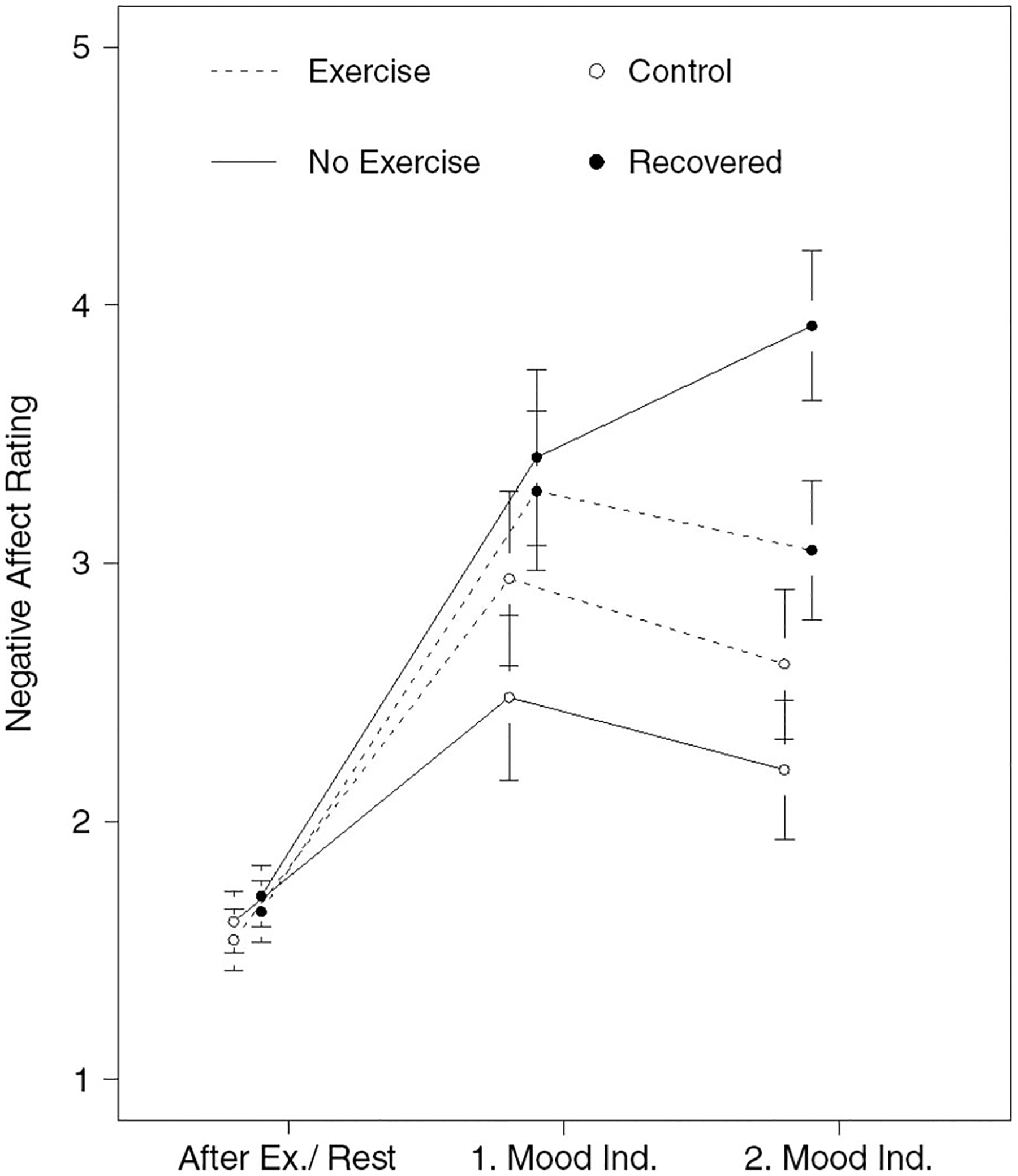
Identifying factors that may protect individuals from developing Major Depressive Disorder (MDD) in the face of stress is critical. In the current study we experimentally tested whether such a potentially protective factor, engaging in acute exercise, reduces the adverse effects of repeated sad mood inductions in individuals who have recovered from depression. We hypothesized that recovered depressed participants who engage in acute exercise report a smaller increase in negative affect (NA) and a smaller decrease in positive affect (PA) when exposed to a repeated sad mood induction (i.e., habituation), whereas participants who do not exercise show sensitization (i.e., increased NA and decreased PA in response to a repeated adverse stimulus). Forty-one women recovered from MDD and 40 healthy control women were randomly assigned to either exercise for 15 minutes or quiet rest. Afterward, participants were exposed to two sad mood inductions and reported their levels of affect throughout the study. Recovered depressed participants who had not exercised exhibited higher NA after the second sad mood induction, a finding consistent with sensitization. In contrast, both recovered depressed participants who had engaged in acute exercise and healthy control participants showed no increase in NA in response to the repeated sad mood induction. Participants who exercised reported higher PA after the exercise bout; however, our hypothesis concerning reported PA trajectories following the sad mood inductions was not supported. Results suggest that exercise can serve as a protective factor in the face of exposure to repeated emotional stressors, particularly concerning NA in individuals who have recovered from depression.
2013 APA, all rights reserved
Figures
References
-
- Almeida DM (2005). Resilience and vulnerability to daily stressors assessed via diary methods. Current Directions in Psychological Science, 14, 64–68.
-
- Babyak M, Blumenthal JA, Herman S, Khatri P, Doraiswamy M, Moore K, … Krishnan KR (2000). Exercise treatment for Major Depression: Maintenance of therapeutic benefit at 10 months. Psychosomatic Medicine, 62, 633–638. - PubMed
-
- Beck AT, Steer RA, & Brown GK (1996). Manual for the Beck Depression Inventory-II. San Antonio, TX: Psychological Corporation.
-
- Blumenthal JA, Emery CF, Walsh MA, Cox DR, Kuhn CM, Williams RB, & Sanders Williams R (1988). Exercise training in healthy Type A middle-aged men: Effects on behavioral and cardiovascular responses. Psychosomatic Medicine, 50, 418–433. - PubMed
Publication types
MeSH terms
Grants and funding
LinkOut - more resources
Full Text Sources
Other Literature Sources
Medical