


Effect of continuous venovenous hemofiltration dose on achievement of adequate vancomycin trough concentrations
- PMID: 22985887
- PMCID: PMC3497205
- DOI: 10.1128/AAC.00459-12
Effect of continuous venovenous hemofiltration dose on achievement of adequate vancomycin trough concentrations
Abstract
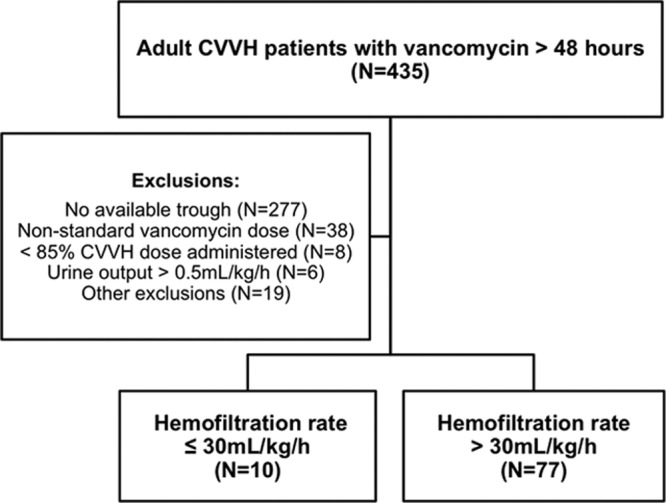
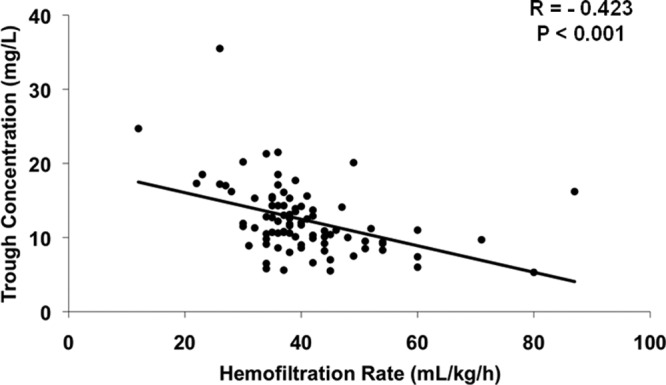
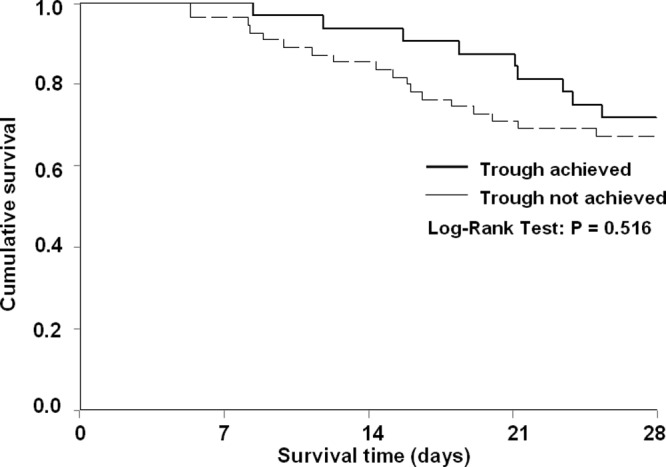
The vancomycin dose necessary for the achievement of target serum trough concentrations during continuous venovenous hemofiltration (CVVH) remains to be elucidated. This was a retrospective cohort study of critically ill adults at a tertiary medical center on concurrent CVVH and vancomycin between 2006 and 2010 with a steady-state vancomycin trough concentration. The 87 included patients were grouped according to low (≤30 ml/kg/h; n = 10) or high (>30 ml/kg/h; n = 77) CVVH hemofiltration rate (HFR) for analysis. Vancomycin goal trough achievement occurred in only 32 (37%) patients. The primary endpoint of trough attainment significantly differed between HFR subgroups: 90% versus 30% in low- and high-HFR individuals, respectively (P < 0.001). Patients with subtherapeutic trough concentrations had a median (interquartile range) HFR of 40 ml/kg/h (range, 37 to 47 ml/kg/h) compared to 36 ml/kg/h (range, 30 to 39 ml/kg/h) in those who achieved the trough goal. Irrespective of goal trough, an inverse correlation existed between HFR and serum vancomycin concentration (r = -0.423; P < 0.001). In the subgroup of 14 methicillin-resistant Staphylococcus aureus (MRSA) patients, trough achievement was similar to the aggregate cohort (36%). Mortality at 28 days was unrelated to trough achievement in both the overall sample (P = 0.516) and in culture-positive MRSA patients (P = 0.396). Critically ill patients undergoing CVVH therapy may experience clinically significant reductions in goal vancomycin troughs. The results of the present study justify prospective evaluations in this population to determine the optimal vancomycin dosing strategy for attainment of goal trough concentrations.
Figures
References
-
- Ali T, et al. 2007. Incidence and outcomes in acute kidney injury: a comprehensive population-based study. J. Am. Soc. Nephrol. 18:1292–1298 - PubMed
-
- Angus DC, et al. 2001. Epidemiology of severe sepsis in the United States: analysis of incidence, outcome, and associated costs of care. Crit. Care Med. 29:1303–1310 - PubMed
-
- Bagshaw SM, George C, Bellomo R. 2008. A comparison of the RIFLE and AKIN criteria for acute kidney injury in critically ill patients. Nephrol. Dial. Transplant. 23:1569–1574 - PubMed
-
- Bellomo R, et al. 2009. Intensity of continuous renal-replacement therapy in critically ill patients. N. Engl. J. Med. 361:1627–1638 - PubMed
-
- Boereboom FT, Ververs FF, Blankestijn PJ, Savelkoul TJ, van Dijk A. 1999. Vancomycin clearance during continuous venovenous haemofiltration in critically ill patients. Intensive Care Med. 25:1100–1104 - PubMed
Publication types
MeSH terms
Substances
Grants and funding
LinkOut - more resources
Full Text Sources
Medical
