


Adipose tissue insulin resistance in peripubertal girls with first-degree family history of polycystic ovary syndrome
- PMID: 22985947
- PMCID: PMC3902032
- DOI: 10.1016/j.fertnstert.2012.08.025
Adipose tissue insulin resistance in peripubertal girls with first-degree family history of polycystic ovary syndrome
Abstract
Objective: To assess metabolic and endocrine defects in girls genetically predisposed to polycystic ovary syndrome (PCOS).
Design: Controlled cross-sectional study.
Setting: University hospital.
Patient(s): Nine girls, aged 8-14 years, having a first-degree relative diagnosed with PCOS (PCOSr) and 10 age-matched girls without a family history of PCOS.
Intervention(s): None.
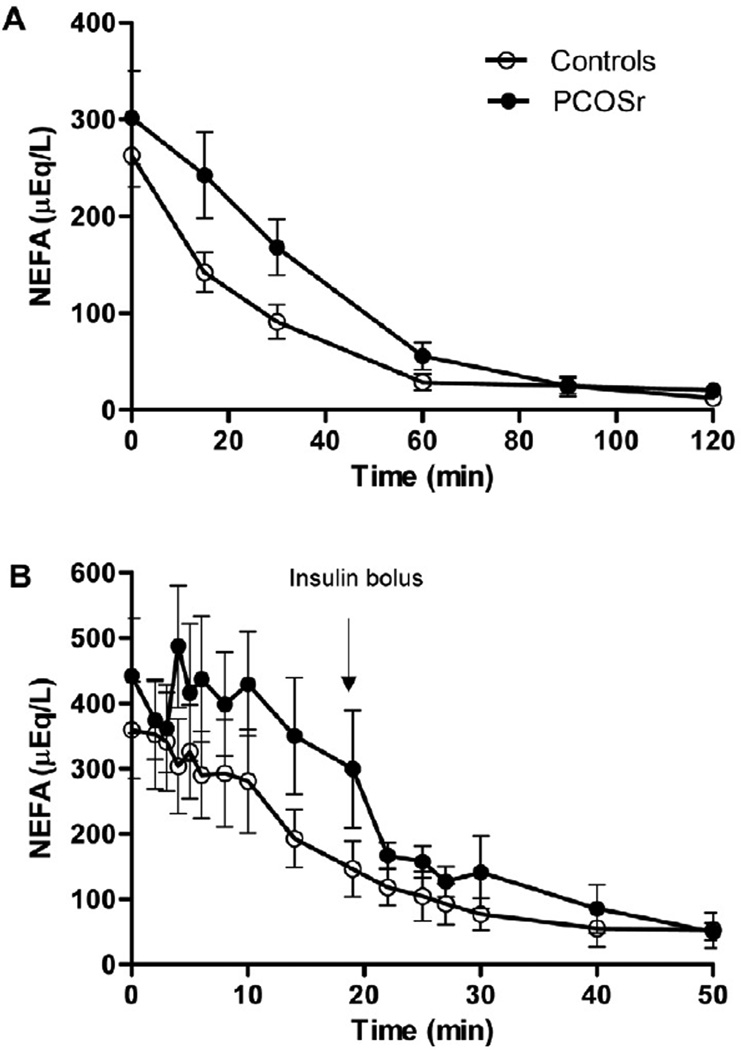
Main outcome measure(s): Insulin sensitivity (IS(FSIVGTT)) determined by frequently sampled IV glucose tolerance testing (GTT) and insulin-induced nonesterified fatty acid (NEFA) suppression, estimated by the log-linear slope of NEFA levels during the first 20 minutes of GTT.
Result(s): In comparison to controls, PCOSr had higher body mass index (BMI) Z-score, waist circumference, and waist-to-height ratio. Levels of the androgen 17α-hydroxyprogesterone (17-OHP) were significantly increased in PCOSr, independent of adiposity, and inversely correlated with IS(FSIVGTT). The IS(FSIVGTT) was decreased and the NEFA suppression was less steep in PCOSr compared with controls, independent of BMI and 17-OHP. The NEFA suppression was more pronounced with increasing IS(FSIVGTT), independent of adiposity.
Conclusion(s): Girls at high risk of developing PCOS display increased adiposity and 17-OHP levels, but are mainly characterized by global insulin resistance and resistance to insulin-induced suppression of lipolysis that were independent of adiposity and 17-OHP levels. Therefore, genetic predisposition to PCOS may be related to early insulin resistance and adipocyte dysfunction.
Copyright © 2012 American Society for Reproductive Medicine. Published by Elsevier Inc. All rights reserved.
Conflict of interest statement
Figures
References
-
- Azziz R, Woods KS, Reyna R, Key TJ, Knochenhauer ES, Yildiz BO. The prevalence and features of the polycystic ovary syndrome in an unselected population. J Clin Endocrinol Metab. 2004;89:2745–2759. - PubMed
-
- Azziz R, Carmina E, Dewailly D, Diamanti-Kandarakis E, Escobar-Morreale HF, Futterweit W, et al. The Androgen Excess and PCOS Society criteria for the polycystic ovary syndrome: the complete task force report. Fertil Steril. 2009;91:456–488. - PubMed
-
- Gambineri A, Pelusi C, Vicennati V, Pagotto U, Pasquali R. Obesity and the polycystic ovary syndrome. Int J Obes Relat Metab Disord. 2002;26:883–896. - PubMed
-
- Maliqueo M, Sir-Petermann T, Perez V, Echiburu B, de Guevara AL, Galvez C, et al. Adrenal function during childhood and puberty in daughters of women with polycystic ovary syndrome. J Clin Endocrinol Metab. 2009;94:3282–3288. - PubMed
Publication types
MeSH terms
Grants and funding
LinkOut - more resources
Full Text Sources
Other Literature Sources
Medical
